
Chinese mitten crab
Eriocheir
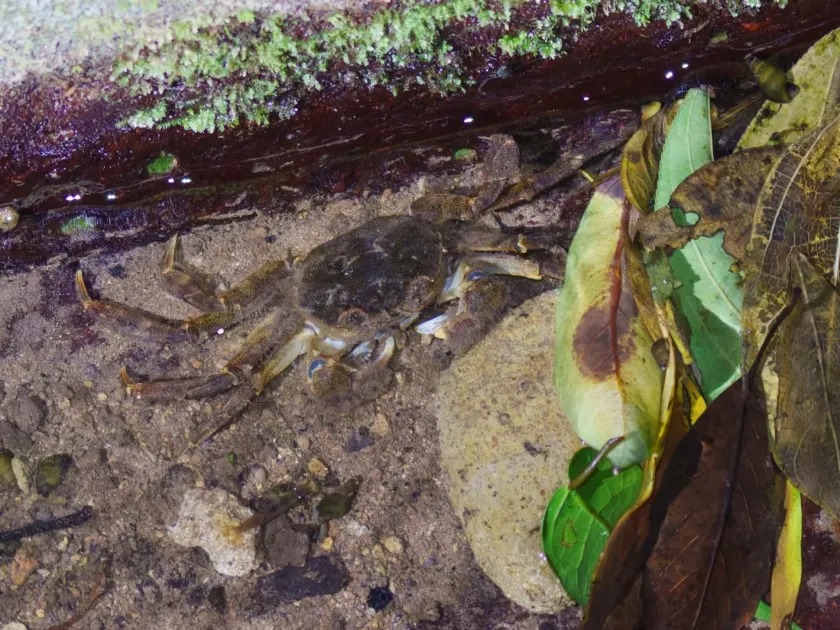
Description
How to identify
The Chinese mitten crab (Eriocheir sinensis) is a crustacean belonging to the order Decapoda and the family Varunidae. It is easily identified by the dense patches of hair on its claws, resembling mittens.
Adult crabs have a round carapace, measuring up to 10 cm in width. Their color ranges from greenish-brown to dark brown, and they possess exceptionally long legs that facilitate both aquatic and terrestrial movement.
This species is catadromous, meaning it migrates from freshwater rivers to saltwater estuaries and coastal seas to breed. This lifecycle makes them highly mobile and capable of colonizing large areas.
Their life cycle includes several planktonic larval stages followed by a migration of juvenile crabs upstream. Their ability to survive in a wide range of salinity allows them to inhabit diverse water bodies.
With high reproductive output—females releasing hundreds of thousands of eggs—this crab can quickly establish large, persistent populations in new river basins.
What it damages
The primary agricultural impact of the Chinese mitten crab is the destruction of hydraulic infrastructure. By burrowing deep into riverbanks and levees, they compromise the integrity of dams and irrigation canals.
On rice farms, these crabs excavate tunnels in the dikes separating fields. This activity leads to significant water loss, which is detrimental to the cultivation of paddy rice and results in crop yield loss.
The crabs are opportunistic omnivores that feed on young rice shoots and other wetland vegetation. Their foraging habits can severely damage plant root systems, leading to partial or total field failure.
Fisheries and aquaculture operations suffer from the crab’s predatory behavior. They consume fish eggs and fry, and their robust claws cause extensive physical damage to fishing nets and equipment.
Beyond material damage, the species acts as a secondary intermediate host for the oriental lung fluke, presenting a health risk to human populations if contaminated crabs are consumed.
Control measures
Controlling the Chinese mitten crab is challenging due to its widespread distribution and burrowing nature. Physical exclusion using barriers and screens is the most common method in smaller irrigation channels.
Trapping programs are employed during peak migration periods to significantly reduce population numbers. These traps, often placed in bottleneck sections of water systems, are vital for management.
Long-term mitigation requires hardening infrastructure. Concrete reinforcement and the use of geotextiles on canal banks prevent the crabs from creating the burrows that cause structural failures.
Integrated pest management also involves strict enforcement of anti-introduction regulations. Preventing the transport of live crabs into non-invaded regions is the most cost-effective protection strategy.
Continued monitoring and public awareness are essential to track the species' spread and to ensure that agricultural infrastructure is maintained to withstand the potential impacts of burrowing.
Taxonomy
- Latin name
- Eriocheir
- Family
- Grapsidae
- EPPO code
- ERCHSP
Discussion
No discussions yet — be the first.