
Birch leaf roller
Epinotia trimaculana
Description
How to identify
The birch leaf roller (Epinotia trimaculana) is a moth belonging to the Tortricidae family. It is a common pest known for its larvae's ability to roll and tie leaves together, forming protective shelters.
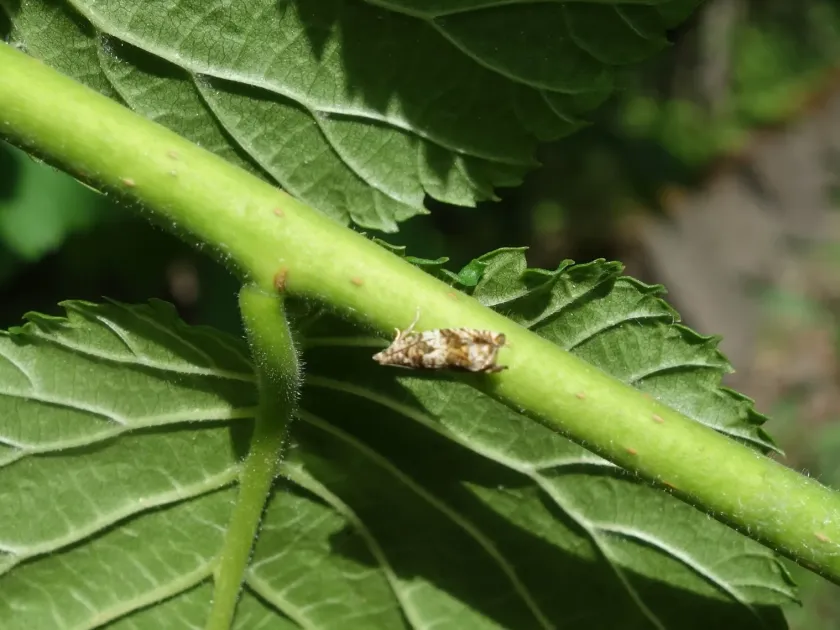
The adult moth typically has a wingspan ranging from 14 to 18 mm. Its forewings display a pattern of three dark, distinct spots against a brownish-gray background, providing excellent camouflage against birch bark.
The insect undergoes complete metamorphosis, including egg, larval, pupal, and adult stages. The overwintering usually occurs at the larval stage, tucked away in silken cocoons within bark crevices.
Larvae are characterized by a cylindrical body with a dark head capsule, typical of the Olethreutinae subfamily. They are mobile and respond quickly to disturbances by dropping from the leaf on a silk thread.
The flight period of the adult moths generally occurs during the summer months, during which mating takes place, followed by the deposition of eggs on the host plant's foliage.
What it damages
Birch trees (Betula species) serve as the primary host for this pest. While it is highly specific, it can occasionally be found on other hardwood species if birch populations are dense and nearby.
The damage is caused primarily by the larval stage. Upon hatching, the larvae immediately seek out young leaves and begin to fold or roll them, securing the edges with strong silk webbing.
As the larvae feed inside these rolled leaves, they consume the parenchyma, which leads to skeletonized patches or irregular holes, significantly hindering the tree's photosynthetic capacity.
Heavy infestations can lead to premature leaf drop and stunted growth. In young ornamental trees or nursery saplings, this aesthetic and physical damage can be detrimental to their market value.
Repeated yearly defoliation, though rarely lethal to mature trees, leaves them susceptible to secondary stressors such as drought, diseases, or attacks by bark-boring insects.
Signs of infestation
The most recognizable sign of an infestation is the presence of tightly rolled or folded leaves, often held together by noticeable silken threads at the ends of branches.
Upon inspecting the underside of the leaves or inside the rolled-up structures, one can find the larvae or their blackish frass pellets accumulated within the shelter.
Leaves showing signs of chlorosis or premature browning due to the larval feeding often stand out against the healthy green canopy of the tree.
The adult moths are nocturnal but can be spotted resting on the trunks of birch trees during the day, displaying their distinct three-spotted wing pattern.
Monitoring for the presence of silk webbing across leaves is a reliable indicator that the larvae are active and that control measures may be required.
Control measures
Mechanical removal is the simplest method for small-scale infestations; pruning affected branches or manually picking off rolled leaves can effectively reduce the local population.
Biological control using microbial insecticides, such as Bacillus thuringiensis, is highly effective against young larvae and minimizes the impact on beneficial insects and predators.
Chemical control should be timed to coincide with the period of larval hatching. Systemic or contact insecticides are recommended to reach the pests before they successfully construct their protective leaf rolls.
Encouraging natural predators, such as birds, ladybugs, and parasitic wasps, provides long-term population regulation, making the ecosystem more resilient to pest outbreaks.
Using pheromone traps helps in accurately monitoring the flight times of adult moths, allowing for the precise application of control measures and reducing unnecessary chemical usage.
Taxonomy
- Latin name
- Epinotia trimaculana
- Order
- Lepidoptera (butterflies)
- Family
- Tortricidae
- EPPO code
- EPINTR
Discussion
No discussions yet — be the first.