
Birch tortrix
Epinotia tetraquetrana
Description
How to identify
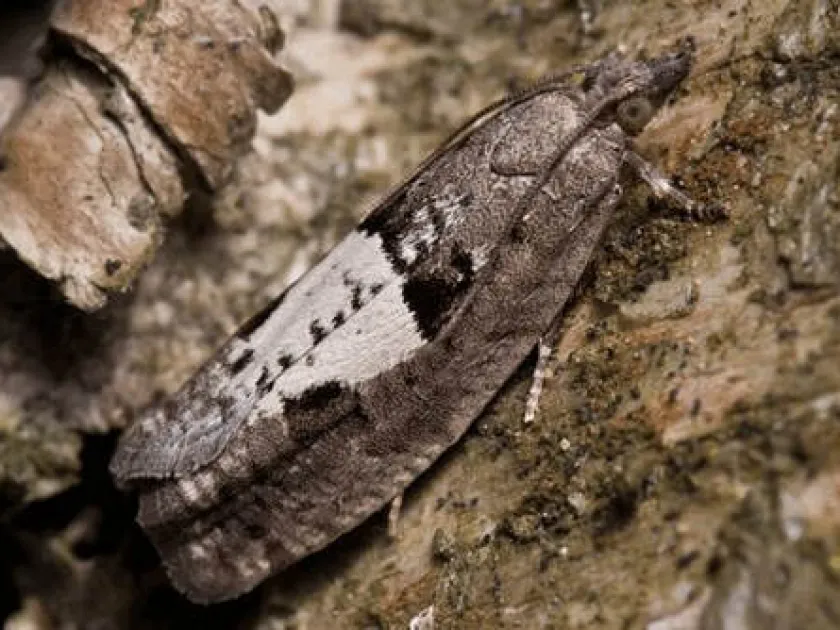
The Birch tortrix (Epinotia tetraquetrana) is a moth belonging to the family Tortricidae, order Lepidoptera. The wingspan of the adult moth typically ranges between 12 and 16 mm, and its forewings are distinguished by a brownish-grey pattern featuring a characteristic dark quadrilateral spot near the costal margin.
The larvae are approximately 13-14 mm long, usually exhibiting a yellowish-white or pale greenish body coloration. Their heads are notably dark, often brownish or black, providing a sharp contrast to the rest of the body. Pupation occurs in a silken cocoon, which is commonly found in leaf litter or under loose tree bark.
What it damages
This species primarily feeds on various Birch (Betula) species, though it is occasionally observed on Alder (Alnus). The larvae cause significant damage by consuming buds, young leaves, and catkins, which disrupts the normal development of the tree canopy during the spring flush.
Severe infestations can lead to partial defoliation of birch trees, significantly reducing their aesthetic value and photosynthetic capacity. While healthy trees often recover, repeated attacks over several years can weaken the tree, making it susceptible to secondary environmental stressors.
When it appears
Adult moths typically emerge in the spring, from April through May, coinciding with the bud burst of birch trees. The timing of their lifecycle is highly synchronized with the phenology of their host plants to ensure that young larvae have immediate access to nutrient-rich plant tissues.
The species overwinters as a mature larva inside a cocoon hidden in the soil or ground debris. As soil temperatures rise in early spring, the larvae undergo pupation, which precedes the emergence of the spring flight of adults to continue the annual reproductive cycle.
Signs of infestation
The earliest signs of an infestation include "webbed" buds that fail to open properly or appear damaged. As the season progresses, leaves become tightly rolled or folded, securely held together by larval silk, which creates a protective micro-environment for the growing caterpillar.
Close inspection of the foliage will reveal skeletonized patches or holes within the rolled leaves. The accumulation of dark, pellet-like frass (excrement) caught within the silk webbing is a definitive indicator of an active population of Birch tortrix present on the tree.
Control measures
Cultural control practices, such as the thorough removal and destruction of fallen leaves in autumn, are highly effective in reducing the number of overwintering larvae. This sanitation practice breaks the life cycle of the moth by eliminating their winter refugia.
For more severe outbreaks, biological controls using Bacillus thuringiensis are recommended as they target the larvae while remaining relatively safe for beneficial insects. If chemical intervention is required, applications should be timed carefully to coincide with the period of larval emergence.
Taxonomy
- Latin name
- Epinotia tetraquetrana
- Order
- Lepidoptera (butterflies)
- Family
- Tortricidae
- EPPO code
- EPIBTT
Discussion
No discussions yet — be the first.