
Spruce needle tortrix
Epinotia tedella
Description
How to identify
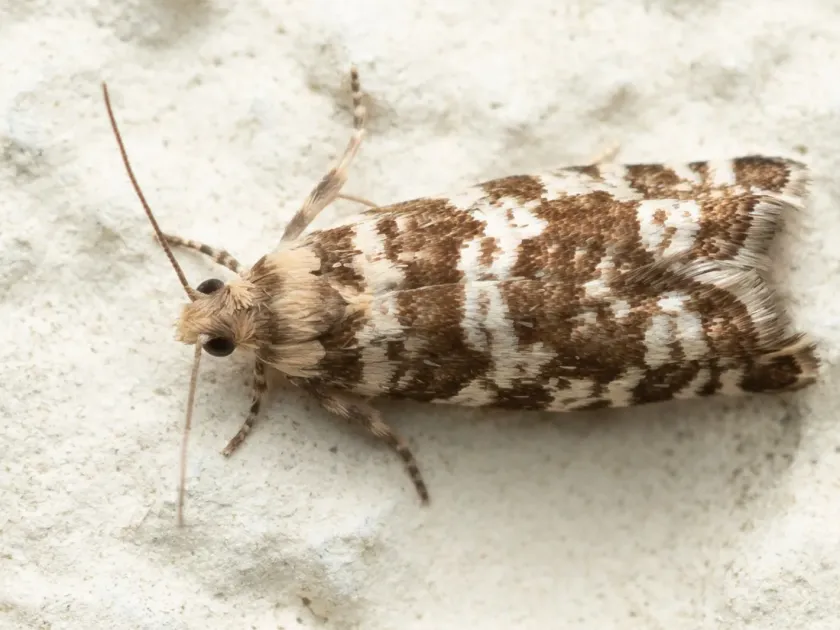
The spruce needle tortrix (Epinotia tedella) is a small moth belonging to the family Tortricidae. It is a well-known defoliator that specifically targets coniferous trees.
The adult moth has a wingspan of approximately 10 to 14 mm. Its forewings are mottled with brownish and grey patterns, providing excellent camouflage against tree bark.
Larvae, or caterpillars, are about 10 mm long with a pale greenish-brown body and a distinctive dark, often black, head capsule.
The species undergoes a complete life cycle, typically overwintering as pupae in the forest litter or soil beneath the host trees, where they are protected from winter cold.
Adult moths emerge in early summer, usually June or July, and are primarily nocturnal, making them difficult to spot during the daylight hours.
What it damages
This pest primarily infests Norway spruce (Picea abies). Both natural forests and ornamental spruce plantings can be heavily affected by the larval feeding activity.
Larvae bore into the base of the needles, consuming the internal tissue while leaving the epidermis intact, which creates hollow, straw-like structures.
The damaged needles turn brown and fall off prematurely, resulting in visible thinning of the foliage, particularly in the lower and middle sections of the tree canopy.
Heavy infestations can lead to significant defoliation, stressing the tree and increasing its susceptibility to secondary attacks by bark beetles and other pathogens.
In cases of severe outbreaks, the entire tree can appear scorched or dead due to the extensive loss of needles, significantly reducing the tree's health and aesthetic value.
Signs of infestation
The most reliable sign of an infestation is the presence of silk webbing among the needles, used by larvae to bind needles together into small protective shelters.
The webbing often contains larval frass, which appears as small dark particles trapped within the silken threads, making the nests noticeable upon close inspection.
The foliage develops a characteristic reddish-brown or "rusty" appearance as the needles die, dry out, and begin to drop from the tree branches.
Hollowed-out needles, often referred to as "sheaths," remain attached to the twigs for a time, providing clear evidence of recent larval feeding activity.
During the flight period, the presence of small moths fluttering around the spruce canopy at dusk is a strong indicator of an active population in the area.
Control measures
Chemical control involving systemic insecticides is most effective when applied during the period of larval emergence and initial feeding in the spring.
Integrated pest management suggests using pheromone traps to monitor adult moth populations and determine the precise timing for necessary control measures.
Biological control using Bacillus thuringiensis (Bt) products is a preferred method for environmentally sensitive areas, as it targets the larvae while sparing beneficial insects.
Sanitation practices, such as removing and destroying infested needles and debris under the trees, can help reduce the overwintering population of the pest.
- Systemic insecticide application during spring.
- Use of pheromone traps for population monitoring.
- Application of biological insecticides containing Bt.
- Promoting natural predators like birds and parasitic wasps.
Taxonomy
- Latin name
- Epinotia tedella
- Order
- Lepidoptera (butterflies)
- Family
- Tortricidae
- EPPO code
- EPIBTE
Discussion
No discussions yet — be the first.