
Spruce needle tortrix
Epinotia pygmaeana
Description
How to identify
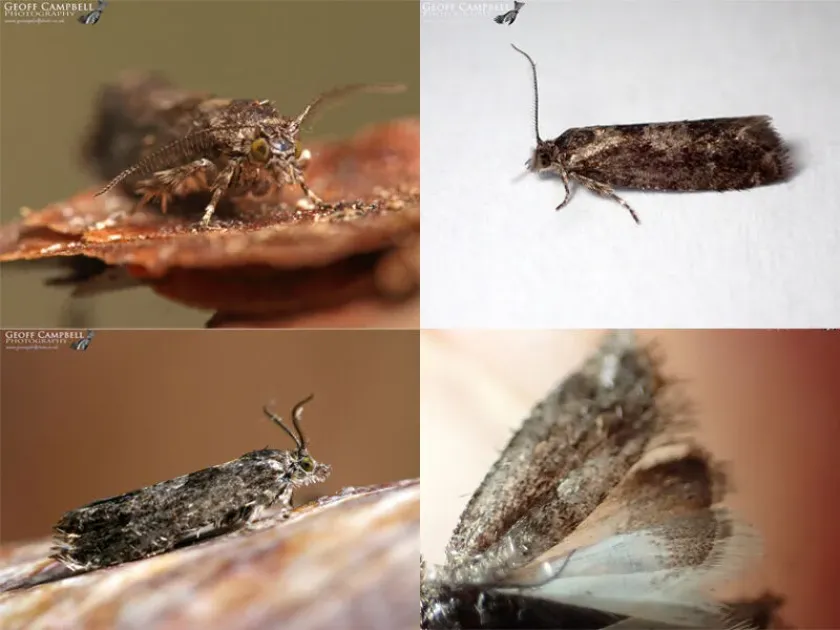
The spruce needle tortrix (Epinotia pygmaeana) is a moth belonging to the Tortricidae family. Adult moths have a wingspan of approximately 10–14 mm, with greyish-brown forewings featuring cryptic patterns that allow them to blend into the bark of spruce trees.
The larvae are small, light green to yellowish-green caterpillars with dark head capsules. Because they feed and live inside spruce needles or buds, they remain concealed for most of their development stage.
The life cycle of the spruce needle tortrix is closely synchronized with the phenology of its host plants. Adults typically emerge in early spring, just as the spruce buds begin to swell and open.
This species undergoes a complete metamorphosis. They spend the winter in the pupal stage, usually hidden in the soil litter or within bark crevices of the host tree.
This pest prefers mature spruce stands where a stable microclimate favors the survival of the population. High population densities can lead to significant stress for the host trees.
What it damages
The primary host for this pest is the Norway spruce (Picea abies). The larvae cause damage by feeding on developing buds and mining the needles of young shoots.
By hollowing out the needles and buds, the caterpillars destroy the photosynthetic tissue. This leads to needle drop and significantly reduces the tree's vigor and growth rate.
Young spruce trees and forest regeneration areas are the most vulnerable. Sustained attacks over several years can result in deformed shoots and stunted height growth.
For adult trees, chronic infestation leads to top-drying, making the trees more susceptible to secondary infestation by bark beetles and other wood-boring insects.
Economically, the spruce needle tortrix is a concern in nurseries and ornamental plantations where maintaining the health and aesthetic value of the trees is essential.
When it appears
Adult moths are active in early spring, usually from April to May, depending on regional temperature variations. This period aligns with the tree's bud burst.
Larval feeding occurs during late spring and early summer, typically peaking between May and June. Once the larvae finish feeding, they descend to pupate.
The pupal stage lasts throughout the summer and autumn, as the insect remains in diapause until the following spring. The species produces one generation per year.
Warm, early springs can trigger an earlier emergence of the moths. Conversely, cold snaps during the larval stage can reduce the survival rate of the population.
Monitoring using pheromone traps is most effective in April to determine the exact flight time and to time protective treatments accurately.
Signs of infestation
The most visible sign of an infestation is the presence of silk webbing on the tips of the shoots. Larvae bind needles together to form protective shelters.
Affected buds often show resin bleeding, as the tree attempts to defend itself against larval mining. Adjacent needles may turn yellow or brown as they die off.
Frass (larval excrement) trapped within the silken webs is a clear indicator of active feeding. These clusters of webbing are easily overlooked until the damage is significant.
Massive needle drop in June, particularly in the upper canopy, indicates a high population of larvae. Infected branches may appear scorched or thin.
- Yellowing of new needles.
- Silk webbing connecting needle clusters.
- Resin droplets on damaged buds.
- Shoot deformity and stunted growth.
- Empty pupal cases found on the bark or needle litter.
Control measures
Chemical control involves the application of systemic insecticides during the early larval stage, before the caterpillars have created protective webs.
Biological control methods, such as the application of Bacillus thuringiensis (Bt) based products, are effective and environmentally friendly for use in parks and garden settings.
Promoting natural enemies, including parasitoid wasps and insectivorous birds, is a vital component of long-term integrated pest management in forests.
For ornamental trees or small nursery areas, manual removal of infested shoots can help suppress local populations if done early in the season.
Regular inspections and the use of pheromone traps are recommended to identify infestation hotspots early, preventing large-scale damage to the spruce canopy.
Taxonomy
- Latin name
- Epinotia pygmaeana
- Order
- Lepidoptera (butterflies)
- Family
- Tortricidae
- EPPO code
- EPINPY
Discussion
No discussions yet — be the first.