
Willow bud moth
Epinotia cruciana
Description
How to identify
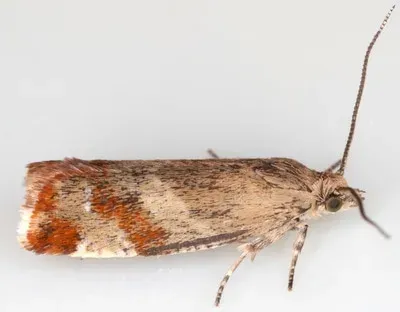
The willow bud moth (Epinotia cruciana) is a small moth belonging to the family Tortricidae, known for their leaf-rolling habits.
Adult moths have a wingspan of approximately 13–17 mm, with mottled grey and brown forewings that camouflage them against willow bark.
The larvae are typically pale yellowish-green with a dark head capsule, growing up to 12 mm in length throughout their developmental stages.
Like all species in the family, they undergo complete metamorphosis, which involves egg, larva (caterpillar), pupa, and adult stages.
They are widely distributed across the Palearctic realm, commonly found in damp areas where willow trees are abundant.
What it damages
The primary host plants for Epinotia cruciana are various species of the willow genus (Salix), and occasionally aspen or poplar trees.
The larvae primarily target the developing buds and young leaves, feeding inside the tight clusters of emerging plant tissue.
In nursery environments, the destruction of apical buds results in the loss of vertical dominance, leading to stunted or malformed growth of the trees.
Heavy infestations can lead to significant defoliation, which reduces the overall photosynthetic capacity and vigor of the infected willow plants.
Young plants are particularly vulnerable, and repeated damage can weaken the tree, making it susceptible to secondary pest and disease attacks.
When it appears
Adult moths typically emerge in mid-summer, with the main flight period occurring between June and August depending on the local climate.
Females lay eggs singly or in small groups on buds or the bark of young shoots, where the eggs remain until the following spring.
Larvae hatch in early spring just as the buds begin to swell, allowing them immediate access to the nutrient-rich developing plant tissues.
The larval feeding period coincides with the period of intense spring shoot elongation, which is the most critical time for monitoring.
Pupation generally occurs within the spun leaves or within the hollowed-out remains of the buds, completing the annual cycle.
Signs of infestation
One of the earliest signs of infestation is the presence of webbed or curled leaves at the tips of the willow branches.
Failure of buds to open correctly or the presence of hollowed-out, necrotic buds indicates larval activity within the structures.
Small amounts of dark frass (larval excrement) trapped within the silk webbing are a definitive sign of an active infestation.
Stunted shoot development and distorted leaf shapes are common indicators that the terminal bud has been damaged by the larvae.
In cases of severe damage, the branch tips may look withered or partially skeletonized, drawing attention to the affected area.
Control measures
Effective mechanical control includes the pruning and destruction of infested tips early in the spring to remove larvae before they mature.
Chemical insecticides should be timed for the early larval stage, as mature larvae are protected by silk structures and curled leaves.
Biological control methods, such as utilizing Bacillus thuringiensis sprays, are effective and environmentally friendly options for landscape trees.
Maintaining healthy trees through proper watering and fertilization can help them withstand minor damage from willow bud moth infestations.
- Regular monitoring of terminal buds in spring.
- Pruning of damaged shoots in early spring.
- Pheromone traps for monitoring adult population.
- Use of systemic insecticides when necessary.
Taxonomy
- Latin name
- Epinotia cruciana
- Order
- Lepidoptera (butterflies)
- Family
- Tortricidae
- EPPO code
- EPINCR
Discussion
No discussions yet — be the first.