
Imbricated snout beetle
Epicaerus imbricatus
Description
How to identify
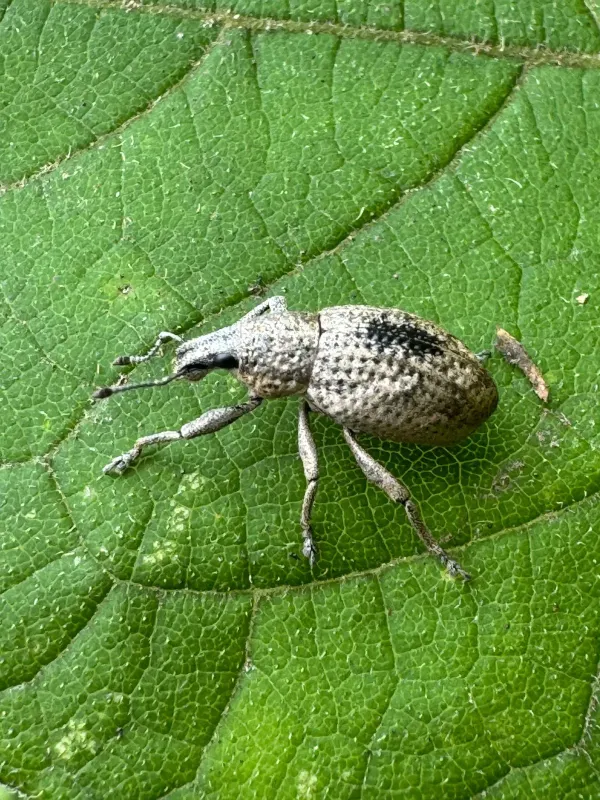
The imbricated snout beetle (Epicaerus imbricatus) is a member of the Curculionidae family in the order Coleoptera. Adult beetles are approximately 10–12 mm long and possess a distinctive color pattern of overlapping gray and brown scales, which resembles roofing tiles.
The body is oval and robust, featuring a characteristic short, thick snout (rostrum). Like other weevils, they have elbowed antennae. Their camouflage color pattern allows them to blend perfectly with the soil surface and plant stems.
The larvae are white, legless grubs with well-developed head capsules and strong mouthparts adapted for feeding on plant roots. They spend most of their life cycle beneath the soil surface, making them difficult to detect.
The beetle's biology is tightly linked to the soil environment, where it undergoes its primary stages of metamorphosis. They are known for their defensive behavior, where they drop to the ground and play dead when disturbed.
This "playing dead" reflex, combined with their excellent camouflage, makes it very challenging for farmers to identify early infestations without digging into the soil or using specialized trapping methods.
What it damages
This pest is a polyphagous insect that attacks a wide variety of agricultural crops, including legumes, cereals, potatoes, tomatoes, and various fruit trees and woody shrubs.
Adult beetles cause damage to the above-ground portions of the plant. They feed on leaves, flower buds, and blossoms, creating ragged edges on foliage and reducing the plant's overall photosynthetic capacity.
Larval stages are particularly dangerous as they feed underground, chewing on the root systems of young crops. This often leads to wilting, stunted growth, and eventual plant death.
The damage is particularly severe during dry seasons, as stressed plants struggle to recover from root damage and are unable to compensate for the lost vegetative mass.
During heavy outbreaks, this beetle can destroy significant portions of a crop in its early stages of development, potentially leading to substantial economic loss for agricultural operations.
When it appears
The activity of adult imbricated snout beetles begins in the spring, once soil temperatures become warm enough. Their peak emergence usually occurs between late spring and early summer.
Females typically deposit eggs on the leaves or in the soil near the host plants. Upon hatching, the larvae move into the soil to begin feeding on the root system.
The life cycle can vary depending on the climatic zone, potentially taking one or more years to complete, as the larvae often overwinter in the soil at various stages of development.
Large clusters of beetles are often observed during warm, humid spring weather. They tend to emerge in waves, especially following rainfall, which facilitates their movement toward host plants.
As autumn approaches, the larvae retreat into deeper soil layers to avoid frost, where they enter a state of diapause and remain inactive until the next growing season.
Signs of infestation
The most visible sign of an infestation is the characteristically notched or ragged appearance of the leaf edges. Unlike caterpillars that consume entire leaves, these beetles create distinctive, scalloped margins.
Wilted or yellowing plants in the field without any visible external pathogen signs on the stems often suggest that the roots have been severely compromised by the larvae.
Close inspection of the soil around the base of the plant often reveals the grubs, while shaking affected shrub branches frequently causes the adult beetles to fall to the ground.
Damage to blossoms and developing fruit buds, leading to premature fruit drop or scarred produce, is another key indicator of an active snout beetle population.
Infestations are often focal at first, usually starting near field borders, hedgerows, or areas with persistent weed populations, before spreading throughout the cultivated crop.
Control measures
Management of the imbricated snout beetle requires an integrated pest management (IPM) approach that combines cultural, biological, and chemical controls to minimize impact.
Deep autumn plowing is a highly effective cultural practice, as it exposes the overwintering larvae to the elements, birds, and other predators, significantly reducing the population for the next year.
Managing weed populations in and around the fields is essential, as these areas serve as primary overwintering sites and early-season food sources for the adults.
If economic thresholds are met, the application of registered insecticides is recommended, particularly targeting the adult beetles during their early feeding phase to prevent egg-laying.
- Implement diverse crop rotation schedules.
- Maintain clean field borders by removing weeds.
- Perform early-season scouting along field edges.
- Apply systemic insecticides if infestation exceeds acceptable levels.
Taxonomy
- Latin name
- Epicaerus imbricatus
- Order
- Coleoptera (beetles)
- Family
- Curculionidae
- EPPO code
- EPIEIM
Discussion
No discussions yet — be the first.