
Alder bud moth
Epiblema penkleriana
Description
How to identify
The Alder bud moth (Epiblema penkleriana) is a member of the Tortricidae family (leafroller moths). It is a small insect widely distributed in forests and orchards.
The adult moth has a wingspan of approximately 14–16 mm. Its forewings exhibit a mottled pattern of greyish-brown scales, providing excellent camouflage against tree bark.
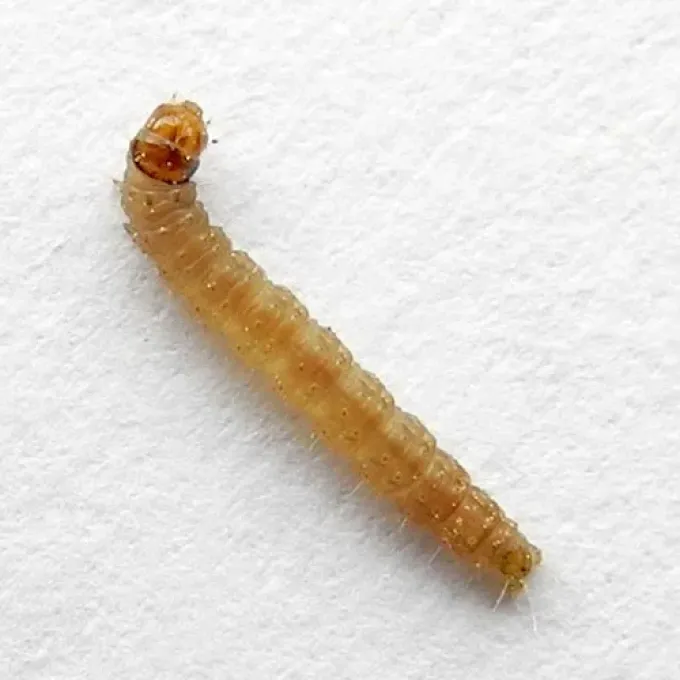
The larvae, or caterpillars, reach about 10–12 mm in length. They are typically whitish or pale pink with a dark brown head and thoracic plate.
As part of the Order Lepidoptera, the species undergoes a complete metamorphosis, transitioning through egg, larva, pupa, and adult stages.
This species is well-adapted to surviving on various host plants, including alder, birch, hazel, and sometimes fruit trees such as apple and plum.
What it damages
The primary hosts of the Alder bud moth are trees belonging to the Betulaceae family, specifically alder, birch, and hazelnut trees.
In proximity to forest areas, this moth frequently migrates into orchards, where it attacks the dormant and swelling buds of fruit-bearing trees.
The caterpillars bore into the buds, consuming the internal tissues. This feeding behavior destroys the developing floral and vegetative organs.
When infestation levels are high, the damage significantly reduces the potential yield, as many flower buds are destroyed before they can blossom.
For young nursery stock, the loss of primary buds leads to stunted growth, apical dominance disruption, and malformed tree structure.
When it appears
The flight period for adult moths occurs during the summer months, typically spanning from June to July, when reproduction takes place.
Females deposit eggs near the buds of host plants. By late summer, the larvae emerge and begin to feed slightly before entering diapause.
The species overwinters as mature larvae within silken cocoons, which are often concealed in crevices of the tree bark or near the bud scales.
Springtime activity commences as temperatures rise and buds begin to swell, signaling the larvae to resume feeding on the plant tissue.
Pupation generally takes place within the damaged buds or inside rolled leaves during late spring, allowing the next generation of moths to emerge.
Signs of infestation
The most visible sign of infestation is the presence of frass (larval excrement) appearing as small, dark granular piles on the exterior of the buds.
Affected buds stop developing, turn brown, and eventually wither, failing to produce leaves or flowers during the growing season.
Silken webbing around the bud scales is a tell-tale sign that a larva is present and has constructed a protective shelter for feeding.
In the spring, one can observe hollowed-out buds that appear empty or partially consumed when opened for inspection.
If the terminal bud is damaged, the resulting shoot growth may be deformed or branch off at abnormal angles, affecting the tree's health.
Control measures
Cultural control involves the removal and destruction of infested branches during the dormant pruning season to eliminate overwintering larvae.
Scraping away loose or dead bark from trunks helps reduce the number of suitable hibernation sites for the moths, limiting population buildup.
Biological control using Bacillus thuringiensis sprays can be very effective if applied when larvae are just beginning to emerge from their winter quarters.
Chemical intervention should be timed carefully, targeting the phase of bud swell before the larvae have fully tunneled into the protective bud tissue.
Monitoring adult populations with pheromone traps provides data on the infestation level and helps determine the optimal window for targeted treatments.
Taxonomy
- Latin name
- Epiblema penkleriana
- Order
- Lepidoptera (butterflies)
- Family
- Tortricidae
- EPPO code
- EPIBPE
Discussion
No discussions yet — be the first.