
Rose bud moth
Epiblema cynosbatella
Description
How to identify
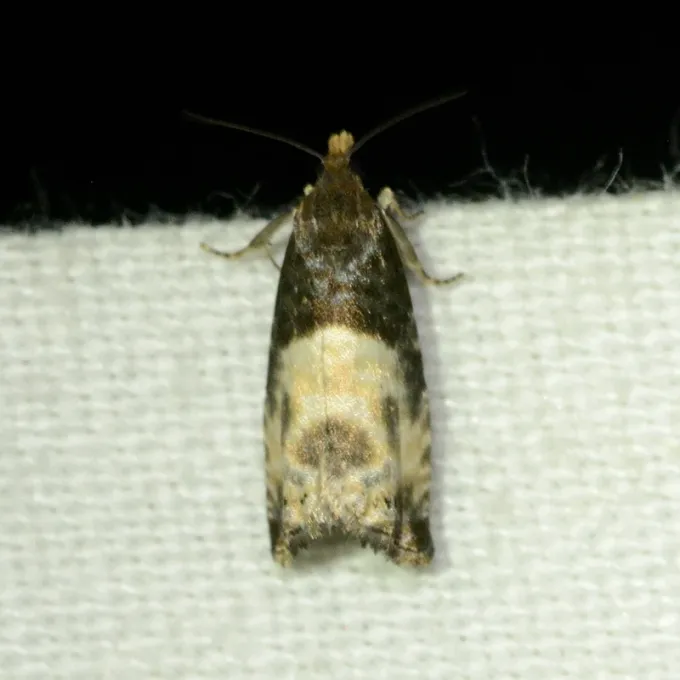
The rose bud moth (Epiblema cynosbatella) belongs to the Tortricidae family. The adult moth has a wingspan of approximately 18–20 mm. Its forewings are brown with a distinct large white patch, providing effective camouflage in a garden environment.
The larvae are about 15–18 mm long when fully grown. They typically have a brownish body with a dark, shiny head shield, which allows them to thrive inside buds and folded leaves.
This species overwinters as a larva in a cocoon hidden within bark crevices, tree forks, or attached to dry leaf remnants. This survival strategy makes them particularly resilient to harsh winter temperatures.
In early spring, when temperatures reach about 10°C, the larvae emerge from their winter shelters. They actively seek out swelling buds to initiate their spring feeding cycle.
The life cycle consists of a single generation per year. Moths usually fly in late spring and early summer, after which they lay eggs on the leaves of host plants.
What it damages
The pest primarily targets Rosaceae species. This includes a wide range of fruit trees such as apples, pears, cherries, and plums, as well as various ornamental shrubs, specifically roses and wild briers.
The most significant damage occurs in early spring when larvae bore into the buds. By hollowing out the buds, they prevent the development of blossoms and foliage, leading to substantial crop loss.
Later in the season, larvae feed on young leaves. They pull leaves together using silk webbing, forming small nests that protect them from predators and direct contact with insecticides.
In roses, the larvae frequently damage the developing buds. This results in deformed flowers or the complete destruction of the bud before it can bloom.
High infestation levels weaken the plant's overall vigor, making the trees more susceptible to secondary fungal infections and environmental stress.
Signs of infestation
One of the earliest signs is the presence of dormant or "blind" buds that fail to open while surrounding buds are healthy and growing. Close inspection will reveal entry holes at the base.
The formation of webbed clusters of leaves on the tips of shoots is a tell-tale sign of active feeding. These "nests" usually contain a larva protected inside the folded leaf tissue.
Deformed or withered flower buds are common indicators of an infestation in rose bushes. These buds often fail to bloom or produce flowers with significant visual defects.
Small piles of frass (excrement) bound together by silk threads near the bud bases indicate that a larva has been actively consuming the plant tissue.
- Failed or hollowed-out spring buds.
- Silk-webbed leaf nests on shoots.
- Deformed rose buds and flowers.
- Visible frass pellets near bud bases.
- Stunted shoot growth in early season.
Control measures
Early spring treatment with systemic insecticides is the most effective way to control the pest before it causes irreversible damage to the buds.
Cultural control practices include scraping off old, loose bark from the trunks of fruit trees during dormancy to eliminate wintering larvae, and removing garden debris.
Manual removal of webbed leaf clusters during the summer can significantly reduce the local population of the pest, especially in smaller gardens or rose collections.
Biological control using Bacillus thuringiensis-based products is effective during the early larval stages while minimizing impact on beneficial insects.
Monitoring adult moth populations using pheromone traps can help determine the precise timing for insecticide applications to maximize efficacy and reduce chemical usage.
Taxonomy
- Latin name
- Epiblema cynosbatella
- Order
- Lepidoptera (butterflies)
- Family
- Tortricidae
- EPPO code
- EPIBTR
Discussion
No discussions yet — be the first.