
Mediterranean flour moth
Ephestia kuehniella
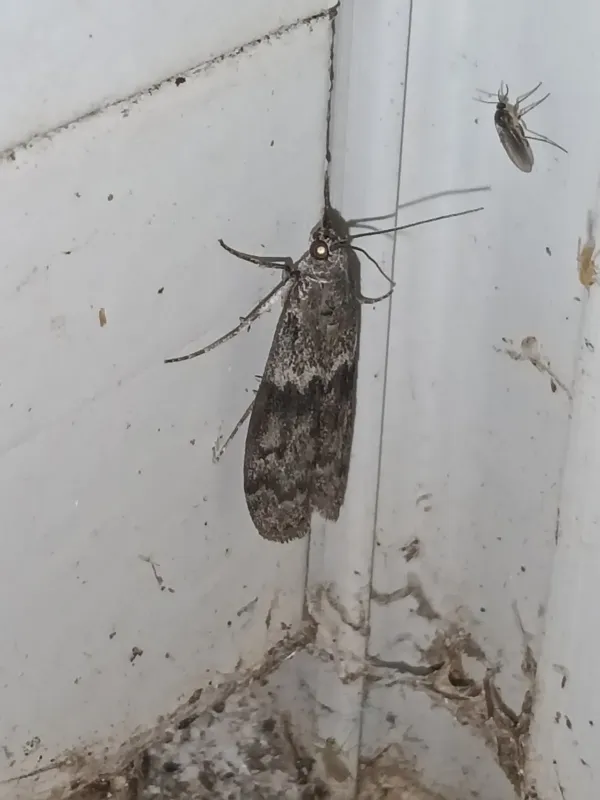
Description
How to identify
The Mediterranean flour moth Ephestia kuehniella belongs to the Pyralidae family and is a significant global pest of stored food products, particularly in flour mills and warehouses.
The adult moth has a wingspan of approximately 20–25 mm. The forewings are lead-grey with distinct transverse wavy dark lines, while the hindwings are pale, semi-transparent, and fringed.
The larvae, which cause the damage, grow up to 15–20 mm in length. Their body is usually whitish, yellowish, or slightly pinkish, with a distinct brown head and thoracic shield.
Pupation occurs within a silken cocoon spun by the larvae. These cocoons are often covered in food particles, making them blend into the substrate where the moth has been feeding.
The species is perfectly adapted to indoor life, thriving in protected environments where temperature and food availability are constant throughout the year.
What it damages
This moth primarily targets cereal products, including flour, semolina, bran, rolled oats, and various dry processed foods kept in storage facilities.
Larvae are the primary cause of damage; they consume the product and, more importantly, spin abundant silk webbing that binds food particles into large, matted clumps.
This webbing causes severe blockages in industrial equipment, such as sifters, conveyors, and spouting in flour mills, leading to operational downtime and maintenance issues.
The contamination of food with silk, excrement, and larval skins renders the products unacceptable for human consumption and significantly lowers their market value.
Under heavy infestation, the product quality degrades rapidly, often leading to secondary issues such as the growth of molds and the attraction of other secondary pests.
When it appears
The Mediterranean flour moth is not restricted by seasons in heated buildings, meaning it can produce multiple generations annually if the environment remains favorable.
Development from egg to adult takes approximately two months under optimal conditions (around 25°C and 60-70% humidity), allowing for rapid population explosions.
Adult moths are primarily nocturnal and are active year-round in mills and warehouses, continuously laying eggs directly onto the food source or in cracks near food supplies.
There is no true diapause for this insect in indoor settings; as long as the temperature stays within the growth range, the lifecycle continues without interruption.
During colder months, populations may slow their development but continue to persist in hidden niches, such as wall cracks, dust accumulations, and residues inside machinery.
Signs of infestation
The presence of fine, sticky silk webbing on the surface of bags, equipment, or inside bins is the most reliable indicator of a Mediterranean flour moth infestation.
Adult moths may be seen flying erratically in the storage area or resting on walls and ceilings, usually near the areas where the product is stored.
Affected products often form irregular, webbed clumps that are noticeable during handling or inspection, indicating that larvae are present deep within the material.
A musty odor often develops in the infested grain or flour as a result of larval activity, excrement accumulation, and potential mold growth within the silk webs.
Exit holes or damaged packaging can indicate where larvae have traveled, and physical inspection of samples will reveal the larvae themselves or their shed skins.
Control measures
Strict sanitation is the foundation of management: regular cleaning of all machinery, walls, and floors to remove flour dust and spilled grain residues is essential.
Pheromone traps are highly effective for monitoring population levels, providing early warning signals, and helping to disrupt mating in controlled environments.
For empty facilities, the application of residual insecticides can help manage population levels, provided they are cleared for use in food processing plants.
Fumigation is the standard procedure for eradicating severe infestations within sealed silos, stacks of bagged goods, or entire warehouse chambers to ensure total mortality.
- Maintain low temperatures (below 10°C) to inhibit larval development.
- Use hermetically sealed containers for long-term storage.
- Inspect incoming raw materials for signs of larvae or webbing.
- Utilize mechanical grain cleaners to remove eggs and larvae.
- Seal structural cracks to limit the movement of insects between storage areas.
Taxonomy
- Latin name
- Ephestia kuehniella
- Order
- Lepidoptera (butterflies)
- Family
- Pyralidae
- EPPO code
- EPHEKU
Discussion
No discussions yet — be the first.