
Four-spotted leafroller
Endothenia quadrimaculana
Description
How to identify
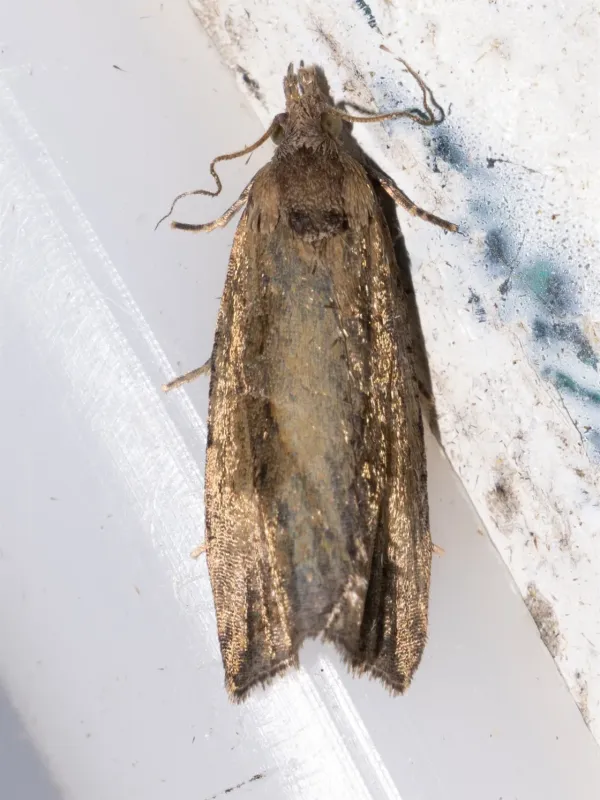
The four-spotted leafroller (Endothenia quadrimaculana) is a moth belonging to the order Lepidoptera and the family Tortricidae. Adults are small insects with a wingspan ranging from 15 to 20 mm.
The forewings are characterized by a distinct pattern with four light-colored spots against a grayish-brown background, which gives the species its common name.
The hindwings are generally lighter in color, appearing off-white or grayish with visible fringes along the edges. When at rest, the moth keeps its wings folded in a roof-like position.
Larvae (caterpillars) progress through several instars and are typically yellowish-white or pinkish with a dark head capsule, growing up to 15 mm in length.
Pupae are brown and develop within a protective silken cocoon constructed either inside the plant tissue or near the soil surface among debris.
What it damages
This pest is polyphagous, but it exhibits a strong preference for plants within the Lamiaceae family, particularly medicinal and aromatic herbs.
Common hosts include mint, sage, oregano, and various ornamental plants, where the larvae cause significant structural and developmental damage.
Early-stage damage involves larvae boring into the stems of young plants, consuming the internal tissues and causing the terminal growth to wither and die.
As the season progresses, larvae may target the reproductive parts of the plant, such as flowers and flower buds, significantly reducing seed yields and biomass quality.
The entry points created by the larvae often facilitate the entry of secondary pathogens, leading to bacterial or fungal infections that further weaken the plants.
When it appears
The life cycle of the four-spotted leafroller is closely tied to climatic conditions, with overwintering typically occurring in the larval stage.
Pupation takes place in early spring as temperatures rise. The duration of the pupal stage is highly dependent on ambient temperature and moisture levels.
Adult moths usually emerge in late May or June. They are primarily nocturnal, spending the daylight hours hidden within the foliage to avoid predators.
Female moths deposit eggs on the underside of leaves or within leaf axils. The embryonic development usually takes about 7 to 10 days depending on the heat.
Depending on the latitude, the insect may complete one or two generations per growing season, requiring careful monitoring to prevent population outbreaks.
Signs of infestation
The most noticeable sign of an infestation is the sudden wilting of the top shoots, which often happens despite sufficient soil moisture.
Close inspection of the stems will reveal small entrance holes often marked by the presence of frass (larval waste), indicating the location of the pest.
Leaves near the point of damage often become distorted, yellowish, or necrotic as the plant loses its ability to transport nutrients effectively.
When flowers are affected, the larvae use silk threads to bind the buds together, creating visible nests that are easily identifiable upon visual inspection.
- Wilting and drooping of terminal shoots.
- Entrance holes on stems with frass deposits.
- Webbing and binding of flower buds.
- Deformation and yellowing of foliage.
Control measures
Cultural control practices, such as deep plowing in autumn, are highly effective as they disturb and destroy the pupae overwintering in the soil.
Maintaining a weed-free environment is essential, as many common weeds can act as alternative hosts for the leafroller early in the season.
The use of light traps or pheromone monitoring can help in detecting the presence of adults and determining the optimal timing for intervention.
Chemical control involving systemic insecticides is necessary when infestation thresholds are exceeded to target larvae hidden inside the stems.
Biological control options, including the application of Bacillus thuringiensis, provide an effective and environmentally friendly solution for managing young larvae.
Taxonomy
- Latin name
- Endothenia quadrimaculana
- Order
- Lepidoptera (butterflies)
- Family
- Tortricidae
- EPPO code
- ENDTQU
Discussion
No discussions yet — be the first.