
Endothenia
Endothenia
Description
How to identify
The genus Endothenia belongs to the Tortricidae family within the order Lepidoptera. Adults are small moths with a wingspan of approximately 12–18 mm, characterized by cryptic coloration that provides excellent camouflage against tree bark or foliage.
The forewings of the moth feature complex patterns consisting of spots and bands in shades of brown, gray, or ochre. The hindwings are typically uniform, grayish-brown, with a fringed edge. When at rest, these moths fold their wings into a tent-like shape, which is a hallmark trait of the leafroller family.
Larvae undergo several developmental stages, shifting in color from light yellow or cream to greenish or pinkish as they mature. The presence of a dark, sclerotized head capsule is a critical diagnostic feature for field identification of the caterpillars.
Pupation typically occurs within the feeding sites or within the top layer of soil. The pupae are yellowish-brown and equipped with small hooks on the abdominal segments, which assist them in pushing towards the surface just before adult emergence.
Correct species identification often requires microscopic analysis of genitalia due to the high morphological similarity between different species within the Endothenia genus. Field observations should focus on plant damage patterns to track infestation levels.
What it damages
This pest attacks a wide range of plants, including commercial crops like strawberries and raspberries, as well as various ornamental species. The larvae are primarily responsible for the damage, as they feed on succulent tissues of leaves and reproductive organs.
Young larvae often create webbed enclosures by folding and tying leaves together. As they grow, they move to target buds, flowers, and developing fruit, boring into these structures and rendering them unmarketable due to mechanical injury.
In cases of high population density, larvae may also bore into the plant stems or the crown area, leading to stunted growth or total plant collapse. This type of damage is particularly devastating for young plantations that have not yet fully established.
The feeding holes created by the larvae serve as entry points for secondary pathogens, such as grey mold (Botrytis) and other fungal infections. This often causes significant indirect yield loss beyond the damage directly caused by the caterpillars.
The economic impact of Endothenia depends heavily on the timing of infestation and the health of the host crop. Early detection is vital to prevent the spread of the population across the entire field or orchard.
When it appears
The life cycle of Endothenia typically includes one or two generations per year, depending on the local climate and temperature gradients. Adult flight begins in late spring when temperatures stabilize above 12–15 degrees Celsius.
The egg-laying period is often protracted, which poses a challenge for timing protective treatments. Females deposit eggs in small clusters on the undersides of leaves or directly onto the buds of host plants.
Larval activity peaks during June and July, making these months the critical window for monitoring and management. The larvae consume plant material rapidly during this stage, leading to visible signs of infestation appearing across the plantation.
By late summer or early autumn, mature larvae descend to the soil or hide in plant debris to overwinter. They construct durable cocoons that protect them from freezing temperatures and other environmental stresses.
Phenological synchronization with host plant development allows the pest to maximize its survival rate. Agronomists track these seasonal cycles to implement interventions before the larvae transition to the more destructive feeding stages.
Signs of infestation
The primary symptom of infestation is the appearance of webbed, rolled-up leaves on the tips of shoots. These leaves gradually turn yellow and dry out, a condition that can easily be mistaken for fungal infection unless inspected closely.
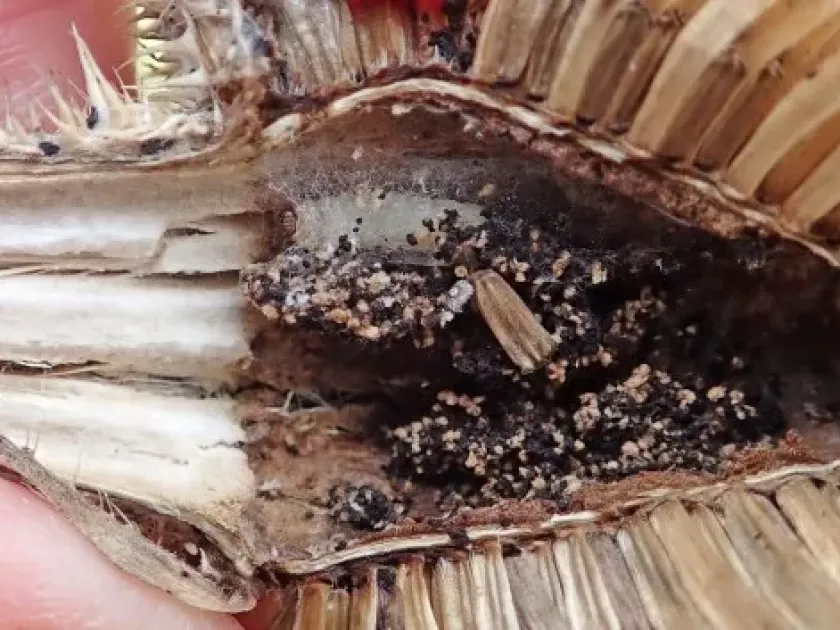
Damaged buds often fail to bloom, showing signs of internal feeding and accumulation of larval frass (excrement). When opened, these buds typically reveal the presence of the larva itself, hidden deep within the floral tissues.
Infestation on the stem or root crown is indicated by small entry holes surrounded by fine sawdust-like material. Plants affected in this manner show signs of water stress and poor overall vigor, despite adequate irrigation.
Adult moths may be spotted during twilight hours near the crops, signaling the start of the egg-laying phase. Monitoring during this period using light traps or pheromone lures can confirm the presence of the pest.
- Webbing on tender shoot tips.
- Premature wilting and death of buds.
- Boreholes in reproductive organs and stems.
- Larval frass visible on leaf surfaces.
- General decline in plant vigor.
Control measures
Cultural control is a cornerstone of management, involving the rigorous removal and destruction of crop residues after harvest. Deep plowing of inter-rows in the autumn disrupts overwintering sites, significantly reducing the survival of pupae.
Biological control methods utilize formulations based on Bacillus thuringiensis, which target larvae without harming non-target organisms. This approach is highly recommended in integrated pest management (IPM) programs.
Chemical control should be employed selectively based on economic injury thresholds. Pyrethroids or neonicotinoids may be used, provided they are registered for use on the specific crop and applied in accordance with local regulations.
Pheromone traps are excellent tools for both population monitoring and mating disruption, which effectively lowers the number of fertilized eggs in the next generation. This reduces the overall need for heavy pesticide usage.
Encouraging beneficial insects, such as parasitic wasps and predators, helps naturally regulate the Endothenia population. Maintaining a diverse ecosystem around the farm minimizes the risk of sudden pest outbreaks.
Taxonomy
- Latin name
- Endothenia
- Order
- Lepidoptera (butterflies)
- Family
- Tortricidae
- EPPO code
- ENDTSP
Discussion
No discussions yet — be the first.