
Clover moth
Enarmonia interstinctana
Description
How to identify
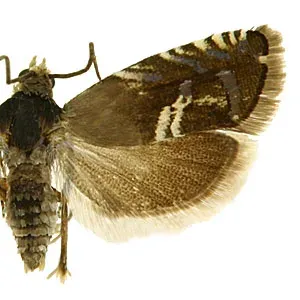
The clover moth (Enarmonia interstinctana) is a small moth belonging to the family Tortricidae, with a wingspan of approximately 8–10 mm. The forewings have a dark brown base color with distinctive white streaks along the front margin, which serves as a key diagnostic feature.
The larva of this pest reaches a length of 8–9 mm. Its body color varies from whitish to greenish-yellow, and it possesses a prominent brown head. The body is covered with sparse short hairs that assist the caterpillar in moving through the plant tissues.
The pupa is protected within a dense white cocoon, which the larva weaves from silk and plant debris. The pest typically overwinters in this stage, hiding in the surface layer of the soil or among plant residues remaining in the field.
Adult moths are nocturnal and active during the evening. During the day, they remain hidden in the dense foliage of the clover, making them difficult to detect without using an entomological net for regular field monitoring.
The life cycle consists of two or three generations per year, depending on the climatic conditions of the region. The rate of reproduction is directly influenced by temperature and humidity levels during the peak flight of the moths.
What it damages
The clover moth primarily targets plants of the legume family, with clover (Trifolium) species being the main hosts. The pest causes the most significant damage during the development of the plant's reproductive organs.
Caterpillars feed on the ovaries, developing seeds, and the receptacle of the flower heads. A single flower head can host several larvae simultaneously, which may destroy almost all the seeds, leading to severe yield losses in seed production.
The harm extends beyond direct seed consumption; it also affects the quality of clover hay. Damaged flower heads dry out prematurely, significantly reducing the nutritional value and biomass quality of the forage crop.
Massive infestations in favorable weather conditions can result in a loss of over 50% of the seed production in clover fields during their second or third year of cultivation.
The pest poses a particular threat to seed-producing farms, where the requirements for high-quality, pure clover seeds are strict and economic losses from reduced yields become highly critical.
When it appears
The emergence of the first generation of moths usually coincides with the budding stage of clover, which occurs in late May or early June. This is the primary time for field colonization by the pest.
A second peak of insect activity occurs in July and August, corresponding with the massive seed ripening period. This phase is the most dangerous for seed-grown crops, as the second-generation larvae are most numerous.
The development of a single generation lasts from 30 to 45 days. In warmer climates or during long autumns, a partial third generation may appear, making it more challenging to control the population at the end of the growing season.
Larvae of the final generation enter diapause to overwinter. They reside in cocoons located in the stubble, under fallen leaves, or in the upper soil layers, waiting for the spring temperature increase to resume their cycle.
Monitoring population density is recommended using pheromone traps, which allow for the precise determination of moth flight initiation and assist in scheduling timely protection measures.
Signs of infestation
The first visible sign of infestation is the presence of silk webbing within the clover flower heads. Upon close inspection, one can find the characteristic droppings of the larvae, which appear as tiny, dark, granular pellets.
Affected clover heads often show signs of deformation and irregular coloration. In later stages of damage, the flower heads begin to turn brown, dry out prematurely, and shatter easily upon touch.
Dissecting the flower head often reveals the presence of a clover moth larva, which is frequently found curled up inside. The absence of seeds or the presence of hollowed-out seeds confirms the pest's activity.
In heavily infested fields, uneven flowering of the clover crop is common. Leaf margins may also appear slightly curled, serving as an indirect indicator of tortricid larvae presence on the host plant.
A standard diagnostic method involves counting larvae per 100 flower heads. Exceeding the economic threshold (typically more than 1–2 larvae per 10 heads) signals an immediate need for control interventions.
Control measures
Agronomic control methods include early harvesting of clover for hay before the mass multiplication of larvae, which effectively destroys a significant portion of the pest population along with the harvested biomass.
Spatial isolation of seed-producing fields from older clover stands is crucial, as older fields serve as primary reservoirs and breeding sites for the moth within the agricultural landscape.
Adherence to crop rotation, which involves plowing fields after two years of clover use, disrupts the pest's life cycle and reduces the number of overwintering larvae in the soil.
During the peak flight of moths, if the economic threshold is exceeded, the application of insecticides from the pyrethroid or organophosphate groups, approved for use on forage crops, is effective.
- Spatial isolation of clover fields
- Early harvesting of seed crops
- Use of pheromone traps
- Timely deep fall plowing
- Application of approved insecticides
Taxonomy
- Latin name
- Enarmonia interstinctana
- Order
- Lepidoptera (butterflies)
- Family
- Tortricidae
- EPPO code
- EUCOIN
Discussion
No discussions yet — be the first.