
Cherry bark tortrix
Enarmonia formosana
Description
How to identify
The cherry bark tortrix (Enarmonia formosana) is a moth belonging to the family Tortricidae. It is a significant pest of fruit trees that spends its larval stage hidden under the bark of the host plant.
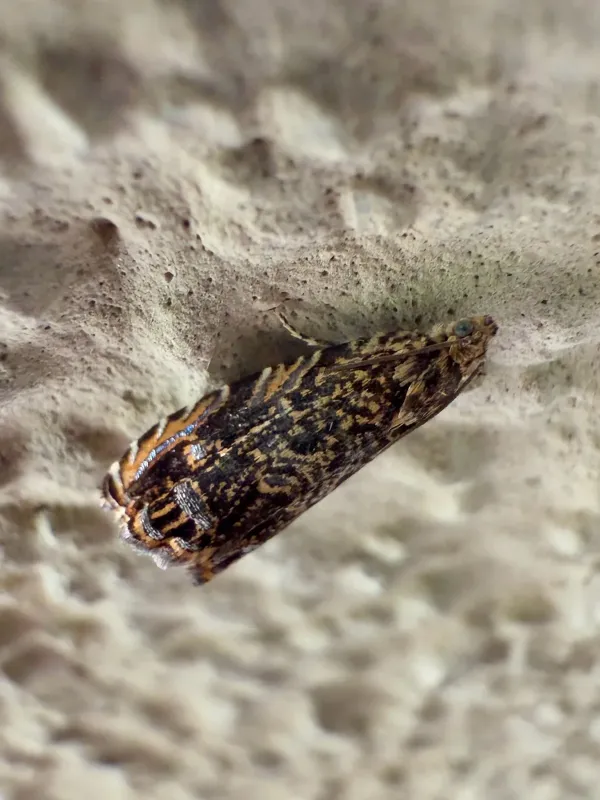
The adult moth has a wingspan of 15–18 mm and features a cryptic pattern of brown and silver-grey scales. This camouflage makes them very difficult to spot when resting on the rough bark of trees during the day.
The larvae are about 15 mm long and possess a creamy or pinkish body with a distinct dark brown head. They live exclusively in the subcortical tissue, consuming the inner bark and cambium.
The life cycle typically includes two generations per year in temperate climates. Hibernation occurs as larvae within their tunnels, which they prepare in late summer and autumn.
In spring, the larvae pupate within their silk-lined galleries. Before emerging as adults, the pupa moves partially out of the exit hole to allow the moth to break free easily.
What it damages
This pest affects a wide range of fruit trees, including apple, pear, cherry, plum, and apricot. It specifically targets trees with existing bark damage, grafting unions, or structural wounds.
The feeding activity of the larvae destroys the phloem and cambium layers. This disrupts the tree's ability to transport nutrients, leading to reduced vigor and stunted growth.
Repeated attacks on the same tree can lead to localized necrosis, causing sections of bark to die and fall off. This creates entry points for secondary pathogens like fungal rots.
Economic damage is high in commercial orchards, as heavily infested trees become unproductive and may eventually die if the main stem is girdled by the larval galleries.
Trees that are poorly maintained or under stress from drought or nutrient deficiency are significantly more susceptible to infestation by the cherry bark tortrix.
Signs of infestation
The most reliable sign of an infestation is the presence of brown frass (larval excrement) mixed with bark shavings, which is pushed out from the holes in the bark.
Look for loose or cracked bark, particularly around graft unions and major branch crotches. Peeling back a small piece of loose bark often reveals the silken galleries made by the larvae.
In the spring, white empty pupal cases protruding from the bark are a clear indication of successful moth emergence and an active infestation in the orchard.
Affected trees may show signs of canopy decline, such as yellowing foliage, smaller leaves, or premature wilting during hot summer months due to damaged vascular tissues.
Long-term infestations result in irregular swelling and distortion of the bark, which can persist for years even if the pest population is managed.
Control measures
Physical control involves the careful removal of damaged or loose bark to expose the larval galleries. The exposed wood should be cleaned and treated with an appropriate wound sealant.
Pheromone traps are highly effective for monitoring flight patterns. By timing insecticide applications to coincide with the peak adult flight, growers can reduce the need for excessive chemical spraying.
Chemical control focuses on applying targeted insecticides to the trunk and main branches during the period of larval hatching, ensuring full coverage of the bark surface.
Maintain tree health to deter the moth. Preventing mechanical damage to the bark and providing proper nutrition and irrigation can significantly increase the tree's natural resilience.
- Applying white lime wash to trunks to discourage egg-laying.
- Regular inspection of graft unions for early signs of frass.
- Pruning and removing severely infested branches to reduce population density.
- Using biological control agents if available in your region.
Taxonomy
- Latin name
- Enarmonia formosana
- Order
- Lepidoptera (butterflies)
- Family
- Tortricidae
- EPPO code
- ENARFO
Discussion
No discussions yet — be the first.