
Spiny bark beetle
Eccoptopterus spinosus
Description
How to identify
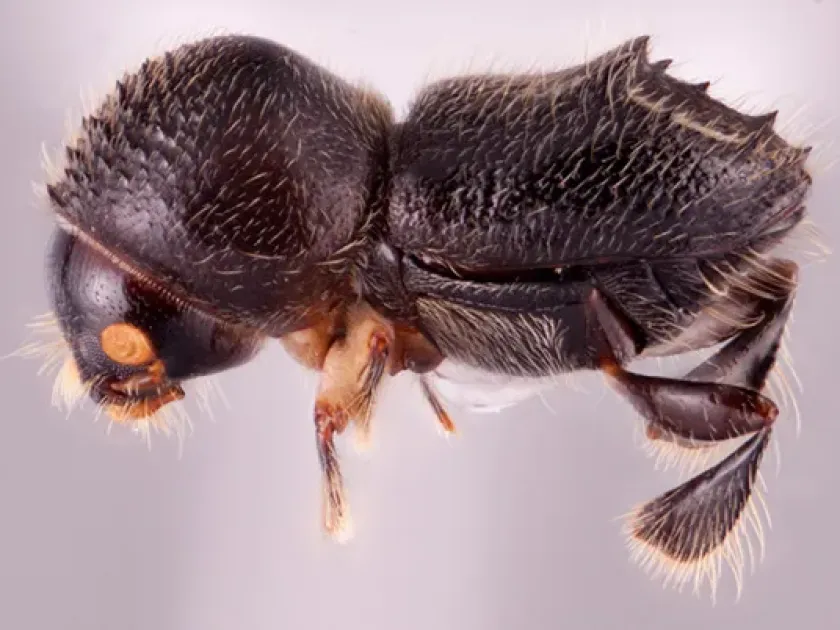
The spiny bark beetle (scientific name: Eccoptopterus spinosus) is a small beetle belonging to the order Coleoptera and the family Curculionidae (subfamily Scolytinae). Its common name comes from the distinct, spine-like projections found on the posterior end of its elytra.
These beetles are generally small, ranging from 3 to 5 mm in length, with a cylindrical, dark-brown to black body. They are specialized wood-boring insects that thrive in the inner bark (phloem) layer of coniferous trees.
The larvae are small, legless grubs with a creamy-white appearance and a yellowish head. They are responsible for the primary damage as they feed and excavate tunnels within the cambium layer of the host tree.
Understanding the unique morphological features of the spiny bark beetle is crucial for entomologists and forest managers to distinguish this species from other sympatric bark beetle populations.
Like many species in the Scolytinae subfamily, they rely heavily on chemical cues (pheromones and host volatiles) to locate suitable host trees and coordinate mass attacks.
What it damages
This beetle primarily targets coniferous species, particularly spruce and fir trees. They are generally considered secondary pests, but they can become lethal to host trees when population densities are high.
Damage occurs when adults bore through the outer bark to reach the nutrient-rich phloem. Once inside, they construct mating galleries, and larvae subsequently tunnel outward, effectively girdling the tree.
The destruction of the vascular system (cambium and phloem) prevents the transport of water and nutrients, which ultimately leads to the rapid decline and death of the infested tree.
In forestry, these beetles cause significant degradation of timber quality and can lead to the widespread mortality of entire forest stands if not managed appropriately during outbreak years.
The economic impact is substantial, as infested stands lose their commercial value, and the resulting deadwood poses an increased risk of forest fires and further pest outbreaks.
When it appears
The life cycle begins in early spring when temperatures rise, signaling the beetles to emerge from their overwintering sites in the soil or deep bark crevices.
The peak flight and colonization period typically occurs from late spring through mid-summer. During this window, beetles aggressively seek out stressed or weakened hosts to initiate gallery formation.
One or two generations per year are possible depending on the regional climate, with warmer seasons accelerating the larval developmental stages significantly.
As autumn approaches, the adults seek protected areas to survive the winter. They often burrow deeper into the bark or migrate to the base of the tree into the forest litter layer.
Environmental factors such as drought stress make trees more susceptible to attack, meaning that the beetle's seasonal impact is often magnified during periods of low precipitation.
Signs of infestation
The presence of fine, brownish-red sawdust (boring dust) at the base of the tree or in the bark crevices is the primary indicator of an active infestation.
Small, circular entrance holes on the trunk are visible upon close inspection. Sometimes, resin tubes or "pitch tubes" may appear on the bark surface as the tree attempts to push out the invader.
A noticeable change in the color of the tree's foliage—turning from healthy green to yellow or reddish-brown—indicates that the tree is already severely compromised and likely dying.
If the outer bark is carefully removed, a clear gallery pattern will be visible, showing the central mating tunnel and numerous side galleries created by the developing larvae.
- Visible sawdust piles at the tree base.
- Fading or discoloration of the tree canopy.
- Entrance holes on the stem.
- Resin accumulation on the bark surface.
Control measures
Sanitation felling is the most effective management tool. Removing and removing infested logs before the new brood emerges is essential to break the life cycle and prevent spread.
Pheromone traps are widely used for monitoring population trends and can help suppress local adult beetle numbers by attracting them away from healthy stands.
Maintaining forest health through proper silvicultural practices, including the removal of windfalls and storm-damaged timber, eliminates vital breeding habitats for the beetles.
Chemical control methods, such as insecticide applications, are generally reserved for high-value trees in urban or ornamental settings rather than broad-scale forest applications.
Encouraging natural predators, such as woodpeckers and various parasitoid wasps, provides a form of biological regulation that helps keep bark beetle populations in check.
Taxonomy
- Latin name
- Eccoptopterus spinosus
- Order
- Coleoptera (beetles)
- Family
- Curculionidae
- EPPO code
- ECCOSI
Discussion
No discussions yet — be the first.