
Dyslobus lecontei
Dyslobus lecontei
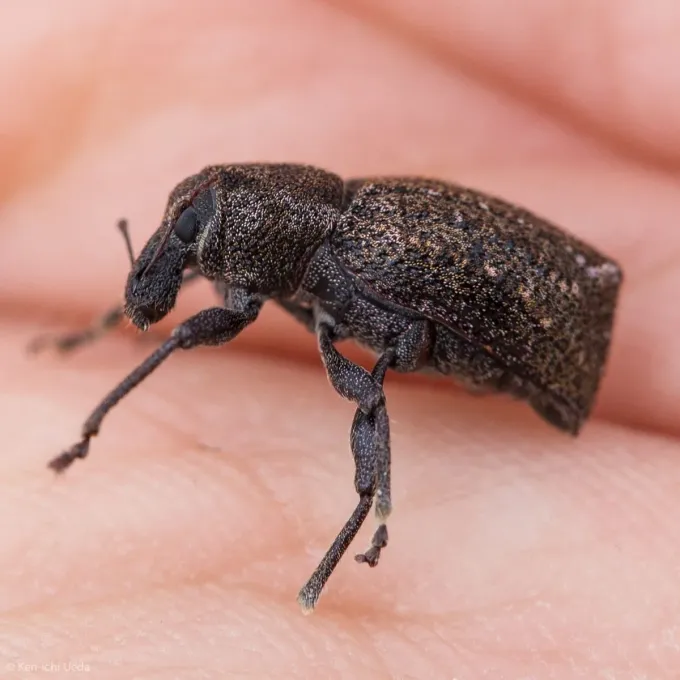
Description
How to identify
Dyslobus lecontei is a species of broad-nosed weevil belonging to the family Curculionidae. These beetles are characterized by their distinct snout and robust bodies.
Adult beetles typically range from 6 to 8 mm in length. Their bodies are covered in scales that provide excellent camouflage against soil and organic debris, making them difficult to spot.
The larvae are legless, C-shaped grubs with creamy white bodies and a hard, brown head capsule. They spend their entire developmental cycle residing within the soil profile.
Due to their nocturnal behavior and limited mobility, these weevils tend to remain hidden during daylight hours, often clustering near the base of host plants.
Identification is best achieved through nocturnal monitoring or by examining the root systems of wilted plants where these larvae are commonly found.
What it damages
Dyslobus lecontei primarily attacks berry crops, with strawberries being a preferred host. Both adults and larvae contribute to significant crop losses.
Larval feeding on the root system is the most destructive phase. They sever fine rootlets and bore into the main crown, severely compromising the plant's nutrient and water uptake.
Adult beetles feed on the foliage, causing distinctive notching or scalloping along the leaf margins, which can reduce the plant's overall photosynthetic capacity.
Root damage creates entry points for soil-borne pathogens, such as fungi and bacteria, leading to secondary infections that accelerate plant decline and death.
In infested fields, this beetle often creates localized patches of stunted or dead plants, which can expand over time if management actions are not implemented.
When it appears
Adult activity typically commences in early spring as temperatures rise, signaling the emergence of overwintering beetles from the soil.
The peak feeding and reproductive period occurs throughout the late spring and early summer, coinciding with the rapid vegetative growth of strawberry plants.
Larvae continue to feed on plant roots throughout the summer and early autumn. Their development is tightly linked to soil temperature and moisture conditions.
As winter approaches, both adult beetles and late-stage larvae retreat deeper into the soil profile to find suitable temperatures for overwintering.
Because the life cycle can be prolonged and staggered, multiple stages of the beetle may be present in the field simultaneously, complicating control efforts.
Signs of infestation
The most visible sign of an infestation is the presence of scalloped edges on strawberry leaves, resulting from the adults' nocturnal feeding habits.
Plants that appear wilted or yellowed despite adequate irrigation often indicate severe damage to the root system caused by larval feeding.
Uprooting a dying plant will often reveal the presence of larvae in the root zone, usually curled into a protective C-shape in the surrounding soil.
Reduced vigor and patchiness within the field are reliable indicators that the soil population of the weevil has reached an economically damaging threshold.
Presence of the beetles can be confirmed by using nocturnal inspections with flashlights or by checking beneath debris surrounding the plants.
Control measures
Effective management requires an integrated approach that combines cultural practices with targeted chemical or biological interventions.
Crop rotation is essential; avoiding the planting of host crops in the same area for at least 4-5 years helps significantly reduce local weevil populations.
Frequent cultivation or deep tillage of soil around the root zone can mechanically destroy larvae and disrupt their preferred habitat before they reach maturity.
Chemical applications should be timed to correspond with the period of peak adult activity, generally requiring evening applications for maximum efficacy.
- Selection of certified, pest-free nursery stock for new plantings.
- Use of entomopathogenic nematodes or fungi to naturally suppress larval populations in the soil.
- Implementation of pheromone or light-based monitoring to track population dynamics.
Taxonomy
- Latin name
- Dyslobus lecontei
- Order
- Coleoptera (beetles)
- Family
- Curculionidae
- EPPO code
- DYSLLE
Discussion
No discussions yet — be the first.