
Dyslobus
Dyslobus
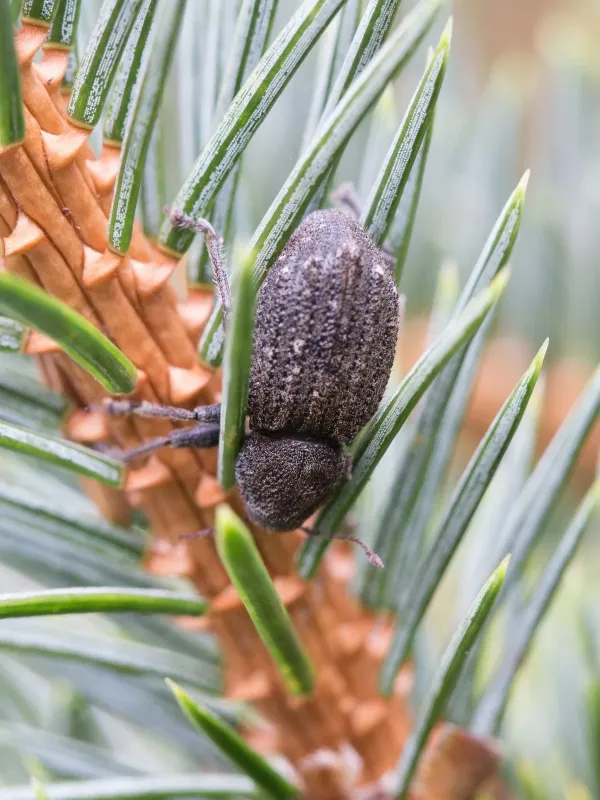
Description
How to identify
Dyslobus is a genus of beetles belonging to the family Curculionidae (weevils), order Coleoptera. These are small insects characterized by their elongated snout, a typical feature of the weevil family, and a hard, sclerotized body often covered in fine scales for camouflage.
Adults typically measure between 5 to 10 millimeters in length. Their coloration ranges from dull brown to gray or black, which helps them blend into soil or foliage environments. They possess elbowed antennae, a standard morphological trait for this group of beetles.
The larvae of the Dyslobus genus are typical weevil grubs: they are legless, white in color, with a C-shaped body and a well-developed, dark head capsule. They spend their entire life cycle underground, feeding on the root systems of various plants, which makes early detection difficult.
There is a wide variety of species within the Dyslobus genus, and exact identification often requires the use of regional entomological keys. Their life cycle is deeply intertwined with the soil environment, where they undergo larval development and often overwinter as adults or larvae.
Understanding their behavior is crucial, as they are primarily cryptic insects. Their ability to remain hidden in the soil profile allows them to avoid conventional surface treatments, making them a persistent pest in both open-field crops and orchards.
What it damages
Both adults and larvae cause economic damage. Adults feed on the aerial parts of plants, primarily leaves. They create characteristic scalloped or notched edges on the leaves, known as "notching," which is a clear diagnostic sign of their presence.
Larvae cause more severe damage by feeding on the root systems. They consume fibrous roots and can girdle the taproot or root crown, which effectively cuts off the plant's nutrient and water supply, leading to wilting, stunted growth, and potentially plant death.
A broad range of crops is affected by this pest. It is frequently observed causing damage to small fruits like strawberries, as well as various vegetable crops, nursery stock, and several types of ornamental plants grown in soil.
Damage to the root system by larvae opens pathways for soil-borne pathogens, including various root rots and fungal infections. These secondary infections often accelerate the decline of the plant, making it difficult to recover even if the pest pressure is reduced.
The cumulative effect of this damage results in significant yield reduction, aesthetic degradation of ornamental plants, and increased costs for producers who must invest in rigorous monitoring and corrective soil treatments.
When it appears
Adult Dyslobus activity usually begins in early spring, as temperatures rise and the soil warms. After overwintering, adults emerge from the soil to engage in supplemental feeding on new foliage and buds of host plants.
The peak period for reproduction and adult activity is late spring to early summer. During this time, mating occurs, and females lay their eggs in the soil near the root zone of suitable host plants, ensuring food availability for the emerging larvae.
Larvae feed actively throughout the summer months. Their growth is optimized by the soil temperatures during the growing season, allowing them to cause sustained damage to the host plant’s root system until autumn approaches.
Pupation typically takes place in late summer or autumn. Many species have a life cycle where they overwinter either as larvae deep in the soil or as newly emerged adults sheltered in the upper soil layers or beneath plant debris.
Due to this seasonal cycle, timing is critical for control. Applications of insecticides are most effective when adults are present on the foliage, while soil treatments against larvae are best timed before the onset of extreme seasonal temperatures.
Signs of infestation
The most visible symptom of an infestation is the presence of scalloped or notched leaf margins. Since the beetles are nocturnal, they are rarely seen during the day, but these distinct feeding patterns remain as evidence of their nocturnal activity.
Sudden wilting or chlorosis (yellowing) of plants without an obvious cause often indicates root damage. If a plant looks stressed despite adequate irrigation, inspecting the root zone for signs of feeding or the presence of larvae is necessary.
To confirm the presence of larvae, one should carefully dig around the base of symptomatic plants. Larvae are typically found in the top 10-15 centimeters of the soil, feeding in close proximity to the roots.
Adults often hide in soil crevices, under leaf litter, or at the base of the plant during the day. Careful inspection of the mulch or the immediate soil surface around the stem during early morning hours can often reveal the hiding beetles.
- Scalloped edges on leaves (notching).
- Unexpected wilting or collapse of the plant.
- Stunted growth and poor vigor compared to surrounding plants.
- Presence of white, legless grubs in the root zone.
Control measures
Management of Dyslobus requires an integrated approach. Cultural practices such as regular soil cultivation can disrupt the larval environment and destroy pupation sites, significantly reducing the population density in the soil.
Mechanical control, such as hand-picking the nocturnal adults or utilizing physical barriers, can be effective in small-scale gardens. Mulching can sometimes be used to discourage the beetles, although it may also provide shelter if not managed properly.
Chemical control focuses on applying systemic or contact insecticides to the foliage during the peak activity period of adults. This helps to reduce the number of egg-laying females and lower the subsequent larval population.
Biological control agents, particularly entomopathogenic nematodes or fungi that target soil-dwelling grubs, offer a sustainable and effective way to manage the larval stage without causing harm to beneficial soil organisms or the environment.
Early monitoring of crop stands is essential for successful management. By detecting the infestation early through scouting for leaf notches, producers can apply targeted interventions, minimizing crop loss and preventing the pest from spreading throughout the planting.
Taxonomy
- Latin name
- Dyslobus
- Order
- Coleoptera (beetles)
- Family
- Curculionidae
- EPPO code
- DYSLSP
Discussion
No discussions yet — be the first.