
Woodlouse spider
Dysdera
Description
How to identify
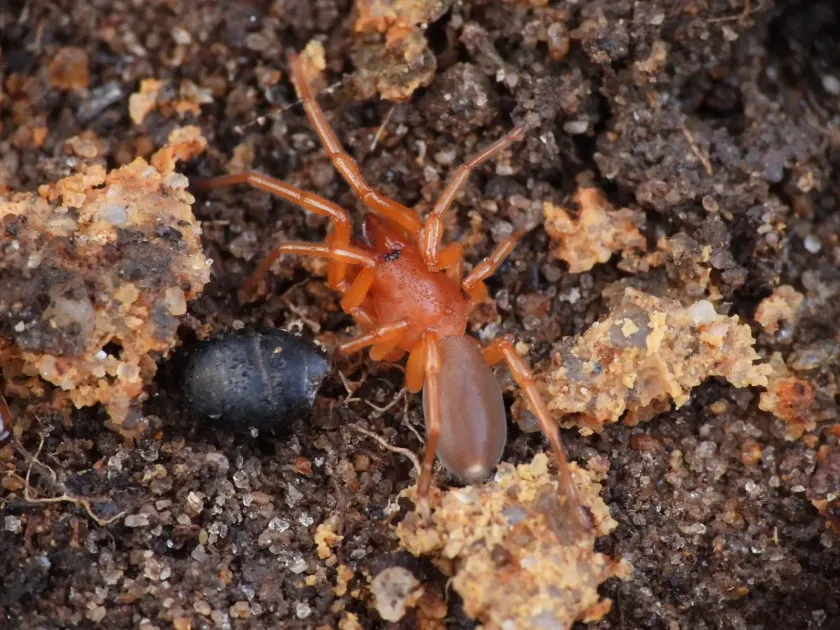
The woodlouse spider (Dysdera) belongs to the family Dysderidae. These spiders are easily recognized by their distinct reddish-brown or bright red appearance, particularly on the cephalothorax.
The most defining characteristic of the Dysdera genus is their pair of disproportionately large, forward-projecting chelicerae. These specialized mouthparts are designed to pierce the tough exoskeleton of woodlice.
These spiders are nocturnal hunters. Unlike web-spinning species, they actively patrol the ground, leaf litter, and sheltered areas, searching for their specific prey.
Adult spiders usually measure between 9 and 15 mm. While their appearance might seem intimidating to gardeners, they are harmless to plants and possess no mechanisms to damage vegetative structures.
Identifying them is simple: if you see a reddish spider with prominent jaws under a rock or a woodpile, you have found a beneficial hunter that helps maintain ecological balance.
What it damages
Dysdera spiders are not agricultural pests. They do not feed on plant tissues, sap, roots, or fruits. Consequently, they do not cause any economic damage to crops or ornamental plants.
Their diet consists almost exclusively of woodlice (Isopoda). By preying on these organisms, they act as natural biological control agents in gardens and greenhouses.
There is no record of Dysdera causing lesions, foliage loss, or developmental issues in crops. They do not exhibit any behavior that could be classified as injurious to agriculture.
The presence of these spiders is a sign of a biodiverse and healthy soil environment. They help regulate the population of detritivores, preventing their overabundance.
As a gardener, you do not need to worry about the damage potential of these spiders, as they are strictly non-phytophagous predators.
When it appears
Woodlouse spiders are most active during the warmer months of the year, from spring through early autumn. During these seasons, their prey (woodlice) is also highly mobile.
In winter, they typically seek refuge in deep soil layers, under dense leaf litter, or in protected crevices where the temperature remains stable.
In protected greenhouse environments, their activity can be year-round, provided that moisture levels are sufficient to keep their prey active within the structure.
Their activity patterns are closely linked to humidity. They thrive in damp, dark environments where they can easily find their prey and avoid desiccation.
During periods of severe drought, these spiders become less active on the surface and retreat into more humid microhabitats underground.
Signs of infestation
There are no symptoms of "infestation" or damage associated with Dysdera spiders. If your plants are unhealthy, the cause is never these spiders.
Visual identification of the spider itself in moist, sheltered areas is the only "sign" of their presence. They are solitary creatures that rarely aggregate in large numbers.
Because they do not feed on plants, you will not find any characteristic bites, wilting, or necrotic spots that would indicate a pest attack.
Observing a Dysdera spider in the garden is a positive indicator that the local ecosystem contains sufficient prey for beneficial predators, suggesting a balanced environment.
Focus your monitoring efforts on actual pests, such as aphids, mites, or caterpillars, as Dysdera is an ally, not a threat, to your agricultural efforts.
Control measures
No control measures are necessary for Dysdera. They are beneficial predatory spiders that perform a service to the gardener by managing woodlouse populations.
If the presence of these spiders is undesirable for aesthetic or personal comfort reasons, simply reducing moist debris, such as piles of wood or damp leaf litter, will encourage them to relocate.
Do not use pesticides or insecticides against these spiders. Applying chemicals disrupts the natural balance and may harm other beneficial insects, potentially leading to actual pest outbreaks.
Incorporating Dysdera into your integrated pest management (IPM) plan is a wise choice, as they contribute to natural, chemical-free pest control.
Prioritize conservation of these predators. A healthy garden relies on diverse species interacting to maintain order, and the woodlouse spider is an essential part of that order.
Taxonomy
- Latin name
- Dysdera
- Family
- Dysderidae
- EPPO code
- DYDRSP
Discussion
No discussions yet — be the first.