
Smooth bark beetle
Dryocoetiops laevis
Description
How to identify
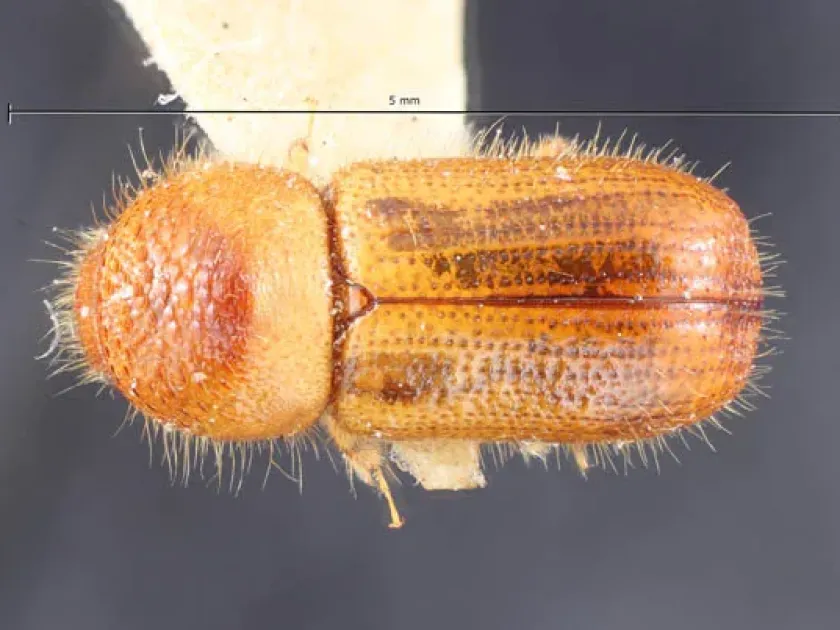
The smooth bark beetle (Dryocoetiops laevis) is a small beetle belonging to the family Curculionidae, subfamily Scolytinae. Adult specimens have a cylindrical body measuring 2 to 2.5 mm in length and are dark brown to black in color.
The surface of the elytra is smooth and shiny, which is reflected in its specific name. The head is partially retracted into the pronotum, and the antennae are club-shaped, which are key morphological features for this species.
The larvae are legless, white with a yellowish head. They live a cryptic lifestyle beneath the bark, excavating specific galleries within the bast layer.
Distinguishing this species from others requires close inspection of the maternal gallery structure, which is typically longitudinal, and the configuration of the pupal chamber.
Accurate identification often requires microscopic examination of the elytral declivity, where tooth-like structures common to many bark beetles are located.
What it damages
This pest prefers coniferous tree species, particularly Norway spruce and fir, as its primary host. It may occasionally infest other conifers that are stressed by environmental conditions.
It poses the greatest threat to weakened or physically damaged trees. In healthy forest stands, populations generally remain in equilibrium with the environment.
Larvae feed on the inner bark layers, damaging the cambium and phloem. This disrupts the transport of nutrients and water within the tree.
During mass outbreaks, this pest can cause rapid wilting and death of individual trees, which negatively impacts forestry productivity.
It most frequently colonizes the lower part of the trunk near the root collar, making it particularly dangerous to the tree's overall vitality.
When it appears
Adult flight begins in the spring when average daily temperatures reach +15...+18 degrees Celsius. Mass colonization of trees usually occurs in May and June.
Depending on regional climatic conditions and the duration of the warm season, the pest may produce one or two generations per year.
Adults primarily overwinter by hiding in leaf litter or beneath the bark of the lower trunk, where they can survive harsh winter temperatures.
The latter half of the summer is characterized by supplemental feeding of young beetles as they prepare for the upcoming winter dormancy.
Adult activity is closely related to sunlight exposure; therefore, activity is lower within dense forest stands compared to forest edges.
Signs of infestation
The primary sign of infestation is the presence of tiny entry holes (bore dust) on the bark, which often accumulate in crevices.
Removing a section of the bark reveals characteristic galleries that penetrate deep into the sapwood, forming a complex network of channels.
Visually, the canopy of an infested tree begins to change color, with needles turning yellow or reddish as nutrient delivery is disrupted.
Needle drop and bark discoloration are late-stage signs indicating that the tree is nearly dead and the beetle colony has expanded significantly.
- Small holes in the bark.
- Presence of bore dust at the trunk base.
- Gradual wilting of the canopy.
- Bark detachment around gallery areas.
Control measures
The primary management strategy is the sanitary logging of infested trees before young beetles emerge, which effectively disrupts the life cycle.
Proper forest management, including the timely removal of logging slash, is essential to eliminate ideal breeding grounds for the pest during spring.
Pheromone traps are used to monitor population levels and capture adults during peak flight periods.
Preventive measures include improving overall stand resilience through silvicultural practices and maintaining biological balance.
Chemical control is rarely used in forest settings and is restricted to contact insecticides applied only when the risk of infestation outbreak is extremely high.
Taxonomy
- Latin name
- Dryocoetiops laevis
- Order
- Coleoptera (beetles)
- Family
- Curculionidae
- EPPO code
- DRYTLA
Discussion
No discussions yet — be the first.