
Hairy bark beetle
Dryocoetes villosus
Description
How to identify
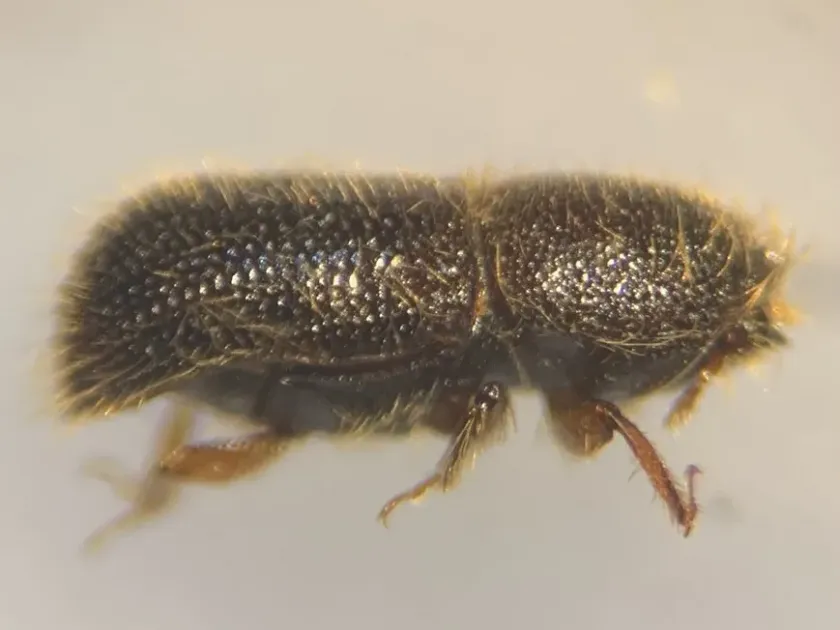
The Hairy bark beetle, known scientifically as Dryocoetes villosus, belongs to the family Curculionidae and the subfamily Scolytinae. These beetles are small, typically measuring 2.5 to 3.5 mm in length.
The body is cylindrical and dark brown or black in color. A defining characteristic of the species is the dense covering of light-colored, erect hairs across its elytra and pronotum, giving it a fuzzy appearance.
Like other bark beetles, the larvae are legless, C-shaped, and white with a hardened, brown head capsule. They spend their entire developmental period beneath the bark, hidden from external predators.
The pupae are also white, undergoing metamorphosis within specialized chambers in the inner bark or cambium layer before emerging as adults to infest new trees or continue the cycle.
The species is well-adapted to environments where bark moisture is sufficient to support larval feeding. Identification is confirmed by the specific hairiness and gallery patterns beneath the bark.
What it damages
The primary hosts of this beetle include various broad-leaved trees such as oaks (Quercus), beeches (Fagus), birches (Betula), and sometimes hornbeams. They often target weakened or stressed trees.
Damage is caused by the adults and larvae tunneling through the cambium layer. These galleries disrupt the flow of nutrients and water, essentially girdling the tree if the infestation is severe enough.
Mass infestations can quickly kill weakened trees. Furthermore, the tunneling activity creates entry points for various pathogenic fungi, which often cause secondary rot and accelerate the tree's decline.
In high-density populations, these beetles may attack healthy trees that are temporarily stressed, such as those suffering from drought or soil compaction, leading to significant dieback.
Visual damage often manifests as canopy thinning, leaf yellowing, and eventual crown death as the beetle galleries effectively disconnect the tree's vascular system.
When it appears
Adult flight typically begins in spring, usually in April or May, once temperatures are consistently high enough to trigger the emergence of overwintered beetles from their brood galleries.
The species may complete one or two generations per year depending on the local climate and temperature. Peak activity is most commonly observed during the warm summer months of June and July.
Overwintering occurs primarily at the adult stage, often deep within the bark of host trees or in sheltered locations within the leaf litter, ensuring survival through harsh winter conditions.
Warm, extended summers provide optimal conditions for rapid development, often resulting in larger population spikes. Dry conditions that weaken host trees also make them more vulnerable.
Monitoring for the start of the season is crucial for successful management. Early detection via pheromone traps or systematic inspection of bark health can prevent major outbreaks.
Signs of infestation
The most prominent sign of an infestation is the presence of small, round exit and entry holes, about 1–1.5 mm in diameter, found on the tree's trunk or larger branches.
Bore dust, or frass, is often found accumulating around these entry holes. The color of this dust typically matches the color of the bark or the inner woody tissue being consumed.
Removing a small section of bark reveals intricate gallery patterns. These galleries are specific to the species and indicate the duration and intensity of the current infestation.
Affected trees may show premature leaf drop, wilting, or foliage discoloration (chlorosis), which serves as an external indicator of internal vascular disruption caused by the beetle.
In later stages, loose or sloughing bark is common. Underneath, one may find adult beetles, larvae, and pupae in their respective chambers, confirming a multi-generational infestation.
Control measures
Sanitation is the most effective management strategy. This involves the prompt removal and disposal of infested, dying, or windthrown trees to reduce the breeding population.
Removing logging residue and fallen timber is essential, as these materials act as primary breeding grounds for the Hairy bark beetle, allowing its population to expand rapidly.
Chemical control using systemic or contact insecticides can be employed to protect valuable individual trees, provided they are applied during the peak flight period and follow label requirements.
Trap trees (felled logs placed strategically) can be used to attract adult beetles. Once infested, these logs are removed and destroyed to eliminate the beetles before they complete their life cycle.
- Maintaining tree vigor through proper watering and soil management.
- Using pheromone-based traps to monitor and reduce beetle numbers.
- Regular inspections of vulnerable tree stands to identify early signs of attack.
Taxonomy
- Latin name
- Dryocoetes villosus
- Order
- Coleoptera (beetles)
- Family
- Curculionidae
- EPPO code
- DRYOVI
Discussion
No discussions yet — be the first.