
Western balsam bark beetle
Dryocoetes confusus
Description
How to identify
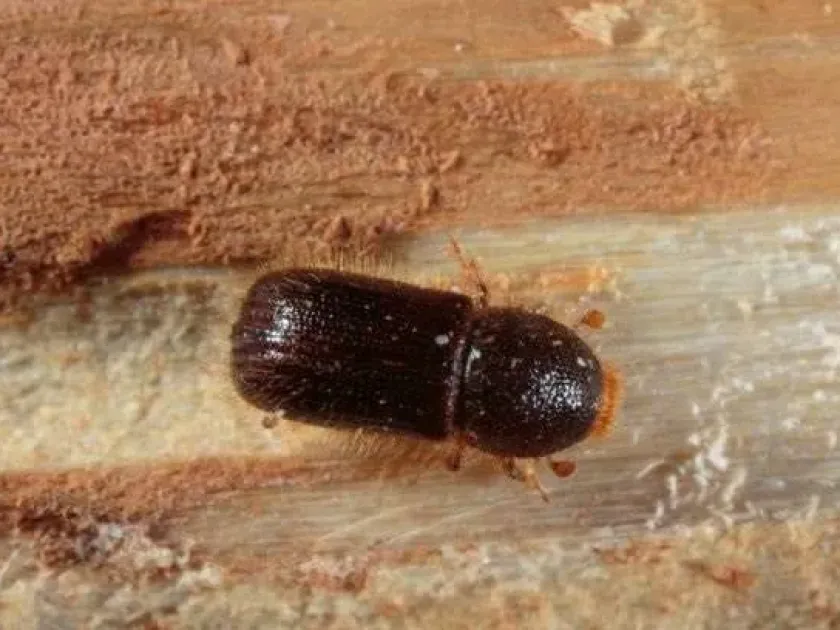
The Western balsam bark beetle (Dryocoetes confusus) is a small wood-boring insect belonging to the family Curculionidae, subfamily Scolytinae. Adult beetles are typically 3 to 4 mm long and exhibit a cylindrical, robust body shape.
The beetle’s coloration ranges from reddish-brown to dark brown or nearly black. Its hard exoskeleton protects it while navigating the narrow spaces between the inner bark and the tree's wood, which is its primary habitat throughout the larval and adult stages.
The larvae are legless, white or creamy-yellow grubs with a distinct brown head capsule. They feed under the bark, carving intricate patterns that disrupt the transport of nutrients within the tree.
Identification is often performed by entomologists through microscopic analysis of the pronotum and elytra. The beetle is well-adapted to high-altitude environments where subalpine fir trees reside.
Understanding their life cycle is crucial, as they can cause significant ecological shifts in forests. The beetle is a persistent resident of mature conifer stands, particularly those already suffering from environmental stress.
What it damages
The primary host for Dryocoetes confusus is the subalpine fir (Abies lasiocarpa). The damage caused by these insects is often lethal to the tree because they target the cambium layer, where the vital phloem tissue is located.
By consuming the phloem, the beetles and their larvae sever the tree's internal pipeline. This prevents water and nutrients from moving from the roots to the branches, eventually causing the entire canopy to wither and die.
In forest ecosystems, these beetles are known for causing extensive tree mortality. Unlike some other bark beetles, they can successfully attack and kill individual trees even at relatively low population densities, creating small gaps in the forest canopy.
The cumulative damage often invites secondary pathogens, such as root rot fungi, which further weaken the stand. This cycle of attack and decay is a natural, albeit destructive, process in high-altitude fir ecosystems.
Economic losses in timber-producing regions are significant. Infested timber suffers from reduced structural integrity and aesthetic degradation, rendering it less suitable for construction or industrial use.
When it appears
The activity of the Western balsam bark beetle is heavily influenced by seasonal temperature cycles. Adult flight and dispersal typically occur during the warmer months, often peaking in early to mid-summer.
During the warmer season, the females seek out suitable hosts, bore through the bark, and begin laying eggs in galleries. The larvae then spend the remainder of the growing season feeding within the tree.
The species is known for its ability to overwinter in various stages of development, including larval and adult stages. They remain protected under the bark, which provides a thermal buffer against harsh winter conditions.
As spring approaches, the emergence of a new generation depends on the accumulated thermal units of the environment. Monitoring these cycles allows forest managers to time their mitigation efforts effectively.
The seasonal progression is monitored via pheromone lures that mimic the chemical signals used by the beetles to find mates and colonize new host trees, providing data on population fluctuations.
Signs of infestation
The most visible sign of an infestation is the discoloration of the tree foliage. The needles transition from a healthy green to a yellow, then deep red-brown as the tree loses its ability to circulate water.
Frass, or boring dust, is a common indicator. It consists of fine wood particles and insect excrement pushed out of the entry holes. This dust is often found in crevices of the bark or near the base of the trunk.
Pitch tubes, which are small masses of resin, may appear on the bark where the beetles have initiated an attack. This is the tree's attempt to expel the invader using its natural defense mechanism.
When the bark is carefully peeled away from infested trees, the characteristic gallery patterns are clearly visible. These engravings into the sapwood confirm the presence of the bark beetle.
Increased woodpecker activity on a specific tree is a telltale sign. Woodpeckers are effective predators that sense the presence of larvae underneath the bark, indicating that the tree is heavily infested.
Control measures
Sanitation harvest is the primary method for controlling Dryocoetes confusus populations. Promptly identifying and removing infested trees helps to limit the number of beetles that emerge to attack neighboring healthy trees.
Pheromone-baited traps are an effective tool for both population monitoring and localized suppression. By mass-trapping adults during the flight season, foresters can reduce the pressure on high-value stands.
Improving general forest vigor is an essential preventative measure. Reducing stand density through thinning ensures that trees have sufficient resources to remain resilient against beetle attacks.
In high-value ornamental or park settings, systemic insecticides can be applied as a trunk spray or root drench to protect vulnerable fir trees from colonization.
- Regular forest health surveys to detect early outbreaks.
- Deployment of trap trees to attract and later dispose of populations.
- Encouraging natural predators such as woodpeckers and parasitic wasps.
Taxonomy
- Latin name
- Dryocoetes confusus
- Order
- Coleoptera (beetles)
- Family
- Curculionidae
- EPPO code
- DRYOCN
Discussion
No discussions yet — be the first.