
Coffee bark beetle
Dryocoetes coffeae
Description
How to identify
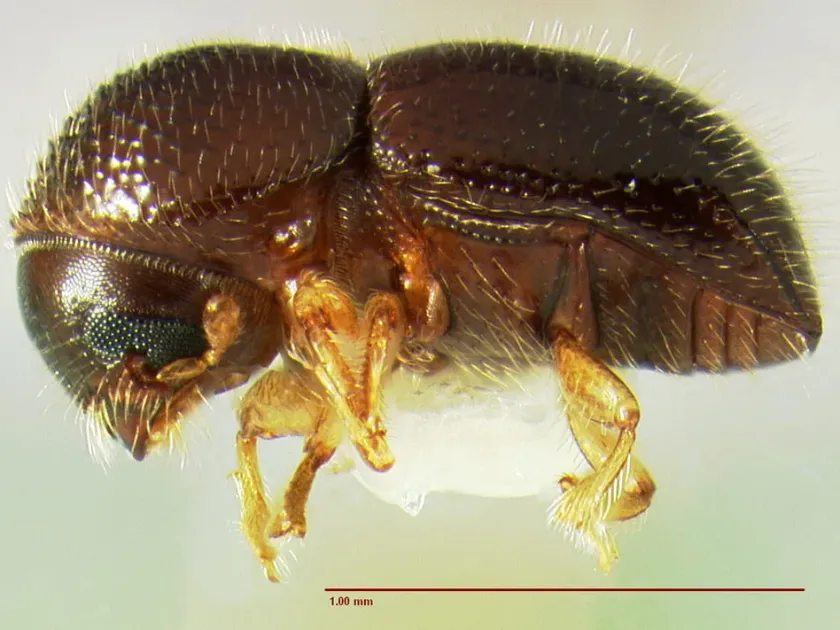
The coffee bark beetle (Latin Dryocoetes coffeae) is a small insect from the order Coleoptera, belonging to the family Curculionidae (subfamily Scolytinae). An adult specimen has a cylindrical body about 2–3 mm long, colored in brown or dark-brown shades.
The beetle's body is covered with fine setae, which is typical for many members of the tribe Dryocoetini. The head is partially hidden by the pronotum, which is an important diagnostic feature for species identification under a microscope.
The larvae are legless, white or cream-colored, with a distinct dark head capsule. They lead a concealed lifestyle inside plant tissues, making them difficult to detect during the early stages of infestation.
Males and females show morphological differences in the structure of the pronotum and abdomen, although in field conditions, it is practically impossible to distinguish them visually without specialized equipment.
The life cycle of the coffee bark beetle is closely linked to the condition of the coffee tree wood, where the insect finds both shelter and a primary food source for creating its galleries.
What it damages
The primary host is the coffee tree (Coffea arabica and other species). The pest prefers stressed or weakened plants, although it can infest relatively healthy trees when the population density is high.
Insects penetrate under the bark of branches and trunks, where they construct complex systems of galleries, disrupting the plant's sap flow. This leads to gradual weakening of the tree and reduced yields.
In the entry points, secondary fungal infections often develop, as the bark beetle's galleries serve as ideal entry points for pathogens to penetrate wood tissues.
In case of severe infestation, premature leaf drop and dieback of individual branches are observed, which, without proper control measures, can lead to the complete death of productive trees.
Damage is also reflected in the quality of the coffee beans, as the overall health of the plant directly affects fruit development and the accumulation of essential aromatic compounds.
Signs of infestation
The first sign of the pest's presence is the appearance of small entry holes on the bark surface, often accompanied by the expulsion of wood dust or resin.
Upon visual inspection, one can notice yellowing and wilting of individual branches, which signals a disruption of the vascular system due to larval activity under the bark.
If the outer layer of bark is removed in the affected area, winding galleries created by larvae feeding in the cambium layer become visible.
A characteristic sign is the accumulation of fine sawdust near the base of the trunk, which insects eject while expanding their internal galleries.
In neglected cases, affected bark areas may die, crack, and peel off, exposing deep damage to the wood, making the tree extremely vulnerable to secondary pests.
Control measures
The primary control method is an agrotechnical approach: regular pruning and destruction of affected, dry, or diseased branches where beetles hibernate.
It is important to maintain optimal nutrient and moisture levels in coffee plantations, as healthy and vigorous trees have higher resistance to bark beetle colonization.
The use of pheromone traps helps monitor pest population dynamics, allowing for timely chemical treatment only during peak insect activity periods.
Chemical protection involves spraying systemic or contact insecticides during the adult flight period, which requires strict adherence to pesticide application regulations.
Biological control methods involve the use of natural natural enemies or entomopathogenic fungi, which can limit the beetle population without harming the environment.
Taxonomy
- Latin name
- Dryocoetes coffeae
- Order
- Coleoptera (beetles)
- Family
- Curculionidae
- EPPO code
- DRYOCF
Discussion
No discussions yet — be the first.