
Spruce bark beetle
Dryocoetes autographus
Description
How to identify
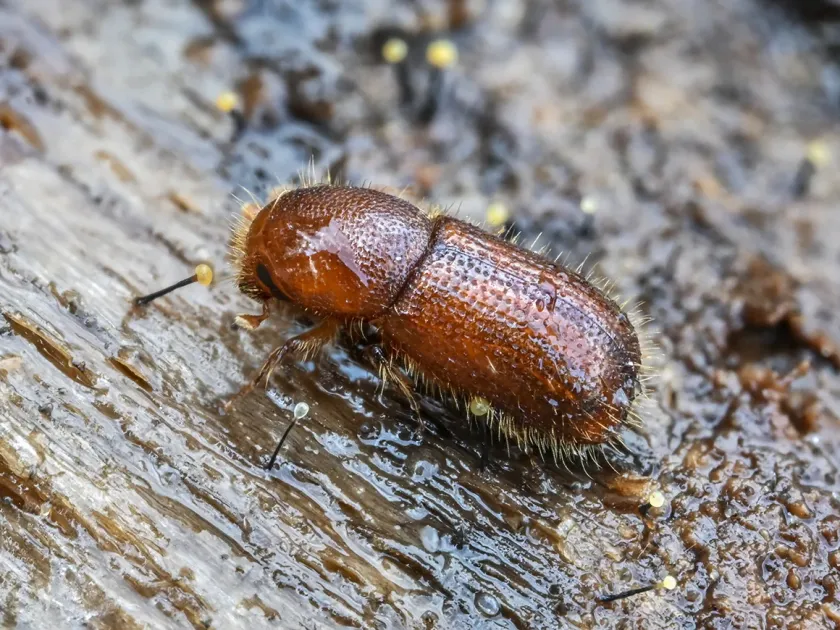
The spruce bark beetle (scientific name Dryocoetes autographus) is a member of the Curculionidae family, subfamily Scolytinae. These beetles are small, measuring about 3.5 to 4.5 mm in length, with a dark brown to black cylindrical body.
The insect is distinguished by its dull, hairy elytra, which lack prominent teeth at the posterior declivity. This structural feature is a key indicator for identification.
Adult beetles are highly mobile and use sensitive olfactory receptors to locate stressed or fallen coniferous trees suitable for breeding.
The larvae are legless, white grubs with a yellowish head capsule that feed within the inner bark, effectively creating complex gallery systems that interrupt sap flow.
The species usually completes one generation per year, although favorable climatic conditions in warmer regions can lead to multiple generations within a single season.
What it damages
The primary hosts for this beetle are various spruce species, although it also attacks pines, firs, and larches, particularly those weakened by environmental stress.
Feeding occurs in the phloem and cambium layers of the trunk. By constructing extensive larval galleries, the beetles girdle the tree, preventing nutrient transport.
When populations reach outbreak levels, the beetle can colonize seemingly healthy trees, leading to rapid crown decline and tree mortality within a short period.
The economic impact includes significant timber degradation, loss of canopy cover, and increased forest fire risks due to the presence of dead, dry material.
Furthermore, the beetles act as vectors for various pathogenic fungi, which further weaken the host and accelerate the decay of the wood.
When it appears
The emergence of overwintering adults typically occurs in early spring, generally when daily temperatures consistently exceed 12–15 degrees Celsius.
Active colonization of new hosts reaches its peak during the late spring and early summer months, coinciding with the mating period.
Larval development continues throughout the summer, while the new generation of adults usually emerges to move into hibernation sites by late autumn.
Hibernation sites are typically found in the forest litter near the base of the tree or within the thick bark of the lower trunk of host trees.
Periods of extreme drought or excessive heat tend to shorten the life cycle and increase the success rate of beetle reproduction in forest stands.
Signs of infestation
The presence of fine, reddish-brown boring dust (frass) gathered around the base of the trunk or in bark crevices is the most reliable early sign of infestation.
Small entry holes on the bark surface indicate that adult beetles have successfully entered the tree to begin gallery construction.
A gradual fading of the tree canopy, shifting from green to yellowish-green and finally reddish-brown, indicates that the tree is already severely compromised.
Increased woodpecker activity on specific trunks often indicates a high concentration of larvae under the bark, as the birds actively hunt these insects.
Peeling back sections of the bark reveals the characteristic gallery patterns, which are often branched and irregular, reflecting the species' name.
Control measures
The most effective management strategy involves proactive forest hygiene, including the prompt removal and disposal of infested and fallen trees.
Logging operations should prioritize the clearance of harvest residues, which provide ideal breeding conditions for the beetle population.
Pheromone-baited traps are widely used for population monitoring and to reduce the pressure of adult beetles on healthy forest stands.
Encouraging natural biological controls, such as predatory beetles and insectivorous birds, is crucial for maintaining a long-term ecological balance.
In high-risk areas, chemical treatment of logs or preventive spraying of susceptible trunks with authorized insecticides may be considered during the peak flight period.
Taxonomy
- Latin name
- Dryocoetes autographus
- Order
- Coleoptera (beetles)
- Family
- Curculionidae
- EPPO code
- DRYOAU
Discussion
No discussions yet — be the first.