
Spruce bast beetle
Dryocoetes affaber
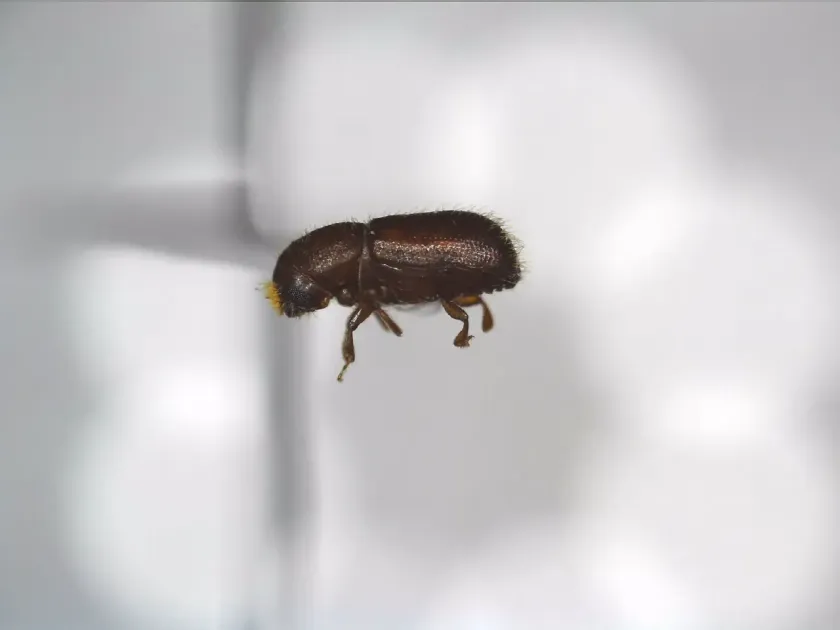
Description
How to identify
The spruce bast beetle, Dryocoetes affaber, is a small insect belonging to the family Curculionidae, subfamily Scolytinae. It is a known pest that targets coniferous trees, particularly spruce.
Adult beetles are typically 2-3 mm long, featuring a cylindrical, dark brown or black body. Their surface is covered with dense, fine hairs which serve as a diagnostic feature for experts.
The head of the beetle is partially concealed beneath the pronotum. Larvae are legless, white grubs with a distinct yellowish head capsule, adapted to life under the bark.
This species is widely distributed across temperate coniferous forests, often thriving in environments where host trees are already stressed by environmental factors.
Taxonomically, it is classified within the diverse group of bark beetles, known for their specific galleries carved into the cambium and phloem of host trees.
What it damages
The beetle primarily damages spruce trees, though it may also infest fir and pine under favorable conditions. Both adults and larvae contribute to the destruction of the tree's vascular system.
By boring into the phloem and cambium, the beetles disrupt the flow of nutrients and water, which ultimately leads to the decline and death of the affected plant tissue.
Heavy infestations can lead to girdling of the stem, effectively cutting off the crown from the root system, which causes rapid yellowing and death of the needles.
Furthermore, the beetles act as vectors for various pathogenic fungi, which introduce wood rot, significantly reducing the quality and economic value of the timber.
While often considered a secondary pest, it can become aggressive when the population density is high, attacking trees that appear healthy to the casual observer.
When it appears
Adult activity typically begins in late spring, as temperatures rise, triggering the search for suitable host trees for mating and egg deposition.
The life cycle involves the female boring through the bark to construct egg galleries. The developmental stages from egg to adult occur within the protected environment under the bark.
Depending on local climatic conditions, the spruce bast beetle may produce one or two generations per year, significantly impacting the growth rate of the pest population.
Peak development of the larvae occurs during the warmer summer months, facilitating rapid progression through the life stages before winter dormancy begins.
Overwintering usually occurs in the adult or larval stage, often within the bark of the host tree or in the leaf litter near the base of the tree.
Signs of infestation
The most evident sign of an infestation is the presence of small, round entrance holes on the bark surface, accompanied by fine, wood-colored boring dust (frass).
As the infestation progresses, the crown of the tree may show signs of discoloration, turning from green to yellow and finally to a reddish-brown as the tree dies.
Resin flow or "pitch tubes" may be visible on the outer bark, representing the tree's attempt to repel the attackers, though this is often unsuccessful against heavy attacks.
Loosened or sloughing bark is another diagnostic sign, exposing the intricate network of larval galleries underneath the outer layer of the stem.
- Entrance holes on the bark.
- Boring dust at the tree base.
- Needle discoloration and drop.
- Resin exudation on the bark.
- Visible gallery patterns under the bark.
Control measures
The primary control strategy involves the sanitation of the forest area, specifically the prompt removal and destruction of infested or recently felled trees.
Pheromone traps are highly effective for monitoring population trends and can be used to mass-trap adult beetles during their peak flight periods.
Preventative measures include maintaining tree vigor through adequate watering and avoiding mechanical damage, which can make trees more attractive to invading beetles.
In ornamental settings, chemical control via professional application of systemic or contact insecticides can protect high-value specimens during the risk season.
Effective management requires ongoing surveillance to detect early signs of infestation, ensuring that affected trees are dealt with before the next beetle generation emerges.
Taxonomy
- Latin name
- Dryocoetes affaber
- Order
- Coleoptera (beetles)
- Family
- Curculionidae
- EPPO code
- DRYOAF
Discussion
No discussions yet — be the first.