
Dryocoetes
Dryocoetes
Description
How to identify
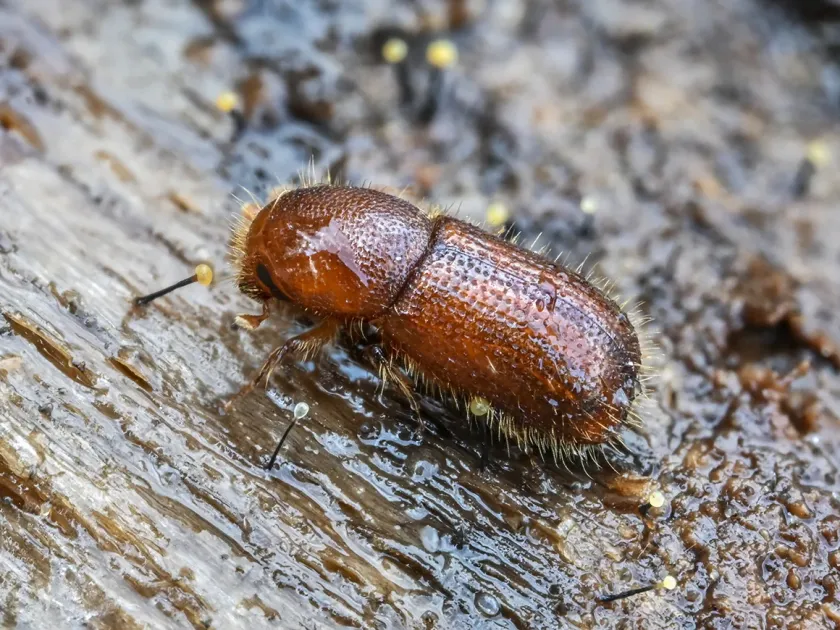
Dryocoetes is a genus of bark beetles belonging to the subfamily Scolytinae (Curculionidae family). These are small beetles, typically 2–5 mm in length, characterized by a cylindrical body that is dark brown or black, often covered with fine hairs.
A distinctive feature of this genus is the shape of the antennal club and the structure of the pronotum, which is usually rounded. The beetle's head is almost completely hidden from above by the pronotum, a common trait among these stem-boring pests.
The larvae are legless, white-bodied with a sclerotized head, and have a curved shape. They develop beneath the bark, feeding on the cambium layer and leading a concealed life throughout their entire growth period.
Sexual dimorphism in Dryocoetes is subtle, though experts can distinguish individuals by the shape of the frons and the number of teeth on the elytral declivity. Proper species identification often requires the use of a stereomicroscope.
The insect's development is closely linked to the physiological health of the host tree. Under favorable conditions, the population can grow rapidly, infesting weakened sections of the forest stand.
What it damages
The primary hosts for Dryocoetes are coniferous tree species, particularly spruce, fir, and occasionally pine and cedar. The pest preferentially selects weakened, dying, or recently fallen trees, but can infest relatively healthy specimens during high-density outbreaks.
The beetles construct maternal galleries within the phloem and cambium, disrupting the transport of nutrients. This causes the gradual wilting of individual branches or the entire tree, significantly reducing wood quality.
Beyond direct feeding damage, Dryocoetes often act as vectors for blue-stain and pathogenic fungi. These microorganisms enter the tree through the beetle tunnels, accelerating wood decay and tree mortality.
Economic losses are most severe in industrial forests and nurseries. Massive outbreaks can result in large-scale mortality of spruce forests, leading to significant timber value depreciation.
In ornamental and urban landscapes, Dryocoetes poses a threat to valuable coniferous plantings, compromising their aesthetic value and shortening the lifespan of these trees.
When it appears
The flight period of adult Dryocoetes typically begins in spring when air temperatures remain consistently above 15–18 degrees Celsius. The exact timing of activity depends on the climatic zone and the warming of the tree bark.
After emergence, the beetles search for a suitable substrate for colonization. Males are the first to bore under the bark, constructing nuptial chambers and attracting females using pheromones.
The development of a single generation can take one to two years, depending on regional temperatures. In northern latitudes, the life cycle is often extended, whereas, in southern regions, two generations per season may be possible.
The insects predominantly overwinter as adults within the bark or in the leaf litter at the base of the tree. As autumn temperatures drop, their metabolism slows, and they enter a state of diapause.
Shorter daylight hours and cooling autumn weather serve as biological cues for the insects to complete active feeding and prepare for winter dormancy under the protection of the bark.
Signs of infestation
The primary visual indicator of Dryocoetes infestation is the presence of "boring dust" (frass) — fine wood particles accumulating in bark crevices or at the base of the trunk. The color of the frass varies based on the depth of the boring.
Entry holes, which appear as small, neat circular openings, are visible on the bark surface. Upon inspection, resinous weeping may be observed if the tree is attempting to "pitch out" the invading beetles.
Removing a section of the bark reveals the characteristic gallery system. The maternal gallery is usually longitudinal, with larval galleries branching off to the sides, gradually widening as the larvae mature.
Yellowing or browning of the needles indicates the tree is in the final stages of infestation. By this time, many beetles may have already departed the trunk, leaving behind exit holes.
- Accumulation of fine boring dust.
- Resin flow at entry points.
- Distinct gallery patterns under the bark.
- Premature yellowing or browning of foliage.
Control measures
The primary management strategy for Dryocoetes is timely sanitary logging of infested trees before the next generation of beetles emerges. This prevents the spread of the pest to healthy forest stands.
Forest pathology monitoring is crucial and includes the use of pheromone traps. These tools help detect pest presence at early stages and provide data for population density control.
Chemical control with systemic insecticides is effective only in ornamental landscapes and nurseries. Applications involve trunk spraying during the onset of the adult flight period.
Biological control methods focus on supporting natural enemies such as woodpeckers, ants, and parasitic wasps. Additionally, biopesticides based on entomopathogenic fungi are utilized for suppression.
Strict adherence to forest management regulations and the prompt removal of logging debris eliminate breeding sites, making forest stands significantly more resilient to colonization.
Taxonomy
- Latin name
- Dryocoetes
- Order
- Coleoptera (beetles)
- Family
- Curculionidae
- EPPO code
- DRYOSP
Discussion
No discussions yet — be the first.