
Drilus flavescens
Drilus flavescens
Description
How to identify
Drilus flavescens is a member of the Drilidae family within the order Coleoptera, known for its distinct sexual dimorphism.
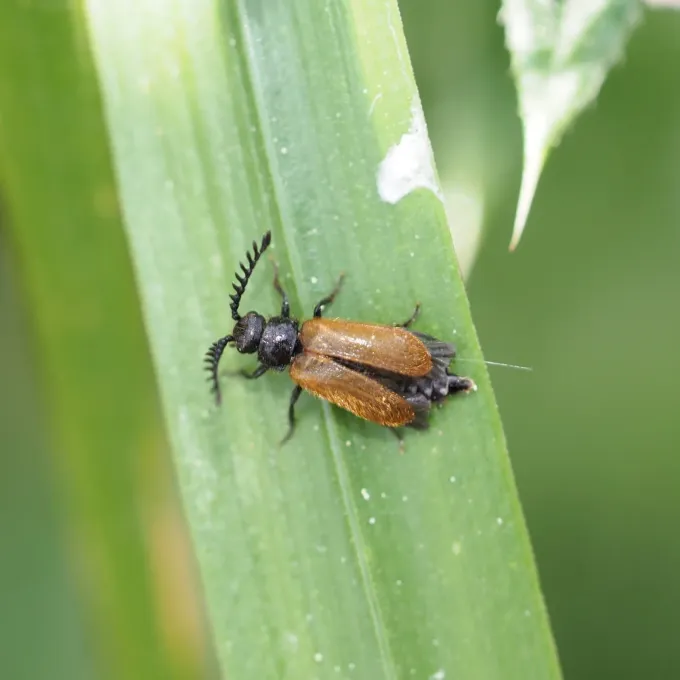
The adult males are winged, capable of flight, and measure approximately 10–12 mm in length with a yellowish or brownish appearance.
Females are neotenic, appearing worm-like and wingless, and spend most of their lives hidden within soil or leaf litter.
The larvae are specialized predators, uniquely adapted to hunt and consume land-based mollusks such as snails and slugs.
Identification is most frequently made during soil sampling or when inspecting the microhabitats where their prey species reside.
What it damages
This insect does not cause damage to agricultural crops as it is strictly a predatory species throughout its larval development.
Instead, Drilus flavescens acts as a beneficial entomophage by naturally reducing populations of slugs and snails that damage garden plants.
By preying on these harmful mollusks, the beetle performs a valuable ecosystem service, assisting in the management of pest populations.
There is no record of this species consuming plant tissues, nectar, or pollen, making it entirely harmless to crops and horticultural plants.
Its presence in an orchard or vegetable garden is considered a positive indicator of a healthy, biodiverse environment.
When it appears
The mating season for Drilus flavescens typically occurs in late spring, when winged males emerge to search for the sedentary females.
Larvae are active throughout the growing season, tracking their prey across the soil surface and under protective plant debris.
Winter is spent in the larval stage, deep within the soil profile, providing protection from freezing temperatures and environmental stress.
Increased humidity and rising spring temperatures stimulate both the activity of the larvae and the emergence of their snail prey.
The seasonal activity patterns of this beetle are closely synchronized with the life cycles of the mollusks they target for food.
Signs of infestation
The primary indication of a Drilus flavescens population is the presence of empty snail shells scattered near the bases of plants.
Observing larvae near clusters of snails during gardening activities or soil cultivation is a clear sign of their establishment.
A noticeable decrease in slug-related leaf damage in a garden where these beetles are present suggests active biological control.
Spotting adult males during their short mating flights in early summer confirms the presence of an active breeding population.
Gardeners can monitor for their presence by checking under damp materials or piles of organic matter where snails tend to congregate.
Control measures
As a beneficial predator, Drilus flavescens requires protection rather than control measures, as it does not constitute a threat to agriculture.
Avoiding the indiscriminate use of soil insecticides is crucial to maintaining a healthy population of this natural pest regulator.
Adopting sustainable agricultural practices, such as minimal tillage and the retention of organic mulch, supports the habitat of these beetles.
If mollusk populations are problematic, biological solutions should be prioritized over chemical ones to preserve the integrity of local predators.
Promoting a diversified garden environment ensures that Drilus flavescens remains a permanent and effective component of the integrated pest management strategy.
Taxonomy
- Latin name
- Drilus flavescens
- Order
- Coleoptera (beetles)
- Family
- Drilidae
- EPPO code
- DRILFL
Discussion
No discussions yet — be the first.