
Drepanothrips
Drepanothrips
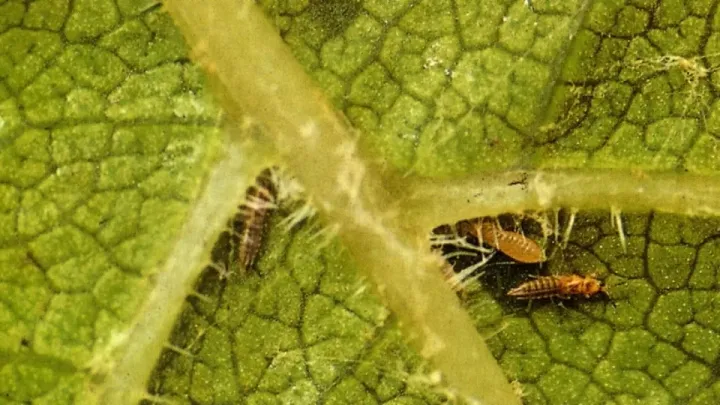
Description
How to identify
Drepanothrips (specifically Drepanothrips reuteri) is a small insect belonging to the order Thysanoptera and the family Thripidae. These pests are typically less than 1 mm in length, making them difficult to spot with the naked eye.
The adult form is yellowish-brown, which helps it camouflage against the surface of leaves, while larvae are much paler and more transparent, often remaining on the underside of foliage.
The life cycle encompasses several stages: egg, larva, protonymph, nymph, and adult. They survive the winter by hibernating as adults under the bark of grapevines or in plant debris on the ground.
Reproduction is highly dependent on temperature, with multiple generations developing throughout the growing season if conditions remain favorable.
Field identification usually requires a magnifying lens, focusing on the undersides of young leaves or using sticky traps placed strategically near the grapevine canopy.
What it damages
The primary host for this pest is the grapevine. Drepanothrips feeds by piercing plant tissues and extracting sap, which negatively impacts the vine's physiological functions.
Damage is most severe on young shoots, expanding leaves, and inflorescences. This leads to stunted growth and, in serious cases, a significant reduction in fruit set and yield quality.
The toxic saliva injected by the thrips during feeding can cause long-term deformation of leaves and shoots, weakening the overall plant structure.
Infestation in nurseries can be particularly devastating, as the weakened growth of saplings often leads to higher mortality rates or poor development of the root system.
Beyond grapevines, these insects may occasionally occupy nearby weed species, which act as a reservoir for the population when favorable hosts are not readily available.
Signs of infestation
Initial symptoms include leaf curling, yellowing, and the hardening of the leaf margins. This is often accompanied by a silvery discoloration on the underside of the leaves.
Distorted shoot growth is a common indicator, where internodes become shortened and the stems exhibit unusual bending or twisting patterns.
Inflorescences show clear signs of distress, turning brown or drying out prematurely, which results in the shedding of blossoms before the berries can even form.
Tiny black fecal spots left behind by the feeding thrips are often visible on the undersides of leaves, providing a distinct clue for accurate diagnosis.
Persistent presence leads to a general lack of vigor in the vineyard, making the plants more susceptible to secondary fungal infections or environmental stressors.
Control measures
Effective control starts with sanitation: removing weeds and clearing fallen leaf litter during the dormant season helps eliminate the primary overwintering sites for the adults.
Chemical intervention remains the standard for large-scale management. Systemic insecticides are generally preferred as they offer residual protection and target the pests within the leaf tissue.
Timing is critical for successful control. Applications must coincide with the peak activity of larvae to ensure that the chemical effectively breaks the life cycle.
Resistance management is vital; growers should rotate chemical classes to ensure that the Drepanothrips population does not develop tolerance to commonly used insecticides.
Integrated Pest Management (IPM) practices, including the use of beneficial predators and monitoring thresholds, are highly recommended to keep the pest population below economic damage levels.
Taxonomy
- Latin name
- Drepanothrips
- Order
- Thrips
- Family
- Thripidae
- EPPO code
- DRETSP
Discussion
No discussions yet — be the first.