
Zebra mussel
Dreissena polymorpha
Description
How to identify
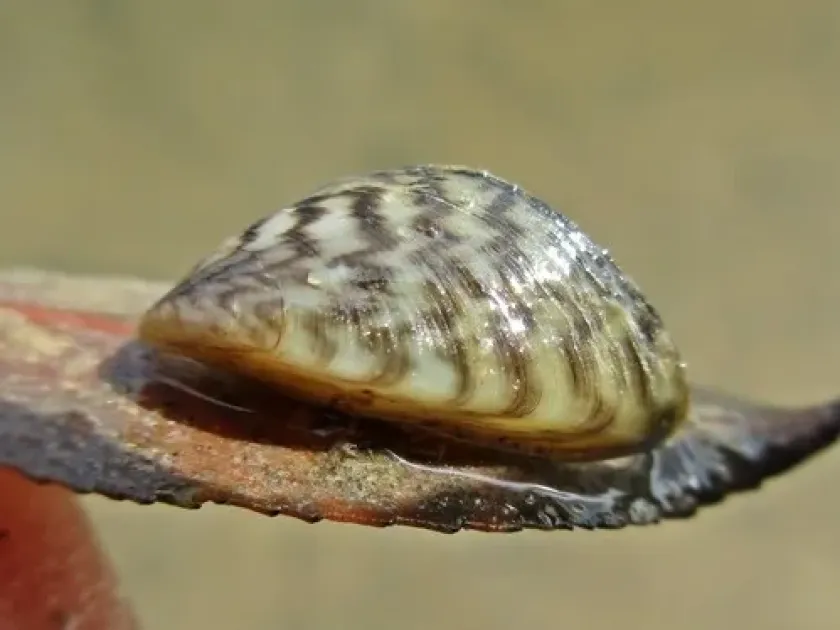
The Zebra mussel is a small freshwater bivalve mollusk belonging to the family Dreissenidae, order Veneroida. Adult specimens typically reach 2 to 4 centimeters in length.
The shell features a distinct triangular, wedge-like shape, often marked with dark, zigzag patterns on a light background, which gives the species its common name.
Unlike many other freshwater mollusks, the Zebra mussel is sessile, meaning it attaches firmly to hard surfaces like pipes, rocks, or boat hulls using strong, sticky byssal threads.
They are highly prolific, with females capable of producing up to a million eggs in a single spawning season, leading to rapid population expansion in suitable habitats.
Identification is easily confirmed by observing dense clusters of these small, striped shells colonizing submerged man-made structures or water intake points.
What it damages
Zebra mussels do not attack agricultural crops directly, but they are considered a major operational pest for irrigation and water management systems.
They colonize the interior of water intake pipes, pumps, and irrigation canals, creating dense layers that drastically reduce water flow and overall hydraulic efficiency.
The obstruction of irrigation pipes leads to increased pressure loss and energy consumption, often causing pumps to overload and fail prematurely.
As the mussels die or detach, their shells are carried through the system, clogging fine nozzles in drip irrigation lines and irrigation sprinklers.
Their biological presence also causes localized corrosion on metal pipes, which increases the frequency of maintenance and the risk of catastrophic pipe failure.
When it appears
The active growth and reproductive cycle of the Zebra mussel occur during the warmer months, specifically when water temperatures exceed 12 degrees Celsius.
The primary reproductive season runs from late spring through late summer, with peak spawning occurring when water temperatures reach an optimal range of 15 to 20 degrees.
During this period, microscopic larvae, known as veligers, drift with the water current, allowing them to penetrate and infest various segments of irrigation systems.
Once settled, these larvae develop into juvenile mussels and reach maturity within a single season, further expanding the population inside the pipes.
While biological activity decreases during autumn and winter, the established colonies remain firmly attached to surfaces, continuing to impede water circulation throughout the year.
Signs of infestation
A primary indicator of infestation is a noticeable drop in discharge pressure and water volume across the irrigation network without any changes to pump settings.
Visible signs include the accumulation of dense, dark-colored shell layers on inlet screens, pump intake grids, and the internal walls of accessible pipe sections.
Frequent clogging of drippers and sprinkler heads with crushed shell debris indicates that large colonies have formed upstream within the plumbing system.
A strong, foul odor originating from the water during pipe maintenance or flushing often indicates the decay of large quantities of mussels within the pipes.
Examination of canal infrastructure or irrigation gate valves may reveal a near-total coverage of the surfaces by these resilient mollusks.
Control measures
Controlling Zebra mussels requires a multi-layered approach focusing on both physical exclusion and chemical treatment to clear existing colonies.
Mechanical methods, such as high-pressure flushing and specialized pipe-pigging, are standard practices to clear shells from long-distance water pipelines.
Chemical control involving molluscicides or oxidizing agents is sometimes used, provided the chemicals are safe for agricultural irrigation and local environmental regulations.
Exclusion strategies, such as the use of fine-mesh intake screens, help prevent larvae from entering the system, although they must be cleaned regularly.
- Periodic cleaning of intake and filtration units
- Application of anti-fouling coatings to internal pipe surfaces
- Monitoring of veliger density in water sources during early summer
Taxonomy
- Latin name
- Dreissena polymorpha
- Family
- Dreissenidae
- EPPO code
- DREIPO
Discussion
No discussions yet — be the first.