
Dorylaimus stagnalis
Dorylaimus stagnalis
Description
How to identify
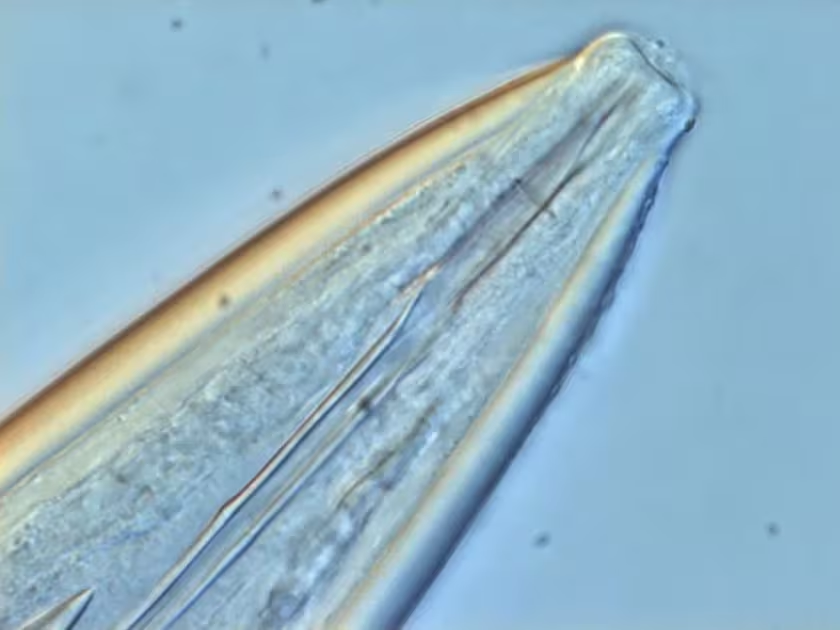
Dorylaimus stagnalis is a species of free-living soil nematodes belonging to the order Dorylaimida and the family Dorylaimidae. These organisms are recognized for their relatively large size and complex anatomy.
The nematode possesses a characteristic odontostyle, a spear-like structure in the stoma, which allows it to move through soil pores and feed on various organic materials or root exudates.
They are primarily associated with aquatic or semi-aquatic habitats, including wet soils and riverbanks, where moisture levels remain consistently high.
The life cycle consists of the egg stage, four larval instars, and the adult stage, all of which are biologically adapted to survive in moist interstitial spaces.
While they are naturally occurring in many soil ecosystems, high concentrations in agricultural fields can lead to increased interaction with plant roots.
What it damages
The primary damage caused by Dorylaimus stagnalis is mechanical, as the nematodes penetrate or graze on plant roots, especially in waterlogged conditions.
These feeding activities cause cellular damage to root tips, which significantly weakens the plant's structural integrity and ability to absorb water and nutrients.
The punctures created in the root tissue serve as entry points for various soil-borne pathogens, leading to secondary infections and increased susceptibility to rot.
Crops grown in low-lying, damp areas of a field are most susceptible to damage, often exhibiting signs of stunted development and nutrient deficiency.
Economic damage is typically localized but can be severe in crops like vegetables or delicate seedlings if environmental conditions favor nematode proliferation.
Signs of infestation
Visible symptoms of infestation include lack of vigor, yellowing of foliage, and uneven patches of growth throughout the cultivated area.
When examining the root system, one may observe necrotic spots, browning of root tips, and a general reduction in the branching of the root structure.
Plants may show symptoms of wilting during the day, even when soil moisture appears adequate, indicating the inability of damaged roots to transport water efficiently.
Professional diagnosis requires soil sampling and extraction of the nematodes to confirm that Dorylaimus stagnalis is present in harmful densities.
Stunting of seedlings in the early growth stages is a clear indicator that root damage has compromised the establishment of the crop.
Control measures
Management focuses on soil water management, as these nematodes thrive in stagnant or over-saturated conditions; improving field drainage is crucial.
Implementing a balanced crop rotation system helps disrupt the nematode life cycle and prevents the build-up of high populations in the soil.
Deep tillage can help aerate the soil and reduce the moisture content of surface layers, creating a less hospitable environment for these nematodes.
Ensuring that seedlings are grown in sterile substrates before transplanting prevents the introduction of the pest into the main field.
- Improve drainage systems for fields.
- Practice diverse crop rotations.
- Avoid over-irrigation in vulnerable areas.
- Conduct regular soil quality monitoring.
Taxonomy
- Latin name
- Dorylaimus stagnalis
- Order
- Nematodes
- Family
- Dorylaimidae
- EPPO code
- DORYST
Discussion
No discussions yet — be the first.