
Raft spider
Dolomedes fimbriatus
Description
How to identify
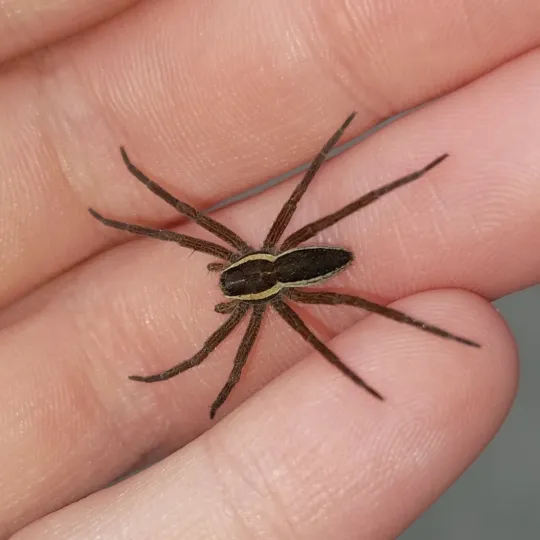
The Raft spider (Dolomedes fimbriatus) is one of the largest spiders in Europe, belonging to the Pisauridae family, known as nursery web spiders.
Females are significantly larger than males, reaching body lengths of up to 22 mm, characterized by a brownish to blackish color with white or yellow stripes.
These spiders are semi-aquatic and are typically found in damp habitats, including marshes, bogs, and the edges of ponds and slow-moving streams.
They are distinct for their hunting behavior, where they wait on water plants, using the surface tension to detect vibrations from potential prey.
Despite their imposing size, they are shy and tend to retreat underwater when disturbed, exhibiting remarkable swimming and diving capabilities.
What it damages
It is crucial to clarify that the Raft spider is a predatory species and does not consume plant matter, making it harmless to crops.
These spiders act as natural biocontrol agents by feeding on various insects that inhabit wetland areas, including small flies and larvae.
Because they lack the necessary mouthparts to feed on plant sap or foliage, they cause zero damage to agricultural productivity or plant health.
In many ecosystems, they help maintain a balance by keeping populations of other arthropods in check, which can be beneficial for the local environment.
There is no economic threshold for this species, as it is considered a non-pest and an integral part of healthy, biodiversity-rich habitats.
When it appears
The activity of the Raft spider commences in late spring as the ambient temperature rises, allowing for emergence from winter dormancy.
The peak hunting and reproductive season occurs during the summer months when insect prey is most abundant near aquatic environments.
As autumn approaches, individuals seek out sheltered locations such as rock crevices, plant debris, or under tree bark to hibernate.
The life cycle of this species is relatively long, often taking up to two years to reach full maturity depending on climatic conditions.
Winter survival is dependent on finding a frost-free environment where the spider can remain in diapause until the following spring.
Signs of infestation
The presence of the Raft spider is typically confirmed by sightings in wetland vegetation or along the banks of water bodies during the early morning.
One may observe a nursery web, which the female constructs to protect her egg sac as the offspring begin to emerge and develop.
There are no diagnostic signs of crop damage associated with this spider, as it does not feed on vegetation or create lesions on plant tissue.
Observations of the spider resting on leaves near the water's surface, awaiting prey, are the most common indicator of its presence in an area.
If you suspect its presence, inspect areas of dense, moisture-loving vegetation near irrigation ditches or water reservoirs on your property.
Control measures
No control measures are necessary for the Raft spider, as it is not a pest and does not interfere with standard farming or gardening practices.
The use of broad-spectrum pesticides should be avoided, as it will indiscriminately eliminate this beneficial predator along with actual pest species.
If habitat management is required for other reasons, maintaining dryer ground conditions will naturally discourage the spider's colonization.
Mechanical management, such as removing excess vegetation around water edges, is the only method to influence their distribution on a property.
Promoting a balanced environment where predators like the Raft spider can thrive contributes to natural pest management without the need for chemicals.
Taxonomy
- Latin name
- Dolomedes fimbriatus
- Family
- Pisauridae
- EPPO code
- DOLMFI
Discussion
No discussions yet — be the first.