
Fishing spider
Dolomedes
Description
How to identify
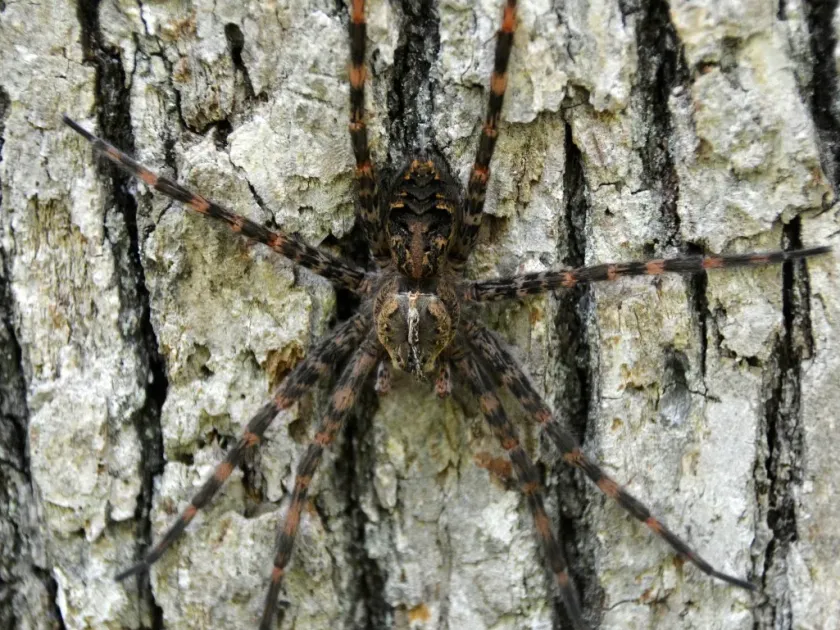
Fishing spiders belong to the genus Dolomedes within the nursery web spider family (Pisauridae). They are large spiders known for their robust build and long, powerful legs.
Their coloration ranges from yellowish-brown to nearly black, often featuring distinct white or cream-colored stripes along the sides of the cephalothorax for camouflage.
These spiders do not build webs to trap prey; instead, they are active hunters that rely on speed and vibration detection to capture insects on water surfaces and vegetation.
Females are significantly larger than males and are known for carrying their egg sacs under their cephalothorax, providing maternal care until the spiderlings hatch.
To identify them, look for their eight eyes arranged in two rows, which provide them with a wide field of vision necessary for their predatory lifestyle.
What it damages
While fishing spiders are primarily predators and do not feed directly on plant tissues, their presence can severely disrupt the balance of beneficial arthropods in agroecosystems.
They frequently prey upon beneficial insects, including ladybugs and lacewings, which are natural enemies of major agricultural pests, thereby reducing biological control effectiveness.
In greenhouses and nurseries, these spiders may build silk shelters among leaves or fruits, which can cause mechanical damage or aesthetic issues due to webbing residue.
Their large size and active hunting habits can impede manual labor during planting or harvesting, as they may bite if handled or accidentally disturbed by workers.
If population densities become high, they can outcompete other predators, leading to an imbalance that indirectly favors the proliferation of destructive plant-eating pests.
When it appears
The activity of fishing spiders is highly dependent on temperature and humidity, with individuals emerging from winter dormancy starting in May.
Peak activity occurs during mid-summer, providing the ideal environmental conditions for mating, egg-laying, and rapid development of juvenile spider populations.
As late summer transitions into autumn, the spiders seek stable environments for overwintering, often migrating into farm buildings or dense plant debris.
The life cycle of a Dolomedes spider typically spans two years, meaning that at any given time, fields may contain overwintered individuals of varying life stages.
Higher rainfall and increased humidity generally correlate with larger populations, as these conditions favor their semi-aquatic hunting and survival strategies.
Signs of infestation
The most prominent sign of their presence is the construction of protective nursery webs, which are draped over plant tops or leaf edges to secure egg sacs.
Direct sightings of large, active spiders on the soil surface or plant foliage near irrigation ditches and humid zones are strong indicators of colonization.
A noticeable decline in the number of smaller beneficial insects near water sources can suggest high predatory pressure from fishing spider populations.
Specific webbing patterns that differ from the geometric traps of web-spinning spiders indicate the presence of hunting species like Dolomedes.
Regular monitoring of the root zone and plant base often reveals cast-off exoskeletons, as the spiders frequently molt while remaining in close proximity to their hunting grounds.
Control measures
Effective management begins with strict field hygiene, such as regular mowing of weeds and dense vegetation around irrigation channels and water management systems.
Avoid the use of broad-spectrum insecticides, as these will eliminate beneficial insects and disrupt the natural predatory balance further; use targeted applications only when necessary.
In greenhouses, ensure all entry points are protected with fine-mesh screens and maintain structural integrity to prevent spiders from finding suitable habitats.
Biological control methods include fostering habitats for insectivorous birds and small mammals that naturally prey on larger spider species in agricultural landscapes.
If infestation levels are high, mechanical removal of nursery webs and egg sacs can significantly decrease the local population density and prevent further spread.
Taxonomy
- Latin name
- Dolomedes
- Family
- Pisauridae
- EPPO code
- DOLMSP
Discussion
No discussions yet — be the first.