
Fruit tree tortrix
Ditula angustiorana
Description
How to identify
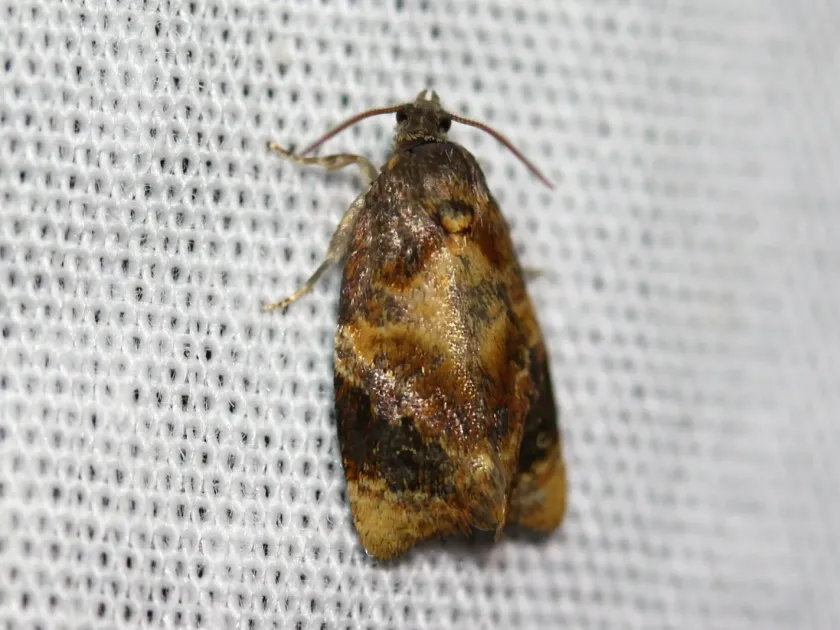
The Fruit tree tortrix (Ditula angustiorana) is a moth belonging to the family Tortricidae. The adult moth typically has a wingspan ranging from 14 to 18 mm.
The forewings are narrow and exhibit a distinct pattern with brownish tones, dark reticulations, and transverse bands that serve as excellent camouflage against tree bark.
The larvae, or caterpillars, reach lengths of 15–20 mm and typically have a yellowish-green to brownish body with a darker head and a prothoracic shield.
Pupation occurs within folded leaves or sheltered crevices in the bark, where the pupa, measuring about 8–10 mm, remains protected until emergence.
This species is highly adaptable to various environmental conditions, allowing it to colonize diverse garden settings and maintain stable population levels.
What it damages
This pest is a significant polyphage, capable of damaging a wide range of fruit crops including apple, pear, plum, cherry, and various berry bushes.
Larval feeding causes direct damage to leaves, buds, blossoms, and young developing fruit, significantly reducing the tree's overall vigor and yield potential.
The larvae construct characteristic webs among leaves and clusters of blossoms, feeding inside these protected structures which prevents contact with predators.
In addition to defoliation, the larvae often graze on the surface of young fruits, causing scarring and deformities that make the produce unmarketable.
Repeated infestation over several seasons can weaken trees, making them more susceptible to secondary pests, fungal diseases, and winter cold damage.
When it appears
The species primarily overwinters as young larvae within dense silken hibernacula located in bark crevices or among leaf debris on the ground.
Activity resumes in early spring, synchronized with the swelling and opening of buds, upon which the larvae emerge to feed on fresh plant tissues.
Adult moths are typically active during the summer months, from June to August, during which mating and egg-laying on the upper leaf surfaces occur.
Usually, there is one generation per year, though warmer climates or favorable seasonal conditions may occasionally support a partial second generation.
After egg incubation, which lasts about two weeks, the newly hatched larvae begin their feeding cycle and start constructing their characteristic webbing.
Signs of infestation
The most recognizable sign of infestation is the appearance of rolled or folded leaves, firmly bound together with silk threads created by the larvae.
Clusters of blossoms matted together with webbing, along with the presence of larval frass (excrement) within these webs, are clear indicators of active feeding.
Surface blemishes, irregular holes, or etched tracks on the skin of young fruits are classic symptoms that the larvae are active within the fruit cluster.
Visible defoliation at the tips of shoots, where larvae are most active, provides a visual alert for horticultural inspection and management intervention.
The presence of fine silken strands between leaves and fruit stalks is a reliable early warning sign that requires immediate monitoring for population density.
Control measures
Integrated Pest Management (IPM) strategies for this species involve a mix of sanitation, biological control, and targeted chemical applications.
Removing and destroying infested foliage and pruned branches during the dormant season helps to reduce the overwintering larval population significantly.
Pheromone traps are highly recommended to monitor the adult flight period, enabling the timing of interventions for when they are most effective.
Biological control options include applying Bacillus thuringiensis-based products, which are selective and safe for non-target beneficial insects.
- Scrubbing loose bark to disrupt overwintering sites.
- Using sticky bands to intercept larvae crawling along trunks.
- Encouraging natural predators such as birds and parasitic wasps in the orchard.
Taxonomy
- Latin name
- Ditula angustiorana
- Order
- Lepidoptera (butterflies)
- Family
- Tortricidae
- EPPO code
- CAPUAN
Discussion
No discussions yet — be the first.