
Barndoor skate
Dipturus laevis
Description
How to identify
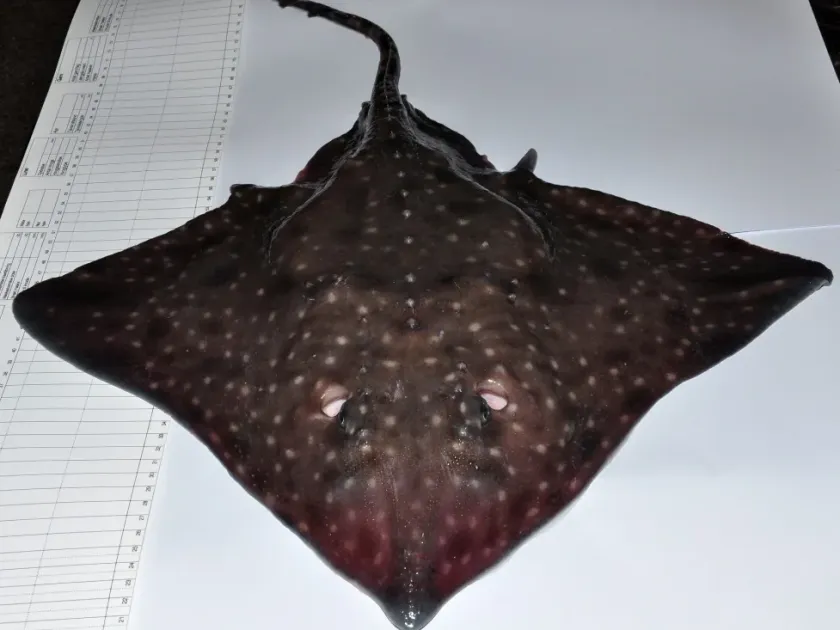
The barndoor skate (Dipturus laevis) belongs to the order Rajiformes and the family Rajidae. It is a large cartilaginous fish found in the Northwest Atlantic Ocean, typically dwelling on the seabed.
The species is distinguished by its large, diamond-shaped body and a significantly elongated snout. Its skin is characterized by a rough texture, and its coloration serves as camouflage against the sandy or muddy ocean floor.
As a purely marine organism, this skate has no biological interaction with terrestrial environments or agricultural systems.
What it damages
The barndoor skate is not a plant pest. It is an apex predator within its marine habitat, feeding on various crustaceans, mollusks, and small fish species.
There is no evidence suggesting this fish causes any harm to agricultural crops, whether in the field or in controlled environments. Its biology is strictly tied to marine ecosystems.
Classifying this organism as a crop pest is a scientific error, as it lacks the physiological tools and environmental proximity to impact land-based vegetation.
When it appears
The lifecycle of the barndoor skate is governed by marine thermal cycles and deep-water currents rather than agricultural seasons. It does not follow any patterns relevant to planting or harvesting cycles.
Reproductive behaviors occur in marine environments throughout the year depending on water temperature, which bears no relation to soil management or crop development.
Control measures
No pest control measures are required for this species in an agricultural context. It is not considered a pest, and any attempts to manage it on land would be impossible and irrelevant.
Conservation efforts are actually focused on protecting this species from overfishing and habitat destruction within its natural maritime range.
Taxonomy
- Latin name
- Dipturus laevis
- Family
- Rajidae
- EPPO code
- DPTULA
Discussion
No discussions yet — be the first.