
Spruce knot-horn moth
Dioryctria schuetzeella
Description
How to identify
The spruce knot-horn moth (Dioryctria schuetzeella) is a member of the Pyralidae family within the order Lepidoptera. It is a specialized pest primarily targeting coniferous tree species.
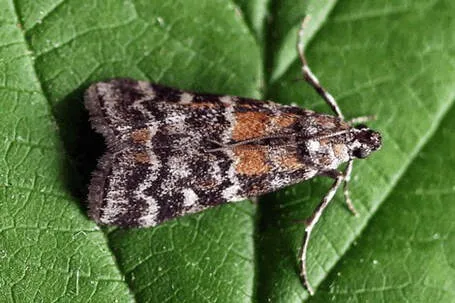
The adult moth has a wingspan of approximately 20–25 mm. The forewings are characterized by a mottled grey-brown pattern with transverse light and dark lines, providing excellent camouflage against bark.
The larvae progress through several instars. Mature caterpillars reach lengths of up to 20 mm and exhibit a brownish-grey coloration with dark lateral spots and a distinct prothoracic plate.
The pupa is typically protected within the infested shoot or in a loosely spun cocoon hidden in the litter layer at the base of the tree, making detection challenging.
Accurate identification of this species often requires professional morphological examination of the genital structures, as the species shares many external features with other members of the Dioryctria genus.
What it damages
The primary host for this pest is the Norway spruce (Picea abies). While trees of various ages can be affected, younger plantations are particularly susceptible to severe damage.
The larvae are internal feeders, boring into young shoots and consuming the inner tissues. This activity disrupts nutrient flow, leading to the yellowing and eventual death of the affected branch sections.
Feeding damage occurs mainly in the upper crown, which can result in apical dominance loss, stem deformation, or the development of multiple leaders, negatively impacting tree architecture.
Repeated infestations lead to a decrease in annual growth and overall tree vitality, making affected spruce stands more susceptible to secondary attacks by bark beetles and wood-boring insects.
In cases of high-density populations, the cumulative damage can significantly reduce the timber quality and the economic value of forest stands, as well as their aesthetic appeal.
When it appears
Adult moths typically emerge during the summer months, specifically June and July. They are nocturnal insects, with mating and egg-laying occurring during the night.
Females deposit eggs singly or in small clusters near the base of buds or near needle fascicles, ensuring the larvae have immediate access to plant tissue upon hatching.
Larval development takes place throughout the summer. Upon hatching, the young caterpillars quickly bore into the host shoots, where they remain protected while feeding until late summer or autumn.
Overwintering occurs as larvae, either within the infested shoots or beneath the bark, depending on regional climatic conditions. Pupation typically happens in the following spring.
The life cycle is generally univoltine (one generation per year), although seasonal weather fluctuations can lead to variations in the timing of the emergence of adults and larval activity.
Signs of infestation
The most visible symptom of an infestation is the chlorosis and subsequent browning of needles on specific shoots within the crown, becoming evident mid-to-late summer.
Infested shoots often show accumulation of granular "frass" (larval excrement mixed with wood debris) held together by silken webbing on the surface of the shoot.
Entry holes made by the larvae are often visible on the shoots. These wounds frequently trigger a resinous defensive response from the tree, resulting in visible resin flow.
Deformation of the shoots, such as twisting or drooping, is a common consequence of internal tissue destruction, often leading to breakage under moderate wind conditions.
During the autumn and winter, dead and discolored branches stand out sharply against the healthy green foliage, facilitating easy identification and monitoring of the infested areas.
Control measures
Effective management begins with regular forest health monitoring to detect early-stage infestations and assess population trends within susceptible stands.
Sanitation practices, specifically the manual removal and destruction of infested shoots before the adult moths emerge, are highly effective in reducing population levels.
In forest nurseries and high-value plantations, the strategic application of contact or systemic insecticides during the peak of larval hatching can prevent widespread damage.
Biological control relies on preserving natural enemies, including various parasitoid wasps and insectivorous birds, which help keep the moth population in check.
Promoting forest stand diversity and maintaining high tree vigor through proper silvicultural practices are essential for creating an environment less favorable for the spruce knot-horn moth.
Taxonomy
- Latin name
- Dioryctria schuetzeella
- Order
- Lepidoptera (butterflies)
- Family
- Pyralidae
- EPPO code
- DIORSC
Discussion
No discussions yet — be the first.