
Spruce coneworm
Dioryctria reniculella
Description
How to identify
The spruce coneworm (Dioryctria reniculella) is a lepidopteran insect belonging to the family Pyralidae. It is a specialized pest primarily targeting spruce trees (Picea species).
Adult moths have a wingspan of approximately 20–25 mm. Their forewings feature a mottled pattern of grey, brown, and black, allowing them to blend in perfectly with the bark of host trees.
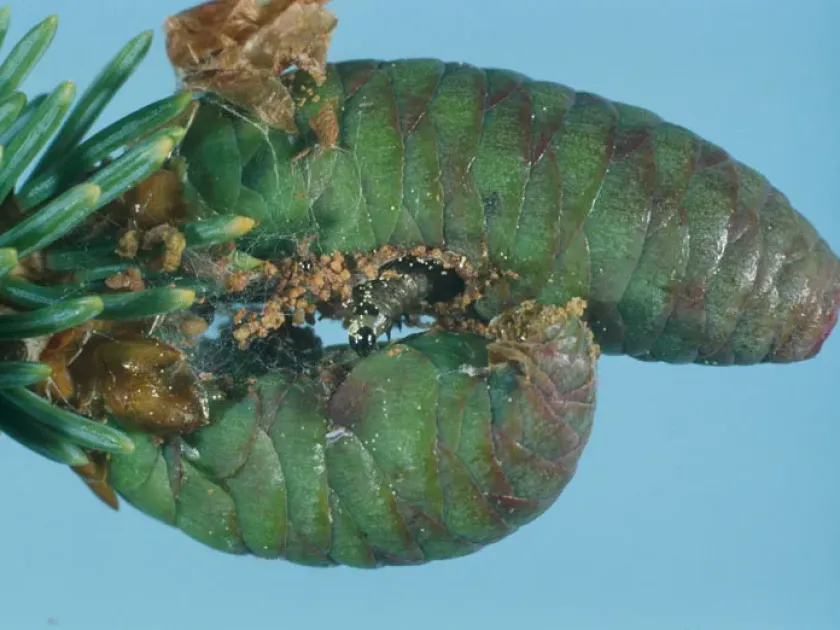
The larvae are typically 15–18 mm long when fully grown. They vary in color from greenish-grey to reddish-brown, usually featuring a dark head capsule and distinct dark spots on the body segments.
The pupal stage occurs within the damaged cones or under bark scales. This provides the insect with a stable environment during the dormant winter period.
Identification often relies on the presence of larvae in the cones, as the nocturnal adults are difficult to spot during the day in forest environments.
What it damages
The larvae primarily feed on the interior of developing spruce cones. They consume the scales and seeds, significantly reducing seed viability and cone quality.
This feeding behavior causes the cones to stop growing, turn brown prematurely, and often drop from the tree before full maturity.
In addition to cone damage, high populations of larvae may feed on vegetative buds and the tips of young shoots, causing distortion and growth retardation of the leading shoots.
Severe infestations can lead to significant economic losses in seed orchards and forest nurseries, where cone production is a critical objective.
Repeated annual damage weakens the vitality of the host trees, making them more susceptible to subsequent attacks by secondary pests and environmental stressors.
When it appears
The spruce coneworm has one generation per year. Adult moths emerge in late spring to early summer, coinciding with the development of young cones on spruce trees.
Females deposit eggs on the scales of young cones. Upon hatching, larvae immediately bore into the cone to begin feeding, protected from predators and weather.
The larvae complete their development throughout the summer months. During this time, a single larva may destroy multiple cones as it moves through the host structure.
Pupation takes place in late summer or autumn. The insects overwinter in the pupal stage, hidden within the remains of the damaged cones or in protective crevices on the tree.
The timing of moth emergence is closely linked to temperature patterns in spring, meaning warmer springs may result in earlier attacks on the cone crop.
Signs of infestation
Visible signs of infestation include brown or discolored needles surrounding the affected cones, which indicates unhealthy tissues.
The presence of fine, brown frass (larval excrement) webbed together on the surface of the cones is a hallmark sign of coneworm activity.
- Pitch or resin flow at the larval entry holes on the cone surface.
- Premature yellowing or browning of cones during the peak growing season.
- Deformed or stunted cone growth with visible tunnel patterns inside.
- Presence of hollowed-out cones lying on the ground under the canopy.
Examining the cones during mid-summer often reveals the larvae inside the tunnels if the infestation is active.
Control measures
Effective management includes sanitation practices, such as the systematic removal and destruction of infested cones to eliminate the overwintering pupae.
Pheromone traps are widely used in commercial plantations to monitor moth activity and determine the precise timing for intervention measures.
Biological control using Bacillus thuringiensis sprays can be effective if applied during the early larval stage when they are most vulnerable before entering the cones.
In high-value seed orchards, chemical applications may be necessary. These are timed to target the larvae before they bore into the protective cone tissue.
Encouraging natural predators and parasitoids in the forest ecosystem can help maintain coneworm populations below economic injury levels.
Taxonomy
- Latin name
- Dioryctria reniculella
- Order
- Lepidoptera (butterflies)
- Family
- Pyralidae
- EPPO code
- DIORRE
Discussion
No discussions yet — be the first.