
Pine cone moth
Dioryctria clarioralis
Description
How to identify
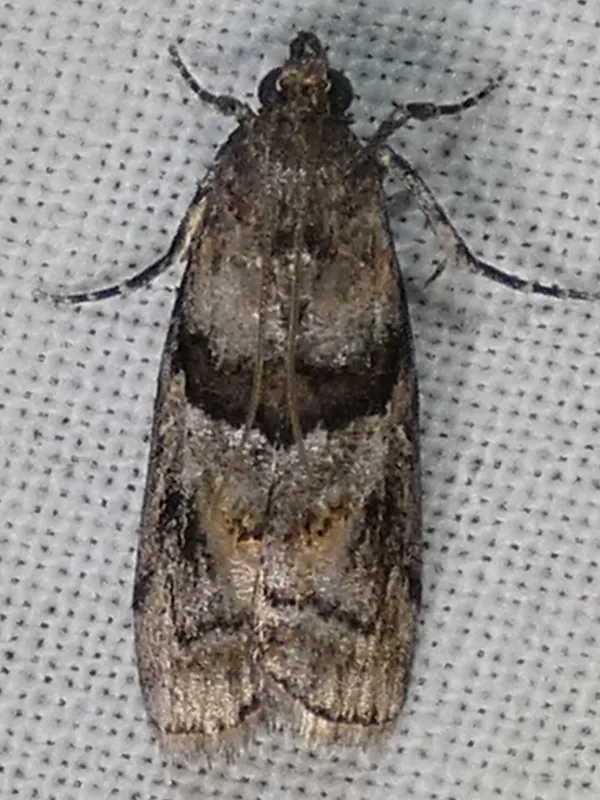
The pine cone moth (scientific name: Dioryctria clarioralis) belongs to the Pyralidae family. The adult moth has a wingspan of approximately 20–25 mm, with forewings displaying a mottled greyish-brown to dark brown pattern with distinct transverse light bands.
The larvae, or caterpillars, grow up to 20 mm in length. Their bodies are yellowish-brown to reddish-brown, characterized by dark, prominent sclerotized plates on each segment. The head capsule is typically dark brown, a key feature for identification.
Pupae of this species are brownish and typically found inside damaged cones, enclosed in thick, spun silk chambers. The insect's lifecycle is tightly linked to the phenological stages of various coniferous trees, primarily pines.
Monitoring efforts often utilize pheromone traps placed in seed orchards or young forest plantations. These traps help detect the initial flight of adults, allowing foresters to plan interventions accurately.
Taxonomically, the species is classified under the order Lepidoptera, family Pyralidae. Understanding the biology of this pest is crucial for preserving the reproductive potential and seed supply of coniferous species.
What it damages
The larvae primarily feed on the reproductive organs of conifers, specifically targeting the cones of the Scots pine and other related species. By consuming seeds and internal scales, the moth significantly reduces seed yields.
Larval activity leads to the premature drying and shedding of cones, which is a major concern for natural forest regeneration. The damage renders the seeds unviable, causing economic losses in seed production areas.
Besides direct consumption of seeds, the caterpillars' tunneling activities weaken the cones, making them susceptible to secondary fungal infections. This compromises the overall health of the tree's reproductive structures.
During outbreak years, the pine cone moth can destroy a significant portion of the annual cone crop. Such high levels of infestation require immediate attention and management in seed-producing regions.
The extent of damage is generally correlated with population density and regional climatic factors. Hot and dry summers often accelerate the life cycle and increase the intensity of the infestation in affected areas.
When it appears
Adult moths typically emerge in late spring or early summer, coinciding with the formation and growth of young pine cones. This is the optimal window for females to lay eggs directly onto the cone scales.
Upon hatching, the larvae burrow into the cones. They develop inside the tissue, feeding on the scales and seeds as they mature. The cone serves as both a source of nutrients and a shelter for the developing larvae.
Overwintering usually occurs in the pupal or mature larval stage. The insects typically survive the winter inside fallen cones on the ground or within deep bark crevices, protected from harsh temperatures.
The generation time varies depending on the climate. Under favorable conditions, a partial or complete second generation may occur, extending the period of risk for conifer plantations throughout the summer.
Monitoring local temperature trends is essential for predicting the emergence of the pest. Effective timing of control measures depends on identifying the precise moment of egg-hatching and larval entry.
Signs of infestation
The most visible sign of infestation is the accumulation of small, brownish granular frass on the cone surface. These droppings are often found between the scales as the larvae feed internally.
A distinctive indicator is the presence of silk webbing around the entry hole. Larvae often use this webbing to secure debris and frass, creating a plug that shields them from external predators.
Affected cones often turn yellow or brown prematurely and show signs of stunted growth. Resin exudation at the entry points is also common, as the tree attempts to defend itself against the intruder.
When an infested cone is opened, clear tunneling patterns are visible. The internal structure is often hollowed out, containing frass, remnants of seeds, and the larva or pupa itself.
A high number of underdeveloped, fallen cones beneath a tree is a strong indicator of a severe infestation. Foresters should inspect such areas immediately to assess the damage intensity.
Control measures
Managing the pine cone moth requires an integrated approach that combines silvicultural, biological, and chemical methods. A multi-pronged strategy is the most sustainable way to protect plantations.
Silvicultural practices, such as the regular removal and destruction of fallen cones, are effective at reducing the overwintering population. This prevents the emergence of the next generation of moths.
Biological control methods involve the use of entomopathogenic agents or the protection of natural enemies, such as parasitic wasps, which help keep the moth population within acceptable limits.
Chemical control is applied during the peak larval emergence period, specifically before the larvae bore deep into the cones. Systemic insecticides are preferred for their efficacy in targeting the larvae at their most vulnerable stage.
- Pheromone trap monitoring for population tracking.
- Sanitation through the collection and destruction of infested cones.
- Application of biological pesticides during larval hatching.
- Systemic insecticide treatments in outbreak hotspots.
- Promoting biodiversity to support natural predator populations.
Taxonomy
- Latin name
- Dioryctria clarioralis
- Order
- Lepidoptera (butterflies)
- Family
- Pyralidae
- EPPO code
- DIORCL
Discussion
No discussions yet — be the first.