
Spruce cone moth
Dioryctria abietivorella
Description
How to identify
The spruce cone moth (Dioryctria abietivorella) is a member of the Pyralidae family. The adult moth has a wingspan of approximately 25-30 mm. Its forewings are mottled with grey, brown, and black patterns, allowing it to blend perfectly into the bark of spruce trees.
These moths are primarily nocturnal, spending the daylight hours resting on tree trunks or hidden among branches. Their cryptic coloration is an evolutionary adaptation that provides excellent camouflage against natural predators in forest ecosystems.
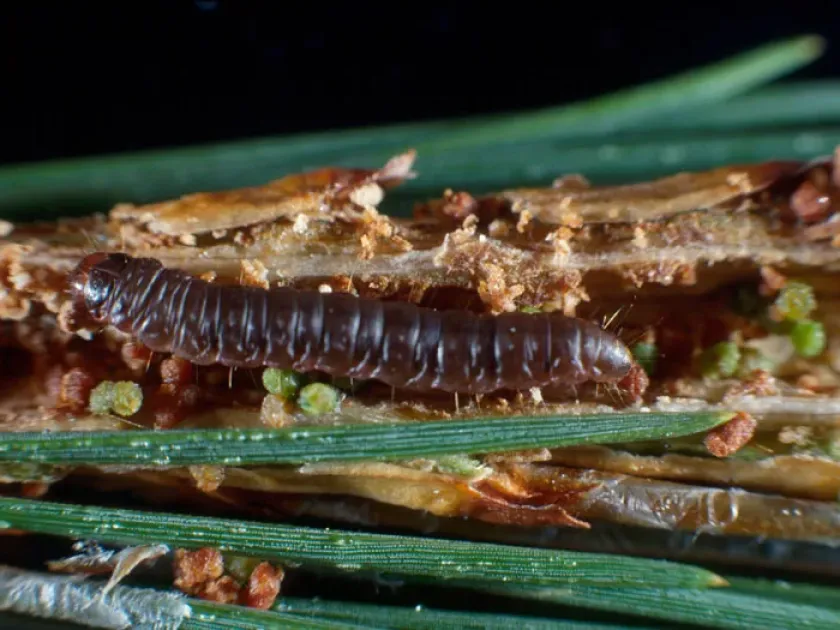
The larvae, or caterpillars, undergo several developmental instars. They are typically reddish-brown to dark brown in color with a darker head capsule. They possess strong prolegs, enabling them to navigate effectively within the tight spaces of conifer cones.
Pupation occurs either within the infested cone or in the bark crevices of the host tree. The pupa is protected by a silken cocoon interwoven with frass and wood particles, providing thermal protection during the overwintering stage.
While the spruce cone moth typically completes one generation per year, environmental factors such as long, warm summers can trigger a partial second generation, significantly increasing the population density and potential for damage.
What it damages
The primary damage is caused by the larvae, which bore into developing cones. They feed on scales, seeds, and the central axis of the cone, effectively destroying the tree's reproductive output for the season.
While the insect primarily targets spruce species, it is a polyphagous pest that can also infest pine, fir, and larch, especially in mixed-stand forests or tree nurseries where various conifers are planted in close proximity.
By tunneling through the cone, the larvae disrupt nutrient transport, causing the cones to dry out, deform, or drop prematurely. This leads to a substantial loss of viable seeds, which is critical for reforestation and seed orchard productivity.
Larval feeding activity often causes resin to leak from the entry holes. This resinosis not only stresses the tree but also creates an environment prone to secondary fungal infections, which further degrade the health of the tree.
In low-yield years, the impact of this pest is particularly severe. A high concentration of larvae can destroy nearly the entire seed crop, posing a significant economic threat to industrial forest seed production.
Signs of infestation
The most reliable indicator of infestation is the presence of resin flow on the exterior of the cone. These resinous masses are often mixed with reddish-brown frass, creating a distinct look on the surface of the scales.
Small entry holes, often surrounded by granular frass (boring dust), are visible at the base of the cone or near the junction of the scales. This is a clear sign that the moth larvae have successfully penetrated the cone.
Premature discoloration, such as yellowing or browning of the cones, is an important sign of infestation. Infected cones often appear shriveled or stunted compared to healthy ones in the same canopy.
Heavy infestation can lead to the premature dropping of cones before they reach maturity. Finding fallen, damaged cones on the ground during mid-summer is a major indicator of an active population in the canopy.
In late summer or autumn, empty cones that remain on the branches often display structural weakness. Close inspection will reveal internal tunnels bored through the core, confirming the past presence of the larvae.
Control measures
Silvicultural management is the first line of defense. Collecting and disposing of infested cones before the larvae exit for pupation significantly reduces the overwintering population for the next season.
Pheromone traps are used to monitor population levels and track the timing of the flight period. This data is essential for timing the application of control agents to maximize efficacy while minimizing impact on beneficial insects.
Biological control using Bacillus thuringiensis or entomopathogenic fungi has proven effective in nursery settings. These agents target the larvae specifically and are environmentally friendly compared to synthetic alternatives.
Chemical control involving systemic or contact insecticides is reserved for high-value seed orchards. Applications are timed precisely to hit the egg-laying phase and the initial hatch of young larvae before they burrow into the cones.
- Regular inspection of seed orchards.
- Conservation of natural parasitoids.
- Prompt removal of fallen cone debris.
Taxonomy
- Latin name
- Dioryctria abietivorella
- Order
- Lepidoptera (butterflies)
- Family
- Pyralidae
- EPPO code
- DIORAI
Discussion
No discussions yet — be the first.