
Stalk-eyed fly
Diopsis thoracica
Description
How to identify
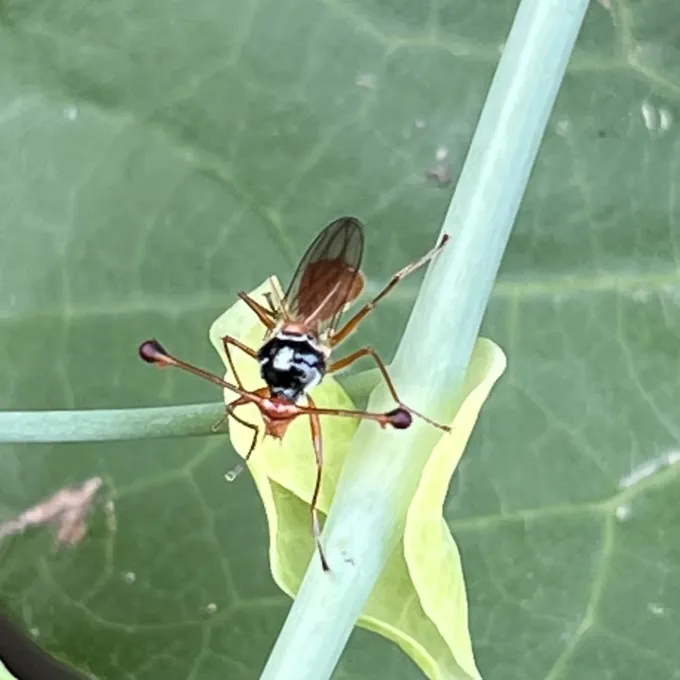
The stalk-eyed fly (Diopsis thoracica) is a member of the family Diopsidae, order Diptera. Its most distinctive feature is the eye-stalks, which are long projections on either side of the head with eyes at the tips.
The body of the adult is typically dark and shiny, with a length ranging from 6 to 8 mm. They possess strong wings that allow them to fly effectively across agricultural landscapes.
Their morphological structure includes specialized spines on the front femora. This anatomy is perfectly adapted for grasping plant surfaces in humid agricultural environments.
The larvae are cylindrical, legless, and creamy-yellow in color. Because they reside deep inside the stems of the host plants, they are often invisible to standard visual field inspections.
The life cycle is tightly synchronized with the hydrological conditions of rice fields, as high humidity is essential for the survival and development of the eggs and larvae.
What it damages
The primary host for Diopsis thoracica is rice (Oryza sativa). It is a significant agricultural pest, particularly within tropical rice-growing regions.
In addition to cultivated rice, the fly can infest various wild grasses found in the vicinity of rice fields, which often act as alternative hosts during off-seasons.
The larvae act as stem borers, feeding on the inner tissues of the rice stem. This feeding process severs the connection to the plant's vascular system.
This damage causes the death of the central shoot, a condition commonly known as 'dead heart'. The plant fails to thrive, and yield potential is significantly compromised.
Mass infestations can result in high levels of crop loss, forcing farmers to replant or accept significantly lower production numbers per hectare.
Signs of infestation
The characteristic sign of an infestation is the yellowing and drying of the central leaf of the rice plant. This 'dead heart' symptom is a reliable indicator of stem-boring activity.
Field inspectors can detect entry holes at the base of the stems. When checking a crop, it is often possible to observe adults resting on the tips of leaves during the morning.
Stunted growth compared to neighboring healthy plants is another strong sign of infestation. Affected tillers may not develop any panicles at all.
If a suspected stem is opened, the presence of the larva or associated debris and frass confirms the presence of the pest.
A sudden decrease in the number of healthy, green tillers across the field is a clear indicator that the fly population has reached a damaging level.
Control measures
Integrated pest management (IPM) for this fly focuses on destroying wild grass weeds near fields, as these serve as secondary reservoirs for the pest population.
Adjusting the water levels in rice paddies can have an impact on larval survival, making flooding a potentially useful tool in specific conditions.
Chemical control involving systemic insecticides is the standard response when the economic injury level is reached. Applications are most effective during the early stages of tiller development.
Research into breeding rice varieties with thicker, more resistant stems is ongoing, as physical barriers can significantly reduce larval boring success.
- Monitoring adult populations using sticky traps.
- Removing and destroying infected rice stubble after harvesting.
- Encouraging natural predators and parasitoids in the field ecosystem.
Taxonomy
- Latin name
- Diopsis thoracica
- Order
- Diptera (flies)
- Family
- Diopsidae
- EPPO code
- DIOPTH
Discussion
No discussions yet — be the first.