
Agnatus pinhole borer
Dinoplatypus agnatus
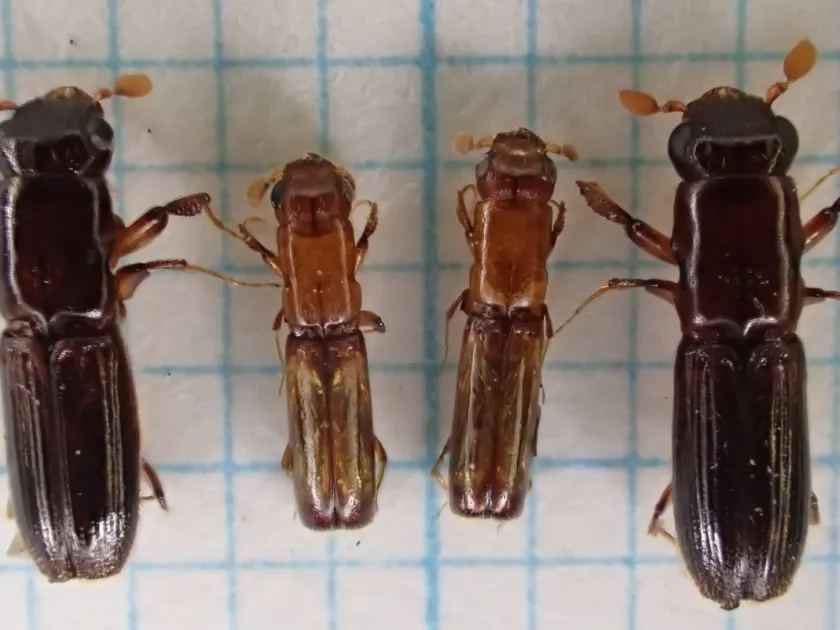
Description
How to identify
Dinoplatypus agnatus belongs to the Curculionidae family and the Scolytinae subfamily. It is recognized as a type of ambrosia beetle, a group of insects highly adapted for boring into timber and wood products.
Adult beetles are characterized by a slender, cylindrical body, which is an evolutionary adaptation for movement within narrow, deep galleries excavated inside host trees. Their coloration is usually dark brown or black.
A key biological feature is their relationship with symbiotic fungi. The beetles possess specific structures called mycangia used to transport fungal spores into the wood. The fungus grows on the gallery walls and serves as the primary nutritional source for the developing larvae.
The larvae are legless, white, and dwell within the galleries. They rely entirely on the fungal garden for survival rather than consuming wood fiber directly, which distinguishes them from many other wood-boring insects.
Positive identification typically requires professional entomological examination. Morphology of the head and the specific gallery architecture are critical factors for diagnostic purposes in research and forest management.
What it damages
The species targets various wood species, favoring weakened, stressed, or freshly felled trees. Their attack is opportunistic, often striking trees that have been damaged by drought or mechanical impact.
The primary damage is caused by the physical tunneling into the sapwood and heartwood. These galleries destroy the vascular structure of the tree, significantly hindering the upward transport of water and nutrients.
Furthermore, the introduction of ambrosia fungi into the wood causes staining. This discoloration lowers the market value of timber, making it unsuitable for high-quality furniture making or structural applications.
In forest ecosystems, a severe outbreak can accelerate the mortality of trees already suffering from environmental stress. The cumulative effect of gallery construction and fungal colonization can lead to the death of the host.
Industrial losses are significant due to degradation of timber quality. Even when the beetle population is under control, the presence of boreholes and fungal stains results in timber waste and economic decline for the lumber industry.
Signs of infestation
The most prominent sign of an active infestation is "frass," or boring dust, accumulating near the entry holes on the bark. This material is finely milled wood pushed out by the beetles as they carve their tunnels.
Entry holes are small, circular, and often appear in clusters. A careful inspection of the bark surface will reveal these precise perforations, which serve as the primary access point for the pest.
Internally, the wood shows dark staining radiating from the galleries. This discoloration is a direct result of the fungal growth, which is a hallmark sign of an ambrosia beetle presence in the wood tissue.
Symptoms in the tree canopy include premature yellowing or wilting of the leaves. As the internal plumbing of the tree is compromised by the beetles' activity, the foliage receives insufficient water, leading to decline.
Upon splitting a piece of infested wood, the complex network of galleries becomes visible. These tunnels often penetrate deeply into the heartwood, exhibiting a branched structure that is characteristic of the Dinoplatypus genus.
Control measures
Sanitation is the most effective management strategy. Removing and destroying infested or fallen timber prevents the beetle from completing its life cycle and spreading to neighboring healthy trees.
For stored timber, applying insecticide sprays or using chemical treatments to seal the wood surface can serve as an effective deterrent against adult colonization during the flight period.
Biological control methods include encouraging natural predators and parasitoids in forest areas. While these natural checks help regulate populations, they rarely eradicate an infestation entirely in high-pressure scenarios.
Pheromone traps are essential tools for monitoring. By identifying the presence of beetles early, forest managers can implement timely control actions before the infestation reaches a critical economic threshold.
Maintaining tree vigor through proper irrigation and fertilization is a fundamental preventive measure. A healthy, robust tree is more capable of using natural defenses, such as resin production, to repel initial beetle attacks.
Taxonomy
- Latin name
- Dinoplatypus agnatus
- Order
- Coleoptera (beetles)
- Family
- Curculionidae
- EPPO code
- DNLPAG
Discussion
No discussions yet — be the first.