
Dichrorampha petiverella
Dichrorampha petiverella
Description
How to identify
Dichrorampha petiverella is a small moth belonging to the family Tortricidae, order Lepidoptera, commonly recognized by its unique wing patterns.
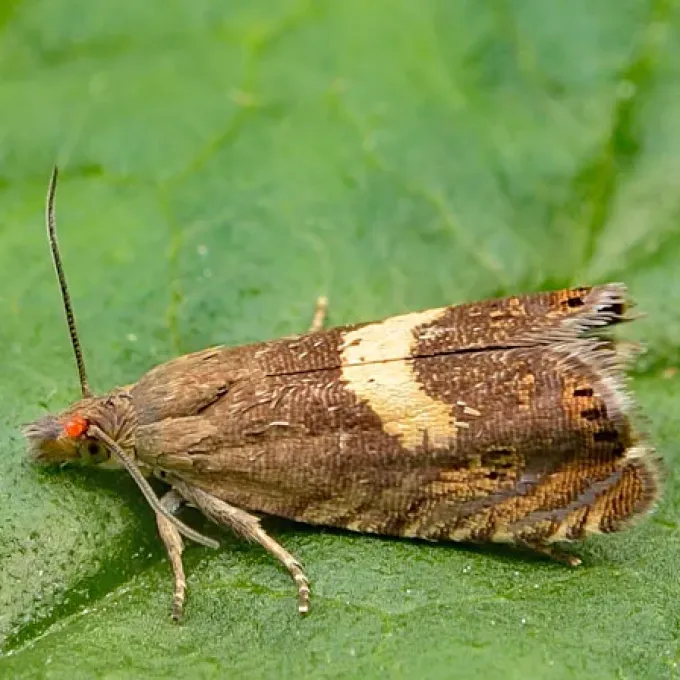
The adult moth has a wingspan ranging from 12 to 15 millimeters. Its forewings feature a yellowish-brown color with a distinctive light, crescent-shaped spot at the trailing edge.
The larvae are typically cream-colored with a dark head and a pronotal shield, reflecting their adaptation to a concealed lifestyle within plant tissues.
As members of the Tortricidae family, these moths are known for their specific relationships with host plants and their nocturnal behavior.
Identification often requires careful inspection of the wings and, in some cases, laboratory analysis of morphological features to distinguish it from related species.
What it damages
The primary host plants for Dichrorampha petiverella larvae are species within the Asteraceae family, most notably the common yarrow (Achillea millefolium).
The larvae act as stem and root borers, creating galleries within the roots and the base of the stem, which significantly disrupts the plant's vascular system.
This damage prevents efficient water and nutrient uptake, leading to weak growth, reduced vigor, and poor development of the aerial part of the plant.
In cases of heavy infestation, the entire root system can be compromised, causing the plant to wither and eventually die, especially during periods of drought.
Economic damage is particularly significant in crops grown for herbal or medicinal purposes, where root health and plant integrity are vital for production.
When it appears
Adult moths are typically active during the summer months, with the primary flight period occurring from June through August.
The species overwinters as a larva, safely nestled within the root system of its host plant, where it remains protected from the winter cold.
In spring, as temperatures rise, the larvae resume feeding and complete their development before reaching the pupal stage.
Since the life cycle can be staggered, various developmental stages of the pest may be found simultaneously in the field throughout the growing season.
Moths are nocturnal creatures, and their mating activities are most intensive during the twilight and night hours.
Signs of infestation
Visual signs of infestation include yellowing leaves and a lack of vitality in plants that otherwise seem to be in good soil conditions.
Closer examination of the plant base often reveals entry holes and frass (larval waste) near the root crown, indicating the presence of tunneling larvae.
- Premature wilting of stems and foliage.
- Darkened tunnels or rot visible within the root crown.
- Reduced flowering and stunted growth compared to healthy plants.
- Plants easily coming loose from the ground due to root damage.
- The presence of adult moths near host plants during the night.
Infected plants are often more susceptible to secondary fungal or bacterial infections that enter through the larval feeding wounds.
Control measures
Cultural control practices, such as autumn plowing and soil cultivation, are effective in destroying the larvae's overwintering sites.
Regular weeding and removal of wild host plants, such as wild yarrow, from the vicinity of crops can help reduce pest population pressure.
Biological control agents, including entomopathogenic fungi or nematodes, can be used to manage larval populations within the soil environment.
Chemical control should be reserved for severe outbreaks and involves the targeted application of systemic insecticides during the peak activity of larvae.
Maintaining high soil fertility and optimal growing conditions helps plants to recover more effectively from light larval feeding damage.
Taxonomy
- Latin name
- Dichrorampha petiverella
- Order
- Lepidoptera (butterflies)
- Family
- Tortricidae
- EPPO code
- LASPDO
Discussion
No discussions yet — be the first.