
Orchid thrips
Dichromothrips smithi
Description
How to identify
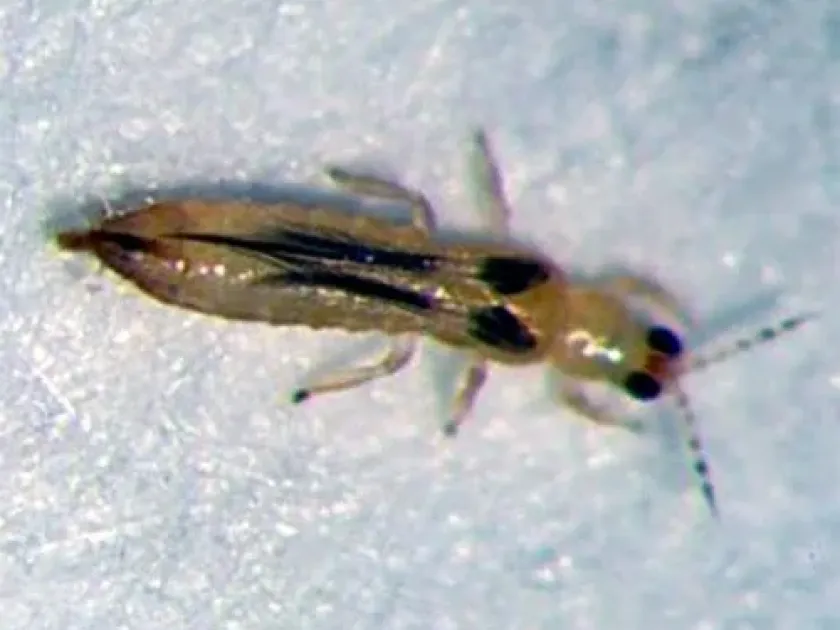
The orchid thrips (Dichromothrips smithi) is a small insect belonging to the order Thysanoptera, family Thripidae. Adults are typically about 1-2 mm long, featuring a slender body and two pairs of narrow wings fringed with long hairs, which is a hallmark of the order.
The life cycle encompasses several stages: egg, two larval instars, prepupa, pupa, and adult. The entire life cycle occurs rapidly in the warm, stable environments of greenhouses or indoor collections, allowing for multiple overlapping generations throughout the year.
Larvae are wingless and lighter in color than adults. They prefer hidden spots, such as the base of leaves, inside unopened flower buds, or between floral sheaths, which protects them from environmental changes and many topical contact insecticides.
Adult thrips are highly mobile and are known to fly or jump between plants when disturbed. Their feeding activity is primarily focused on extracting fluids from epidermal cells, which they access using their specialized mouthparts.
Due to their microscopic size, identifying an early-stage infestation can be challenging. Agronomists recommend using blue or yellow sticky traps as an early warning system to detect adult activity within the greenhouse environment.
What it damages
The primary hosts of Dichromothrips smithi are orchids, including popular genera such as Phalaenopsis, Dendrobium, and Cattleya. These insects target the most succulent parts of the plant, including young leaves, roots, and flower buds.
Feeding causes significant damage to the plant tissue. As thrips rupture cell walls to feed on the contents, they cause the localized death of cells, leading to a loss of vigor and the characteristic stippling effect seen on foliage.
These pests are also known to be vectors for various orchid viruses. By piercing plant tissue, they facilitate the transmission of pathogens that can cause systemic infections, which are often irreversible and fatal to the plant.
Severe infestations result in significant aesthetic damage. Flowers may fail to open fully, exhibit distorted shapes, or develop unsightly blotches and spots, which drastically reduces the commercial or ornamental value of the orchid.
Chronic feeding weakens the host plant, making it significantly more susceptible to secondary infections like soft rot or bacterial wilt, especially when the plant is kept in conditions of high humidity or poor ventilation.
Signs of infestation
The most distinctive sign of thrips activity is the appearance of silvery or metallic streaks on the leaves. This is caused by the evacuation of cell contents, leaving behind air-filled tissue that reflects light differently.
Tiny black spots, which are the excrement (frass) of the thrips, are frequently found on the undersides of leaves or near the veins. These spots act as a clear diagnostic indicator, confirming that the damage is due to thrips rather than nutritional issues.
Flower buds are particularly sensitive. When infested, they often deform or fail to bloom altogether. If they do bloom, the petals may display irregular coloring and premature wilting due to the internal tissue damage.
Infested plants may exhibit a general decline in health, often characterized by a loss of leaf turgor and stunted growth. If the infestation is widespread, the plant may drop its leaves prematurely as a defense mechanism.
- silvery, metallic stippling or streaks on leaves;
- small black fecal spots on the underside of foliage;
- deformed, spotted, or unopened flower buds;
- premature flower senescence and leaf drop;
- visible adult thrips moving on plant surfaces.
Control measures
The first step in managing an outbreak is to isolate infested plants immediately. Thoroughly rinsing plants with a strong stream of warm water can physically remove a large portion of the insect population from the foliage.
For chemical control, systematic insecticides that are absorbed by the plant are the most effective. These should be applied in 7–10 day intervals to ensure that newly hatched larvae are eliminated before they reach maturity and reproduce.
It is essential to rotate different classes of insecticides to prevent the development of resistance. Dichromothrips smithi is known for its ability to adapt, so relying on a single active ingredient is rarely a successful long-term strategy.
Biological control, such as the introduction of predatory mites (e.g., Amblyseius species), provides an excellent eco-friendly option. These predators actively hunt thrips larvae, keeping population levels below the threshold of economic damage.
Preventative maintenance involves keeping the greenhouse environment clean and monitoring new additions to the collection. Maintaining a balanced humidity level can also discourage thrips, as many species prefer drier conditions.
Taxonomy
- Latin name
- Dichromothrips smithi
- Order
- Thrips
- Family
- Thripidae
- EPPO code
- TAETSM
Discussion
No discussions yet — be the first.