
Dichromothrips
Dichromothrips
Description
How to identify
Dichromothrips is a genus of tiny insects belonging to the order Thysanoptera (thrips). These pests are specialized feeders that primarily target Orchidaceae species.
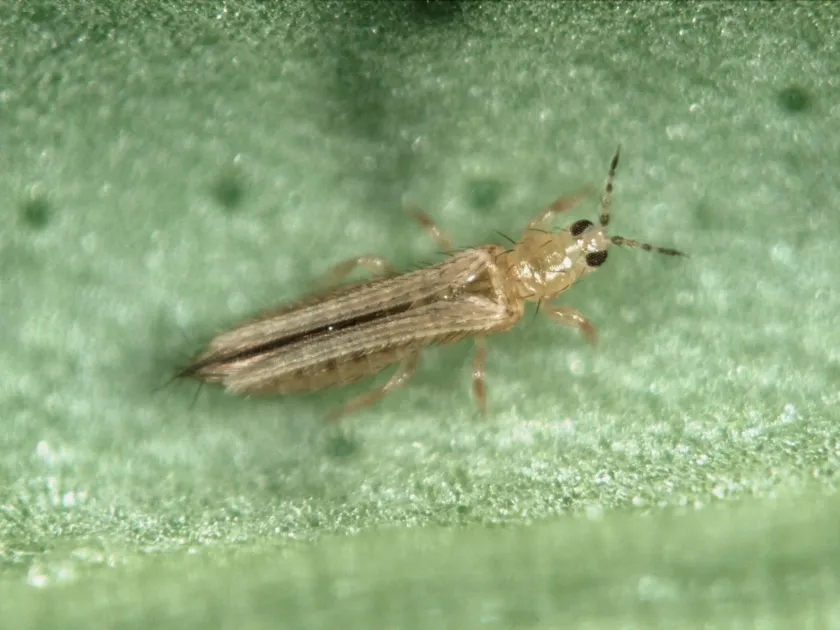
Adults are very small, usually measuring 1–2 mm in length, with a slender body that ranges in color from yellow to dark brown, often featuring fringed wings.
Larvae are typically smaller, wingless, and pale in color. They are highly mobile and tend to congregate in concealed parts of the host plant, such as leaf axils.
The life cycle involves egg, larva, prepupa, pupa, and adult stages. The pupal stage often occurs in the soil or in sheltered crevices on the plant surface.
Due to their microscopic size and rapid movement, Dichromothrips species are often difficult to detect until the plant exhibits significant symptoms of stress.
What it damages
These thrips cause damage by using their piercing-sucking mouthparts to rupture plant cells and ingest the internal fluids of the host's foliage, buds, and flowers.
As they feed, they inject saliva into the plant tissues, which often leads to cellular collapse, localized necrosis, and the death of epidermal cells.
Severe infestations result in stunted growth, leaf deformation, and the total failure of flower spikes to develop or open correctly, ruining the plant's aesthetic value.
Besides direct damage, the feeding sites become entry points for various pathogens, including fungi and bacteria, which can lead to secondary infections.
The loss of sap and cellular integrity places severe physiological stress on the orchid, significantly weakening its overall health and resilience.
When it appears
Under controlled greenhouse or indoor environments, Dichromothrips can complete multiple generations throughout the year, as conditions remain optimal for development.
Temperatures ranging between 22°C and 28°C significantly accelerate the life cycle, allowing the population to reach damaging levels in a short period.
Low humidity levels, typical in many indoor settings during winter, are highly favorable for the proliferation of this pest species.
Increased activity is often observed during spring, correlating with the plant's growth cycle, as fresh shoots and new leaves provide an abundant food source.
Continuous monitoring is essential because the pests are cryptic and can remain hidden for long periods before populations explode across the collection.
Signs of infestation
The most characteristic sign is the appearance of silvery or metallic-looking patches on the leaf surface, caused by the air entering the empty cells.
Small, dark, pinpoint-sized spots of excrement are often visible on the underside of leaves, which is a clear indicator of active thrips presence.
Buds affected by Dichromothrips often display irregular spotting, failure to bloom, or severe distortion once they attempt to open.
Plants may show reduced vigor, with leaves appearing dull, slightly shriveled, or showing premature yellowing due to the constant loss of nutrients.
- Silvery streaking or patches on leaves.
- Tiny black fecal spots on the foliage.
- Distorted and deformed flower buds.
- General decline in plant vigor and growth rate.
Control measures
Systemic insecticides are generally the most effective method for controlling Dichromothrips, as these chemicals are absorbed into the plant's vascular system.
It is crucial to perform repeated treatments spaced 7–10 days apart to target larvae emerging from eggs, as eggs are usually protected from contact sprays.
Rotating chemical classes is a recommended strategy to prevent the development of pesticide resistance within the thrips population.
Maintaining high humidity and regular cleaning of leaves can help mitigate the pest's environment, making it less attractive for egg-laying and development.
Strict quarantine protocols for all new plants being added to a collection remain the most effective preventive measure to stop the introduction of this pest.
Taxonomy
- Latin name
- Dichromothrips
- Order
- Thrips
- Family
- Thripidae
- EPPO code
- DCHTSP
Discussion
No discussions yet — be the first.