
Dichelia leafroller
Dichelia
Description
How to identify
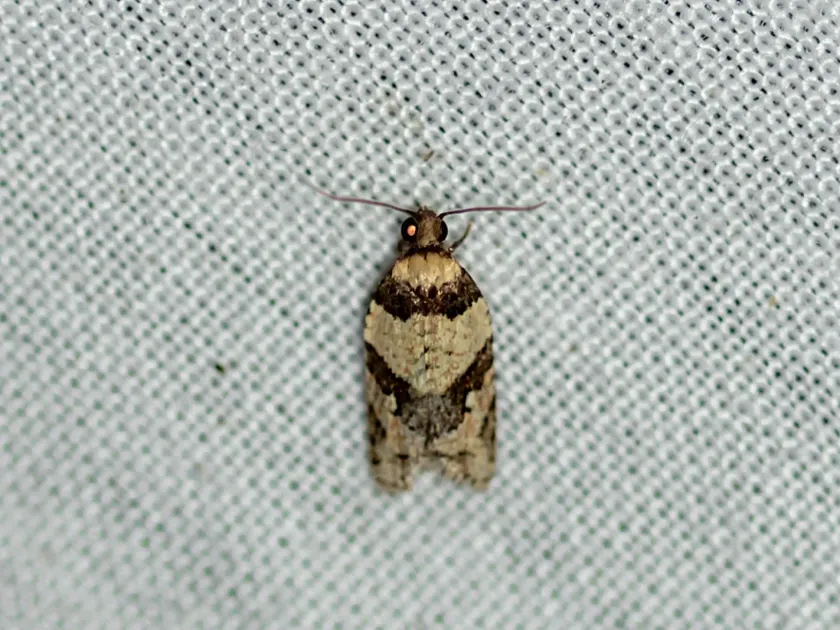
The Dichelia leafroller (lat. Dichelia histrionana) belongs to the Tortricidae family, order Lepidoptera. The adult is a small moth with a wingspan of approximately 18–22 mm.
The moth's wings have a characteristic pattern: the forewings range from light brown to ochre with dark transverse bands, providing excellent camouflage on tree bark.
The larva has a cylindrical body up to 20 mm long, colored in greenish or yellowish-grey tones. The caterpillar's head is typically dark, which is a key diagnostic feature during inspection.
The pupae of the leafroller are usually hidden inside rolled leaves or in bark crevices; they are dark brown and have specific projections at the rear end of the body.
The biology of the species is closely linked to woody plants, where the insect completes a full metamorphosis cycle, including egg, larval, pupal, and adult stages.
What it damages
The primary food source for the larvae consists of coniferous trees, particularly spruce, although in garden settings, the pest may also attack deciduous crops.
The larvae feed actively on needles, binding them together with silk, which leads to significant defoliation and weakening of young trees in nurseries.
Damage to buds and young shoots is the most critical, as it disrupts normal tree growth and deforms the canopy for several years.
Under conditions of intense reproduction, the leafroller can destroy a significant percentage of growth, reducing the market value of ornamental and forestry seedlings.
Heavy infestation also creates entry points for fungal and bacterial infections, which penetrate the plant through damaged tissues.
When it appears
The flight of the moths is observed in the summer, usually from June to July, when the insects begin an active search for egg-laying sites.
Young larvae overwinter, hiding in dense silk nests on branches or under bark scales, which allows them to successfully survive low temperatures.
In spring, when mean daily temperatures rise above 10°C, overwintered larvae resume feeding and begin actively damaging emerging buds.
The developmental cycle is univoltine (one generation per year), so the peak of damage occurs specifically during the spring vegetation recovery period.
By late spring, the larvae finish feeding and pupate, preparing the cycle for the emergence of the next generation of adults in early summer.
Signs of infestation
The main external sign of the pest's presence is the existence of characteristic silk nests, inside which larvae or remnants of eaten needles are hidden.
On the trees, one can notice areas with browned, dried-out needles glued together with fine silk threads, which distinguishes infested areas from healthy parts of the canopy.
Upon inspecting the shoots, one can see larval excrement in the form of small dark granules, which remain inside the silk webbing of rolled leaves or needles.
Deformation of young shoots and their abnormal bending often indicate that the larvae have damaged the plant's apical meristem.
In the case of a mass outbreak, the tree canopy appears sparse and "dirty" due to the accumulation of silk and insect waste products.
Control measures
For leafroller control, spraying with biological agents (based on Bacillus thuringiensis) is applied during the mass emergence of larvae from hibernation.
In cases of high pest density, the use of systemic insecticides is justified, as they penetrate plant tissues and provide long-lasting protection of the needles.
Agrotechnical measures include the regular removal and burning of damaged shoots where pest nests are localized, which significantly reduces the population density.
The installation of pheromone traps allows for the precise determination of adult flight dates, helping to adjust the timing of chemical treatments for maximum effect.
Maintaining tree health through balanced irrigation and fertilization increases plant resilience to damage and accelerates recovery processes.
Taxonomy
- Latin name
- Dichelia
- Order
- Lepidoptera (butterflies)
- Family
- Tortricidae
- EPPO code
- DCHLSP
Discussion
No discussions yet — be the first.