
Northern corn rootworm
Diabrotica barberi
Description
How to identify
The northern corn rootworm (Diabrotica barberi) is a member of the leaf beetle family (Chrysomelidae). Adult beetles are small, measuring about 5–7 mm in length, with a uniform pale green to olive-yellow body color.
Larvae are slender, creamy white, with a brown head capsule. They spend their entire life cycle underground, feeding exclusively on the root systems of host plants, primarily corn.
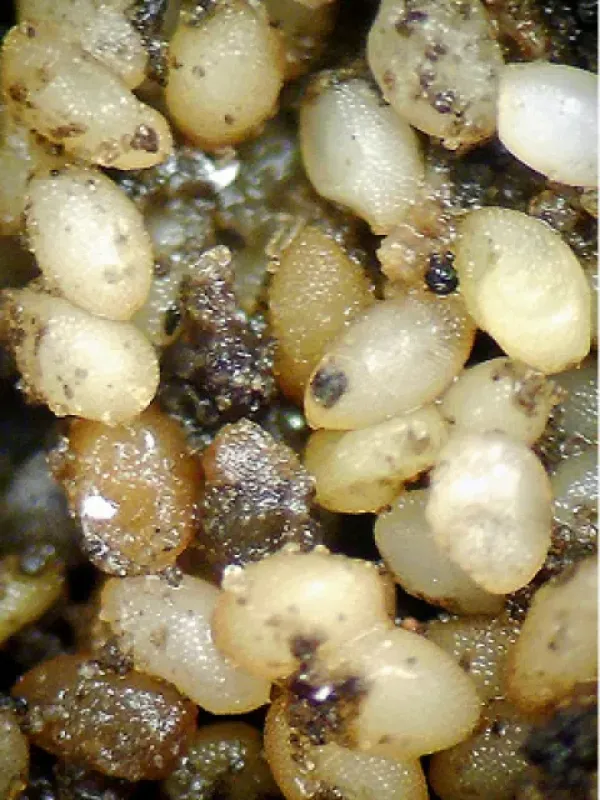
Eggs are minute, oval-shaped, and deposited by females in the top layer of the soil (5–15 cm deep) near the base of the corn plant. They are known for their ability to survive harsh winters in a state of diapause.
The pupal stage occurs in small earthen cells in the soil. The transformation from larva to adult takes about a week, after which the adult beetles emerge to feed and reproduce.
The species is univoltine, meaning there is only one generation per year. Its life cycle is perfectly timed to coincide with the phenology of corn development in agricultural fields.
What it damages
Larval damage is the most destructive part of the cycle. Larvae prune and consume corn roots, which significantly impairs the plant's ability to uptake water and essential nutrients.
Adult beetles feed on corn silks, pollen, and leaves. When they consume the silks before pollination is complete, it results in poor kernel set and significantly reduced grain yields.
Root system destruction leads to plant lodging, where stems become unstable and lean over, often forming a "goose-neck" appearance after a windstorm, making harvesting difficult.
The feeding wounds on the roots serve as entry points for various soil-borne pathogens, leading to secondary infections such as root rot, which further stresses the corn crop.
Severe infestations can lead to total crop failure, especially in continuous corn fields where populations have built up over several consecutive growing seasons.
When it appears
Egg hatch usually begins in late May or early June, coinciding with the early vegetative growth stages of corn when soil temperatures reach optimal levels.
Larval feeding lasts for several weeks until they reach maturity. Peak emergence of adult beetles typically occurs from mid-July through August, during the silking stage of corn.
Mating and egg-laying happen throughout the late summer and early autumn. Females prefer to lay eggs in moist, loose soil where corn is present, ensuring offspring survival.
As soil temperatures drop in the fall, adults perish, and the next generation remains in the egg stage in the soil throughout the winter months until spring.
Phenology is highly dependent on soil heat units. Warmer spring weather can accelerate development, leading to an earlier emergence of larvae and adults compared to cooler years.
Signs of infestation
Lodging is the most visible field sign. Plants may appear bent at the base, creating a curvature that makes the entire stand look uneven and chaotic after wind events.
Roots excavated from the soil will show visible pruning and necrosis. In heavy infestations, the brace roots may be completely missing or significantly stunted.
High numbers of adult beetles on the ears and silks during the pollination period are clear indicators of potential damage to the upcoming harvest's kernel development.
Stunted plant growth and yellowing of the lower leaves are common symptoms caused by the root system's inability to support the nutrient needs of the developing corn plant.
Thinning of the stand in specific areas of the field can occur as plants die or become so weak that they cannot compete with surrounding weeds or neighboring plants.
Control measures
Crop rotation is the most effective management tool. Since northern corn rootworm larvae require corn roots to survive, rotating to a non-host crop like soybeans breaks the life cycle.
Seed treatments using systemic insecticides provide early-season protection to the primary root system, helping the plant establish itself before heavy larval feeding occurs.
Soil-applied insecticides at planting are a standard practice in fields where continuous corn is grown and the risk of larval infestation is high.
Monitoring adult populations with sticky traps helps farmers make informed decisions about the risk levels for the following year and the necessity of management interventions.
- Practice a strict 2-year crop rotation schedule.
- Use systemic insecticidal seed treatments for early protection.
- Apply granular soil insecticides at the time of planting.
- Monitor field populations using yellow sticky cards during the silking stage.
- Scout for root damage and lodging in fields to assess economic thresholds.
Taxonomy
- Latin name
- Diabrotica barberi
- Order
- Coleoptera (beetles)
- Family
- Chrysomelidae
- EPPO code
- DIABLO
Discussion
No discussions yet — be the first.