
Banded cucumber beetle
Diabrotica balteata
Description
How to identify
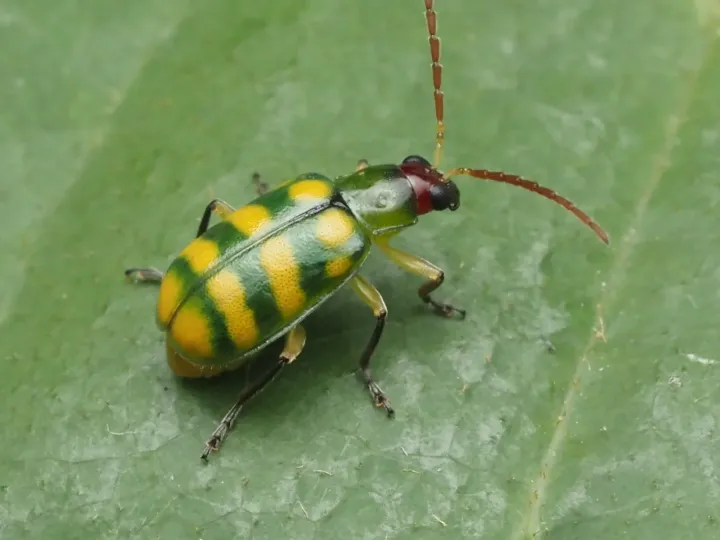
The banded cucumber beetle is a member of the leaf beetle family, Chrysomelidae. Adult beetles are approximately 5 to 6 millimeters long and feature a distinct yellow-green color with three dark transverse bands across their wing covers.
The head of the beetle is typically black, and it possesses long, thread-like antennae. The larvae, which reside underground, have a whitish-yellow body, a cylindrical shape, and a hardened brown head capsule.
The life cycle consists of four stages: egg, larva, pupa, and adult. Females lay their eggs in the soil near the base of host plants, ensuring that the larvae have immediate access to roots once they hatch.
Development speed is highly temperature-dependent, with warmer climates allowing for multiple generations per season. Pupation occurs in the soil, usually within the top 10 centimeters of the earth.
These insects are strong fliers and exhibit high mobility, enabling them to migrate rapidly between different fields, which makes managing their population a significant challenge for growers.
What it damages
This pest is a major polyphagous insect that attacks a wide range of agricultural crops. Its primary hosts include cucurbits such as cucumbers, squash, pumpkins, and melons, which can be severely damaged by both adults and larvae.
Beyond cucurbits, the beetle also feeds on legumes including beans and soybeans. Additionally, it has been observed causing economic damage to solanaceous crops like potatoes, tomatoes, and eggplants.
Larval feeding is particularly destructive as they consume the root hairs and tunnel into the main roots. This damage disrupts the plant's ability to uptake water and nutrients, leading to stunted growth and sudden wilting.
Adult beetles damage the foliage, flowers, and fruit of the plant. They chew holes in the leaves, which reduces the surface area available for photosynthesis and can severely weaken the plant's overall health.
Furthermore, the banded cucumber beetle is a significant vector for several plant viruses, such as cucumber mosaic virus, which can cause total crop failure if the beetle population is not kept under control.
When it appears
Adult beetles typically emerge from their overwintering sites in the spring when soil temperatures reach an optimal range for activity. The initial colonization of fields usually happens shortly after crop emergence or transplanting.
The beetle thrives in warm conditions, with an optimal temperature range between 25 and 30 degrees Celsius. In these environments, the lifecycle accelerates, leading to rapid population spikes throughout the summer months.
The most critical period for protection is during the seedling stage and the early flowering phase of the crop. Stress caused by beetle feeding during these times can prevent the plant from producing a viable harvest.
As the season turns to autumn, adults prepare for winter by feeding heavily before seeking sheltered locations. They often overwinter in soil debris, leaf litter, or dense vegetation surrounding the agricultural site.
Effective scouting during the peak summer months is essential to determine if insecticide application is required to prevent the buildup of secondary generations.
Signs of infestation
One of the earliest signs of an infestation is the presence of small, ragged holes in the foliage of young plants. As the population grows, leaves can become extensively skeletonized.
Plants that exhibit wilting during the heat of the day, despite adequate irrigation, are a strong indicator of larval root damage. Such plants are often easily pulled from the soil due to compromised root systems.
Feeding scars on the surface of developing fruits are another common sign of adult beetle activity. These scars can lead to secondary infections from fungi or bacteria, causing the fruit to rot prematurely.
Adult beetles can often be spotted on the undersides of leaves or hiding within the blossoms of host plants. They are alert and will often drop to the ground when disturbed, which is a defensive behavior.
Viral infection symptoms, such as mosaic patterns, chlorosis, or deformation of the leaves and fruits, serve as indirect signs that the beetle population has successfully transmitted pathogens into the crop.
Control measures
Cultural control is the first line of defense, with crop rotation being a primary strategy. By moving away from cucurbit hosts for several seasons, growers can break the lifecycle and reduce the local beetle population.
The use of row covers or physical barriers during the early vegetative stage is highly effective at preventing female beetles from accessing the soil near the plant base to lay their eggs.
Biological control agents, such as entomopathogenic nematodes or certain microbial products, can be applied to the soil to target larvae without leaving harmful chemical residues on the marketable produce.
Chemical control remains a common approach in commercial settings when threshold levels are exceeded. Rotating insecticide classes is vital to prevent the development of resistance within the beetle population.
- Maintain weed-free borders to eliminate alternative host plants.
- Implement deep plowing after harvest to destroy pupae in the soil.
- Use yellow sticky traps to monitor for the arrival of adult beetles.
- Apply systemic insecticides to seeds or transplants to protect early growth.
Taxonomy
- Latin name
- Diabrotica balteata
- Order
- Coleoptera (beetles)
- Family
- Chrysomelidae
- EPPO code
- DIABBA
Discussion
No discussions yet — be the first.