
Leatherback sea turtle
Dermochelys coriacea
Description
How to identify
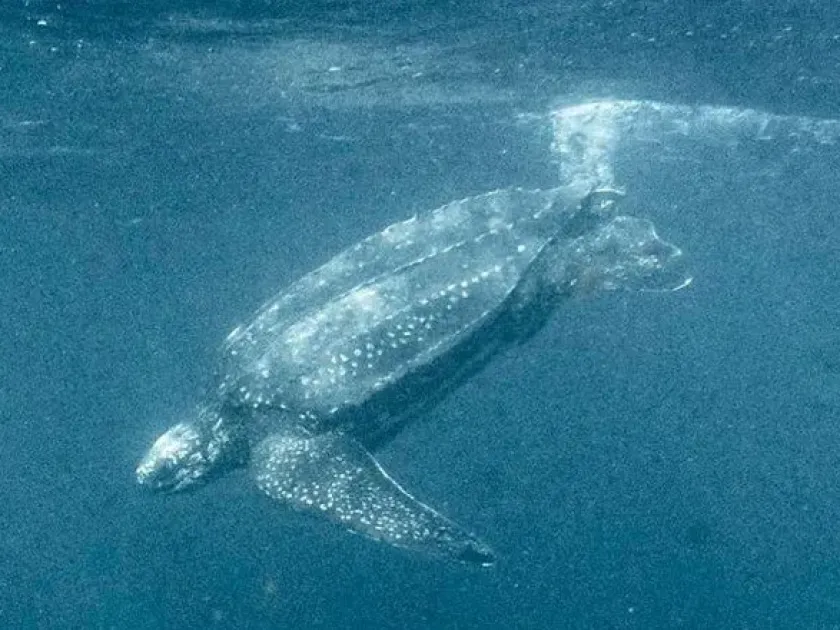
The leatherback sea turtle is a marine reptile belonging to the order Testudines and the family Dermochelyidae.
Unlike other turtles, it lacks a bony shell covered with scutes, possessing instead a leathery skin with small embedded bony plates.
It is the largest of all living turtles, with mature individuals growing to significant lengths and masses of several hundred kilograms.
The species is primarily identified by its seven distinct longitudinal ridges along the carapace, providing hydrodynamic efficiency.
These creatures are highly migratory, spending the vast majority of their lives in open ocean waters throughout the world.
What it damages
The leatherback sea turtle is not an agricultural pest; it poses no threat to crops, orchards, or vegetable fields.
Its biological adaptation is strictly limited to marine ecosystems where it feeds primarily on gelatinous zooplankton, specifically jellyfish.
The animal possesses specialized jaw structures for consuming soft marine organisms, making it incapable of feeding on terrestrial vegetation.
There is no interaction between the species and human agriculture, as they never venture into or inhabit agricultural environments.
Classifying this turtle as a plant pest is entirely inaccurate and lacks any scientific basis in agronomy or entomology.
Control measures
No pest control methods are required for the leatherback sea turtle, as it has zero negative impact on agricultural production.
The species is currently recognized as vulnerable or endangered in many regions, necessitating international conservation efforts.
Farmers do not need to implement any strategies against this animal, as it remains isolated within deep sea and coastal water habitats.
Ecological education is the only relevant measure, ensuring that people recognize this species as part of essential marine biodiversity.
If a specimen is found on shore, it should be treated with care and reported to local wildlife protection authorities rather than handled.
Taxonomy
- Latin name
- Dermochelys coriacea
- Family
- Dermochelyidae
- EPPO code
- DRMOCO
Discussion
No discussions yet — be the first.