
Leatherback sea turtle
Dermochelys
Description
How to identify
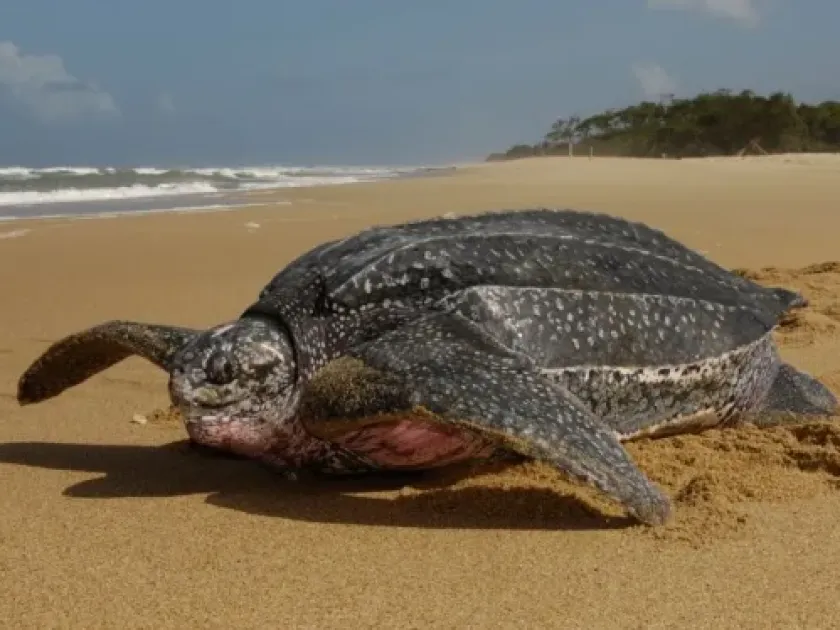
The Leatherback sea turtle (Dermochelys coriacea) is the largest of all living turtles and the only member of the family Dermochelyidae.
Unlike other sea turtles, they lack a hard bony shell; instead, their carapace is covered by oily flesh and skin, supported by a matrix of tiny dermal bones.
They are highly migratory, swimming vast distances across oceans, and can grow to weigh over 500 kilograms.
Their front flippers are significantly longer than those of any other sea turtle, making them excellent swimmers.
This species is uniquely adapted to life in the open ocean and is rarely encountered in terrestrial agricultural habitats.
What it damages
Their diet is specialized, consisting almost exclusively of jellyfish, salps, and other soft-bodied marine invertebrates.
They do not have the specialized dentition or dietary habits to feed on crops, vegetables, or field grasses.
Agricultural damage caused by this species is non-existent as they are not herbivores or pests to land-based vegetation.
There is no economic harm to farms or plantations, as their lifecycle and feeding habits are entirely contained within the marine environment.
Any concern about crop loss from this species is scientifically unfounded and should be dismissed in an agronomic context.
When it appears
Nesting season for these turtles generally occurs during warmer months in tropical and subtropical regions.
They return to the same general nesting beaches every two to three years depending on environmental conditions.
The incubation period lasts several months, with hatchlings typically emerging under the cover of darkness to avoid predators.
Migration cycles are governed by oceanic currents and the availability of their primary prey, the jellyfish.
The presence of nesting adults is highly seasonal and limited strictly to coastal shorelines adjacent to their feeding grounds.
Signs of infestation
The most distinctive sign of their presence on a beach is a wide, deep furrow in the sand, created by their heavy bodies and massive flippers.
Nest sites are characterized by large, bowl-shaped depressions in the sand where the female has deposited her eggs.
Tracks on the sand will typically indicate a straight path between the surf line and the high-tide mark.
There are no signs of vegetation damage or crop consumption associated with their presence near coastal properties.
Monitoring the shoreline for these tracks is a standard practice for marine conservation groups in coastal areas.
Control measures
Leatherback turtles are protected by international law and are considered a critically endangered species.
Control measures are not applicable as the species does not interfere with agricultural productivity or plant health.
If they are found on private property, the best approach is to minimize disturbance and contact local wildlife rescue organizations.
Physical barriers such as lights or fences are unnecessary and can be counterproductive to the conservation of this species.
Maintaining clear, natural beaches is the best way to support their natural nesting behavior without interfering with farm operations.
Taxonomy
- Latin name
- Dermochelys
- Family
- Dermochelyidae
- EPPO code
- DRMOSP
Discussion
No discussions yet — be the first.