
Derelomus
Derelomus
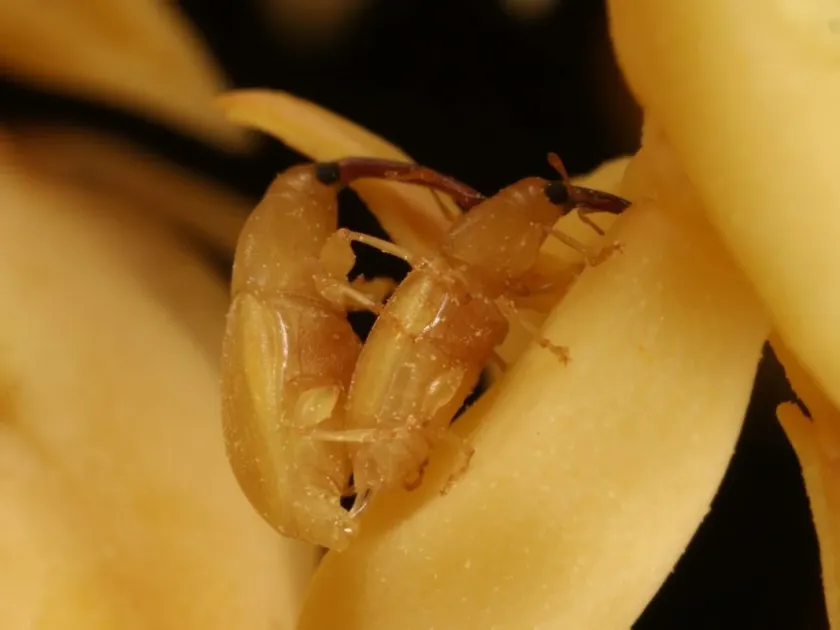
Description
How to identify
Derelomus is a genus of weevils belonging to the family Curculionidae within the order Coleoptera. These small beetles are characterized by their elongated rostrum, which is a defining feature of the family, and a specific structure of their antennae.
Physically, these beetles have a compact body typically ranging from 3 to 4 millimeters in length. Their coloration generally ranges from dark brown to black, providing camouflage within soil environments or leaf axils.
The larvae of Derelomus are apodous (legless) with a C-shaped, cream-colored body and a well-defined chitinous head capsule. They lead a concealed life, developing entirely within host plant tissues.
Accurate species identification often requires microscopic examination of the male and female genitalia. In agricultural settings, it is crucial to distinguish this genus from other weevils that commonly target cereal or grain crops.
Males and females display subtle morphological differences in the shape of the pronotum and the texture of their elytra. Their entire life cycle is intimately linked to the growth phases of their host plants.
##damage##The primary damage occurs during the crop's vegetative stage. While Derelomus species often specialize in palm trees and certain wild plants, they can migrate to agricultural crops under favorable ecological conditions.
Adult beetles feed on young foliage and floral parts, causing visible deformation. These damaged areas often undergo necrosis, which significantly reduces the plant's overall photosynthetic efficiency.
Larval feeding is particularly destructive, as they bore internal tunnels through stems and flower stalks. This feeding behavior disrupts the vascular system, restricting the movement of nutrients and water.
Young plantations are at the highest risk, where damage to the main stem or growing point can lead to plant mortality. Extensive infestations lead to a notable decrease in the marketability and quality of the yield.
Furthermore, feeding sites created by the adults often serve as infection points for opportunistic fungal and bacterial pathogens, complicating the overall health status of the crop.
When it appears
The development cycle of Derelomus is closely synchronized with environmental temperature patterns. The first emergence of adults usually occurs in spring, once daily average temperatures reach the threshold required for insect activity.
The peak period for flying and mating activity typically spans late spring to early summer. During this time, females oviposit directly into the tissues of the chosen host plants.
The generation time for one cycle ranges from several weeks to a few months, depending on local climate conditions. In warmer regions, the species can produce multiple generations within a single growing season.
As autumn approaches, adult activity declines. The beetles enter a period of dormancy, overwintering in sheltered locations such as plant debris, tree bark, or the upper layers of the soil.
Sudden temperature fluctuations in early spring can delay emergence from diapause, a phenomenon that should be accounted for when planning monitoring schedules to ensure accurate population assessment.
Control measures
Effective management of Derelomus requires an integrated approach that combines cultural, biological, and chemical methods to suppress populations below economic injury levels.
Cultural practices include deep plowing after harvest to destroy overwintering sites, as well as strict crop rotation and the removal of alternative host weeds from field perimeters.
Chemical control involves the application of contact-systemic insecticides during the period of peak adult feeding. Treatments should be timed strategically to avoid harming pollinators and other beneficial organisms.
Biological control leverages the use of entomopathogenic fungi and the preservation of natural predators. These methods are particularly effective in protected cultivation or organic farming systems.
- Deployment of pheromone traps for regular population monitoring.
- Proper disposal and destruction of damaged plant residues.
- Adherence to strict pesticide application guidelines and safety intervals.
Taxonomy
- Latin name
- Derelomus
- Order
- Coleoptera (beetles)
- Family
- Curculionidae
- EPPO code
- DERESP
Discussion
No discussions yet — be the first.