
Dentalium
Dentalium entalis
Description
How to identify
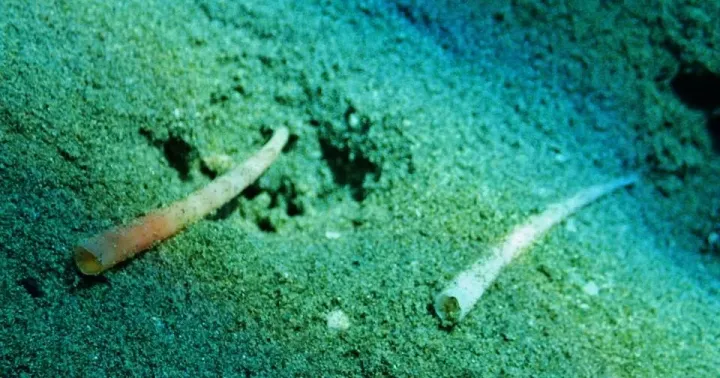
Dentalium (Dentalium entalis) is a genus of marine scaphopod mollusks, often referred to as tusk shells. Their defining feature is a tubular, slightly curved shell that resembles an elephant's tusk, open at both ends.
These organisms reside on the ocean floor, typically buried in sandy or silty substrates. Their anatomy is specialized for filtering nutrients from the surrounding marine sediment, making them purely aquatic creatures.
The taxonomic classification of this mollusk belongs to the class Scaphopoda. Unlike terrestrial insects or gastropods that affect crops, these organisms have no evolutionary adaptation to survive in soil or freshwater environments.
In terms of morphology, they lack the biting mouthparts associated with herbivorous pests. Their feeding mechanism relies on ciliated appendages that capture microscopic prey in their marine habitat.
It is biologically impossible for a Dentalium to inhabit, forage, or breed within a terrestrial farming environment, as they require high salinity and specific water depth for survival.
What it damages
There is no evidence in agricultural literature to classify Dentalium entalis as a plant pest. They do not consume plant matter and are entirely absent from the food chains involving agricultural crops.
The damage often attributed to mollusks in agriculture is caused by terrestrial slugs and snails. Dentalium, being a deep-sea marine inhabitant, cannot cause any mechanical damage to plant roots, stems, or leaves.
Reports labeling this organism as a pest are scientifically inaccurate. They lack the biology required to interact with land plants and represent no threat to the harvest or the health of agricultural systems.
The presence of empty, calcified shells in soil conditioners or aquatic-based fertilizers might occasionally occur; however, these are considered inert mineral matter rather than harmful biological agents.
An agronomist or gardener does not need to worry about the presence of this mollusk, as it has zero negative impact on plant physiology or crop yield development.
Control measures
No pest control or management strategies are necessary for Dentalium entalis, as it does not constitute a threat to any cultivated plant species, including vegetables, fruits, or grains.
Applying pesticides or any form of chemical control against marine organisms in terrestrial soil is counterproductive, environmentally irresponsible, and economically useless.
Efforts should instead be directed toward managing actual terrestrial pests that threaten crop stability, such as aphids, nematodes, or various species of soil-dwelling beetles.
Should shell fragments be present in garden soil or compost, they will merely act as a calcium-rich supplement, which is generally harmless and sometimes even beneficial for soil pH regulation.
Maintaining a healthy crop rotation and utilizing verified agricultural inputs is sufficient to ensure a pest-free environment, without any need for action against non-target marine species.
Taxonomy
- Latin name
- Dentalium entalis
- Family
- Dentaliidae
- EPPO code
- DENTEN
Discussion
No discussions yet — be the first.