
Dendrolaelaps quadrisetus
Dendrolaelaps quadrisetus
Description
How to identify
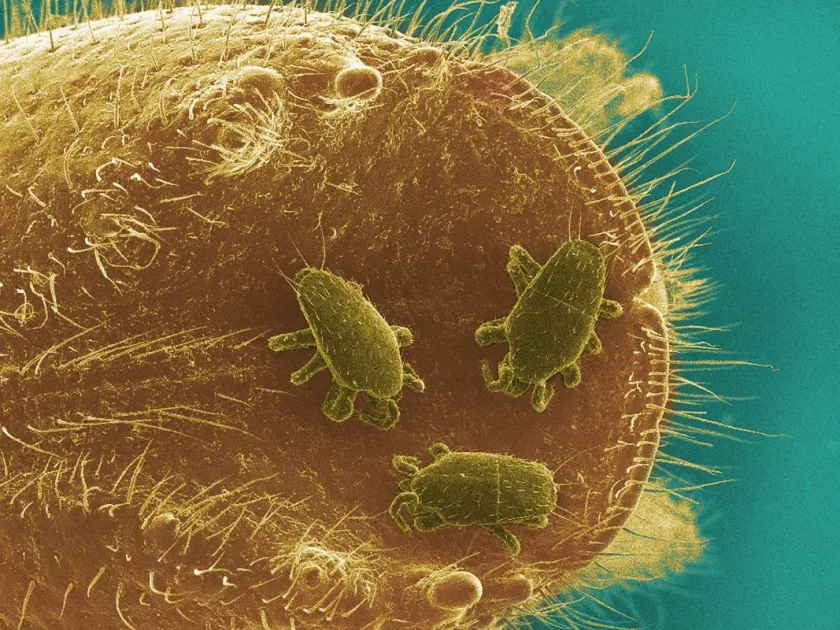
Dendrolaelaps quadrisetus is a tiny soil-dwelling mite belonging to the Digamasellidae family within the order Mesostigmata. Adult individuals are flat, oval, and brownish, typically measuring about 0.4 to 0.5 mm in length.
Identification of this species is complex and usually requires microscopic examination of the chelicerae and dorsal shield bristles. Due to their small size, these mites are difficult to detect during the early stages of a colony buildup.
These mites exhibit high mobility and are known for their ability to thrive in organic-rich substrates. They frequently utilize phoresy, attaching themselves to various insects like mushroom flies to travel between growing rooms.
The life cycle encompasses stages from egg to adult. Under optimal conditions of high humidity and temperatures around 20-25°C, a generation can develop in as little as 7 to 14 days, leading to rapid population explosions.
In closed agricultural environments, they act as both predators and scavengers, frequently congregating in decomposing organic matter, which serves as a breeding ground for their massive numbers.
What it damages
The primary economic damage caused by this mite is to cultivated mushrooms. The mites feed on the fungal mycelium, disrupting its structural integrity and causing the death of the mycelial network.
Although less common as a primary pest in vegetables, they can impact plant health by feeding on root hairs in weak or over-saturated soils. Their presence often complicates the recovery of plants from other diseases.
Damage is characterized by the localized disappearance of mycelium on the surface of the casing soil. This leads to the formation of bare patches where mushroom fruiting bodies fail to emerge, resulting in significant yield losses.
Feeding activity also stresses the fungus, making it highly susceptible to opportunistic bacterial and fungal pathogens. This results in secondary rot infections that further destroy the crop quality and overall production.
If not controlled, heavy infestations can cause up to 50% loss in production. The mites significantly compromise the quality of the harvested mushrooms, making them unmarketable due to the presence of mites on the fruiting bodies.
When it appears
This mite species can be active year-round in indoor cultivation facilities, such as mushroom houses or greenhouses, where climate conditions remain constant. It is not limited by seasonal cycles.
High population densities are most frequently observed during the peak cropping phases of mushrooms. In these periods, the availability of abundant nutrition and high moisture supports continuous, rapid growth.
Signs of infestation
The most visible sign of infestation is the emergence of thinning or bare patches in the growth medium. Mycelium in these areas may become watery or disappear entirely, exposing the underlying casing layer.
Under magnification, one can observe clusters of small, mobile mites gathered around the base of mushroom stalks or within the damp casing material. A stale, musty odor often accompanies heavy infestations.
Control measures
Strict sanitation is the cornerstone of managing Dendrolaelaps quadrisetus. Comprehensive steam pasteurization of the substrate and casing soil is essential to eliminate all mite life stages before planting.
Chemical control options are restricted to acaricides labeled for use in mushroom production. These must be applied carefully to ensure effectiveness without harming the delicate mushroom fruit bodies or leaving residues.
- Thorough terminal cleaning of rooms after each harvest cycle.
- Implementing fly-control programs to prevent mite transport.
- Using fine-mesh screens on ventilation intakes.
Biological control strategies, including the introduction of predatory mite species or entomopathogenic nematodes, have proven effective in reducing mite populations in integrated pest management systems.
Ongoing monitoring of the substrate quality is critical. Early detection allows for spot treatments and rapid intervention, preventing the mites from spreading throughout the entire facility and causing severe economic impact.
Taxonomy
- Latin name
- Dendrolaelaps quadrisetus
- Order
- Mites
- Family
- Digamasellidae
- EPPO code
- DDRLQU
Discussion
No discussions yet — be the first.